

colonies not containing the plasmid DNA of interest and
reduces wild-type revertant. The subculturing step also
increases the biomass of the colony used for inoculation of
liquid media.
3. When heat-killing M. tuberculosis check the temperature of the
water bath every 30 min, if the temperature falls below 90
C,
restart the timer to ensure complete inactivation.
4. The volume of the M. tuberculosis cultures can determine the
amount of DNA immunoprecipitated at the end, and the
amount required for good quality ChIP-seq.
5. Store the crosslinked bacterial pellet at À80
C while awaiting
the sterility results from the 7H11 agar plates before removing
the pellets outside of the CL3 laboratory for up to 6 weeks.
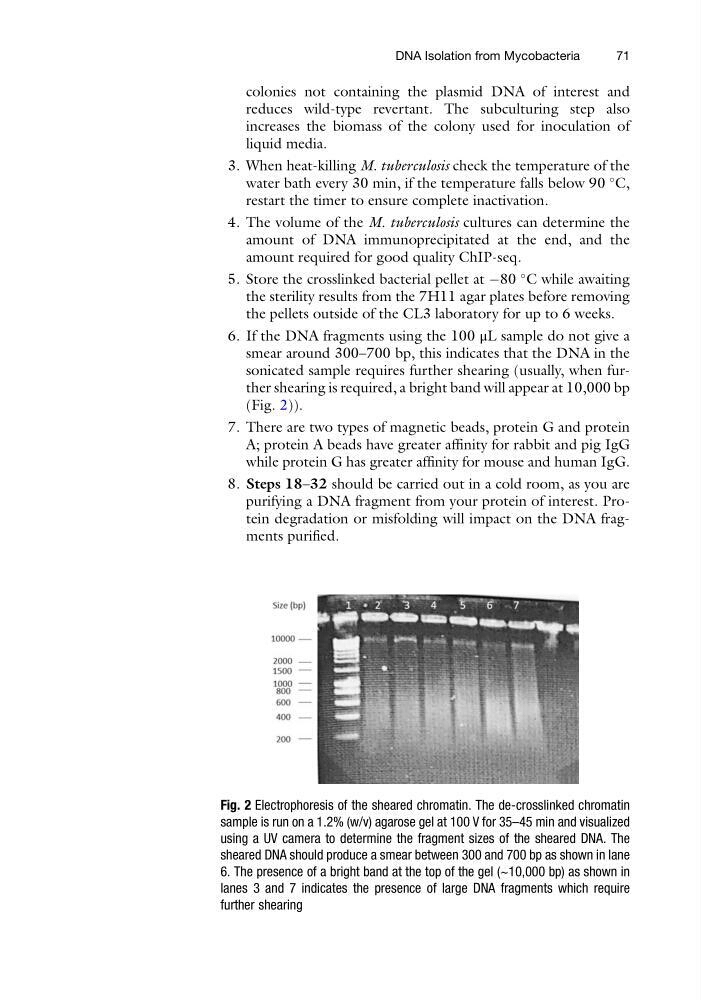
6. If the DNA fragments using the 100 μL sample do not give a
smear around 300–700 bp, this indicates that the DNA in the
sonicated sample requires further shearing (usually, when further shearing is required, a bright band will appear at 10,000 bp
(Fig. 2)).
7. There are two types of magnetic beads, protein G and protein
A; protein A beads have greater affinity for rabbit and pig IgG
while protein G has greater affinity for mouse and human IgG.
8. Steps 18–32 should be carried out in a cold room, as you are
purifying a DNA fragment from your protein of interest. Protein degradation or misfolding will impact on the DNA fragments purified.
Fig. 2 Electrophoresis of the sheared chromatin. The de-crosslinked chromatin
sample is run on a 1.2% (w/v) agarose gel at 100 V for 35–45 min and visualized
using a UV camera to determine the fragment sizes of the sheared DNA. The
sheared DNA should produce a smear between 300 and 700 bp as shown in lane
6. The presence of a bright band at the top of the gel (~10,000 bp) as shown in
lanes 3 and 7 indicates the presence of large DNA fragments which require
further shearing
DNA Isolation from Mycobacteria
71
reduces wild-type revertant. The subculturing step also
increases the biomass of the colony used for inoculation of
liquid media.
3. When heat-killing M. tuberculosis check the temperature of the
water bath every 30 min, if the temperature falls below 90
C,
restart the timer to ensure complete inactivation.
4. The volume of the M. tuberculosis cultures can determine the
amount of DNA immunoprecipitated at the end, and the
amount required for good quality ChIP-seq.
5. Store the crosslinked bacterial pellet at À80
C while awaiting
the sterility results from the 7H11 agar plates before removing
the pellets outside of the CL3 laboratory for up to 6 weeks.
6. If the DNA fragments using the 100 μL sample do not give a
smear around 300–700 bp, this indicates that the DNA in the
sonicated sample requires further shearing (usually, when further shearing is required, a bright band will appear at 10,000 bp
(Fig. 2)).
7. There are two types of magnetic beads, protein G and protein
A; protein A beads have greater affinity for rabbit and pig IgG
while protein G has greater affinity for mouse and human IgG.
8. Steps 18–32 should be carried out in a cold room, as you are
purifying a DNA fragment from your protein of interest. Protein degradation or misfolding will impact on the DNA fragments purified.
Fig. 2 Electrophoresis of the sheared chromatin. The de-crosslinked chromatin
sample is run on a 1.2% (w/v) agarose gel at 100 V for 35–45 min and visualized
using a UV camera to determine the fragment sizes of the sheared DNA. The
sheared DNA should produce a smear between 300 and 700 bp as shown in lane
6. The presence of a bright band at the top of the gel (~10,000 bp) as shown in
lanes 3 and 7 indicates the presence of large DNA fragments which require
further shearing
DNA Isolation from Mycobacteria
71