

4. Wipe down the surfaces of the microclaves attached to the
external ECS ports, first with a disinfectant wipe and then
with a sterile, disposable 70% alcohol swab.
5. Load the inoculum into a 5 or 10 mL Luer–lock syringe fitted
with a rounded, blunt-end needle. Carefully cap the needle and
remove it from the syringe (see Note 15).
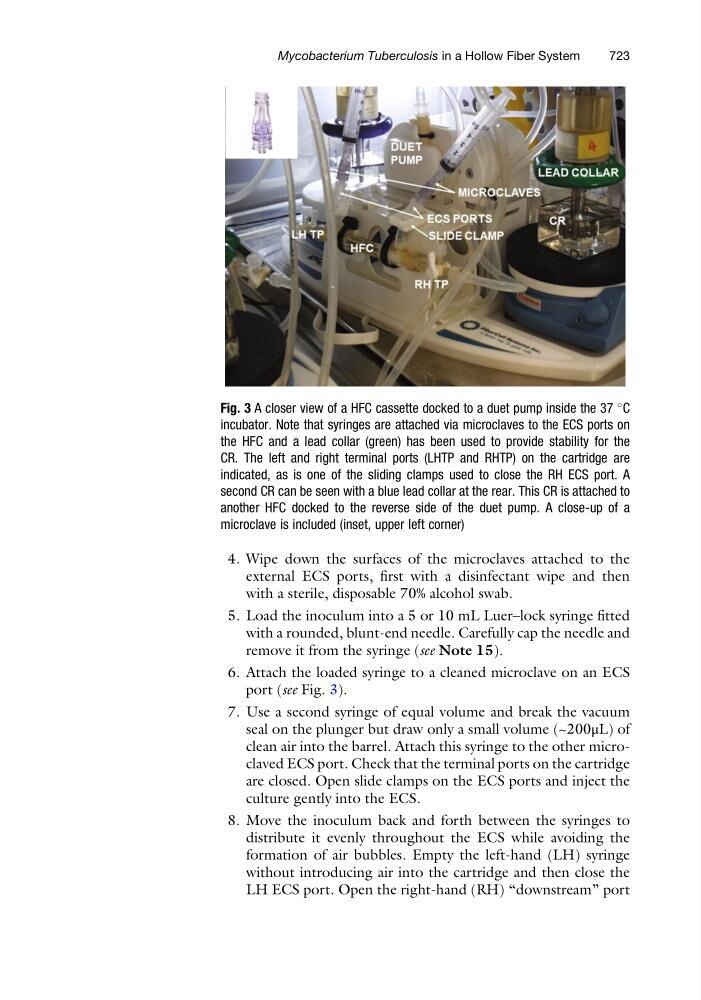
6. Attach the loaded syringe to a cleaned microclave on an ECS
port (see Fig. 3).
7. Use a second syringe of equal volume and break the vacuum
seal on the plunger but draw only a small volume (~200μL) of
clean air into the barrel. Attach this syringe to the other microclaved ECS port. Check that the terminal ports on the cartridge
are closed. Open slide clamps on the ECS ports and inject the
culture gently into the ECS.
8. Move the inoculum back and forth between the syringes to
distribute it evenly throughout the ECS while avoiding the
formation of air bubbles. Empty the left-hand (LH) syringe
without introducing air into the cartridge and then close the
LH ECS port. Open the right-hand (RH) “downstream” port
Fig. 3 A closer view of a HFC cassette docked to a duet pump inside the 37
C
incubator. Note that syringes are attached via microclaves to the ECS ports on
the HFC and a lead collar (green) has been used to provide stability for the
CR. The left and right terminal ports (LHTP and RHTP) on the cartridge are
indicated, as is one of the sliding clamps used to close the RH ECS port. A
second CR can be seen with a blue lead collar at the rear. This CR is attached to
another HFC docked to the reverse side of the duet pump. A close-up of a
microclave is included (inset, upper left corner)
Mycobacterium Tuberculosis in a Hollow Fiber System
723