

protection studies). However, they did not establish practical methodologies that were predictive of the clinical outcome.
Since that original research, the concept of antimicrobial susceptibility testing has become an essential part of clinical microbiology. Antimicrobial testing has played a central role in the
identification of new antibiotics and defining their clinical uses;
different institutions and researchers have collaborated in the development of standards and guidelines accepted by the vast majority of
the scientific community working in the antibacterial field. In the
case of first line and most second line agents, semi-automatic
methods have been developed to define the clinical cut-off based
on bacterial susceptibility and the plasma concentrations obtained
using current doses [4].
The main drawbacks for the development of a well-established
method for antitubercular testing come from the physiology of the
bacteria; on the one hand, the slow rate of growth implies long
incubation periods, and on the other hand, the complexity of the
disease makes it very difficult to predict the clinical outcome based
on a single in vitro assay. In the case of M. tuberculosis, a consensus
regarding the medium, pH, composition, carbon source, temperature, time of incubation, or strain has yet to be reached.
Most laboratories have solved the issue of slow growth by using
surrogates of bacterial growth, which has allowed a reduction in the
testing time from a month to a week without affecting the reliability
of the measurement and has also made it possible to miniaturize the
assay to be run in microtiter plates. In the search for new drugs,
determining the Minimum Inhibitory Concentration (MIC) of
each compound is a key tool.
In order to increase the throughput of MIC testing, compounds can be evaluated in a single shot by defining a statistically
significant cut-off of growth inhibition. The surrogate of growth
used for High-Throughput Screening (HTS) will have a great
impact in the robustness of the assay.
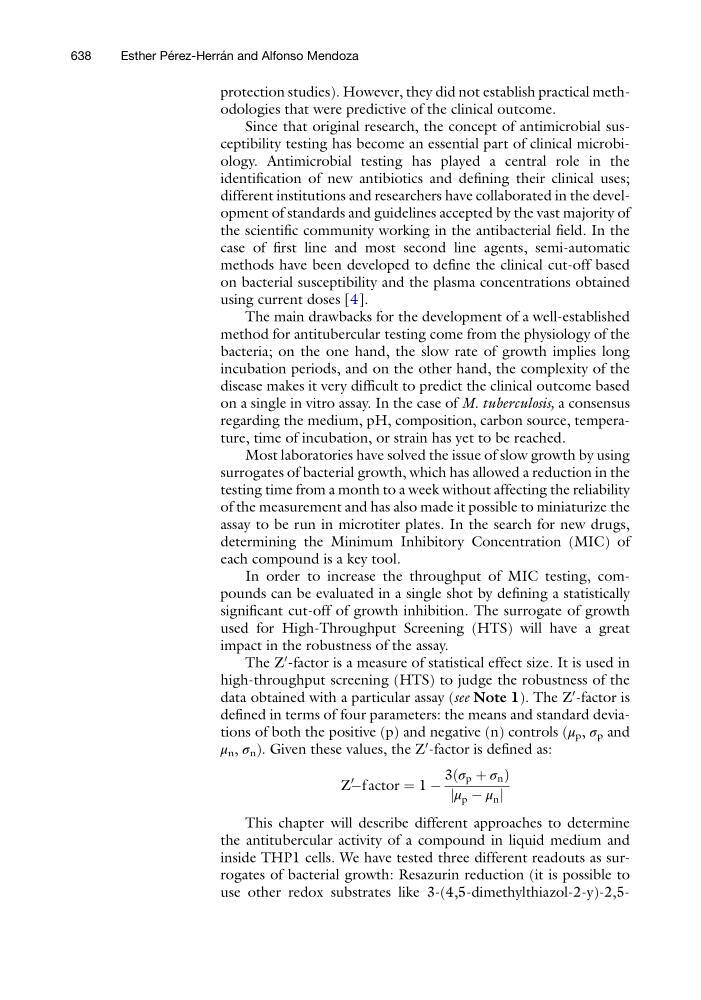
The Z
0 -factor is a measure of statistical effect size. It is used in
high-throughput screening (HTS) to judge the robustness of the
data obtained with a particular assay (see Note 1). The Z
0 -factor is
defined in terms of four parameters: the means and standard deviations of both the positive (p) and negative (n) controls (μ p , σ p and
μ n , σ n ). Given these values, the Z
0 -factor is defined as:
Z
0
Àf actor ¼ 1 À
3ðσ p þ σ n Þ
jμ p À μ n j
This chapter will describe different approaches to determine
the antitubercular activity of a compound in liquid medium and
inside THP1 cells. We have tested three different readouts as surrogates of bacterial growth: Resazurin reduction (it is possible to
use other redox substrates like 3-(4,5-dimethylthiazol-2-y)-2,5638
Esther Pe ´ rez-Herra ´ n and Alfonso Mendoza