

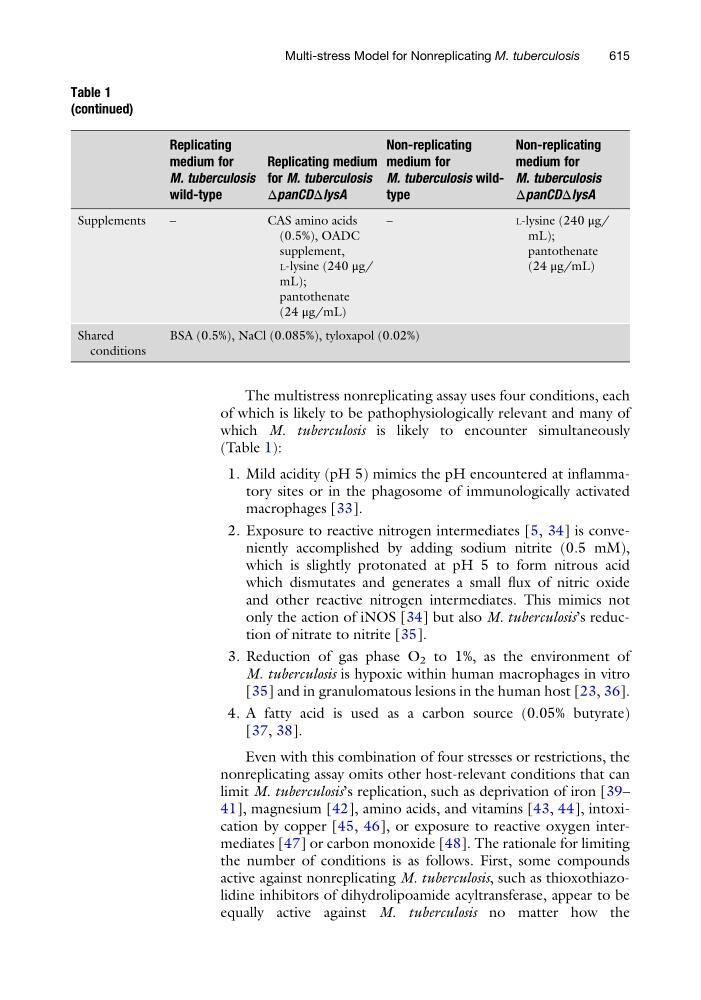
The multistress nonreplicating assay uses four conditions, each
of which is likely to be pathophysiologically relevant and many of
which M. tuberculosis is likely to encounter simultaneously
(Table 1):
1. Mild acidity (pH 5) mimics the pH encountered at inflammatory sites or in the phagosome of immunologically activated
macrophages [33].
2. Exposure to reactive nitrogen intermediates [5, 34] is conveniently accomplished by adding sodium nitrite (0.5 mM),
which is slightly protonated at pH 5 to form nitrous acid
which dismutates and generates a small flux of nitric oxide
and other reactive nitrogen intermediates. This mimics not
only the action of iNOS [34] but also M. tuberculosis’s reduction of nitrate to nitrite [35].
3. Reduction of gas phase O 2 to 1%, as the environment of
M. tuberculosis is hypoxic within human macrophages in vitro
[35] and in granulomatous lesions in the human host [23, 36].
4. A fatty acid is used as a carbon source (0.05% butyrate)
[37, 38].
Even with this combination of four stresses or restrictions, the
nonreplicating assay omits other host-relevant conditions that can
limit M. tuberculosis’s replication, such as deprivation of iron [39–
41], magnesium [42], amino acids, and vitamins [43, 44], intoxication by copper [45, 46], or exposure to reactive oxygen intermediates [47] or carbon monoxide [48]. The rationale for limiting
the number of conditions is as follows. First, some compounds
active against nonreplicating M. tuberculosis, such as thioxothiazolidine inhibitors of dihydrolipoamide acyltransferase, appear to be
equally active against M. tuberculosis no matter how the
Table 1
(continued)
Replicating
medium for
M. tuberculosis
wild-type
Replicating medium
for M. tuberculosis
ΔpanCDΔlysA
Non-replicating
medium for
M. tuberculosis wildtype
Non-replicating
medium for
M. tuberculosis
ΔpanCDΔlysA
Supplements
–
CAS amino acids
(0.5%), OADC
supplement,
L-lysine (240 μg/
mL);
pantothenate
(24 μg/mL)
–
L-lysine (240 μg/
mL);
pantothenate
(24 μg/mL)
Shared
conditions
BSA (0.5%), NaCl (0.085%), tyloxapol (0.02%)
Multi-stress Model for Nonreplicating M. tuberculosis
615