

of sample (biological fluids, tissue, or cell culture) and the “targeted” versus “untargeted” nature of the study condition these
different steps. Whether the study focuses on certain lipid families
of the lipidome (targeted study) or, on the contrary, on the lipidome in a global way with the possible discovery of new lipids
(untargeted study) will lead to favor specific methods for lipid
extraction and MS devices according to their performance in
terms of sensitivity, dynamic range, and resolution.
Mycobacteria produce a very diverse and specific repertoire of
alkyl chain-containing molecules including lipids and glycolipids
[3], lipoproteins [4], and lipoglycans, which are potent immunomodulators with key roles in host-pathogen interactions
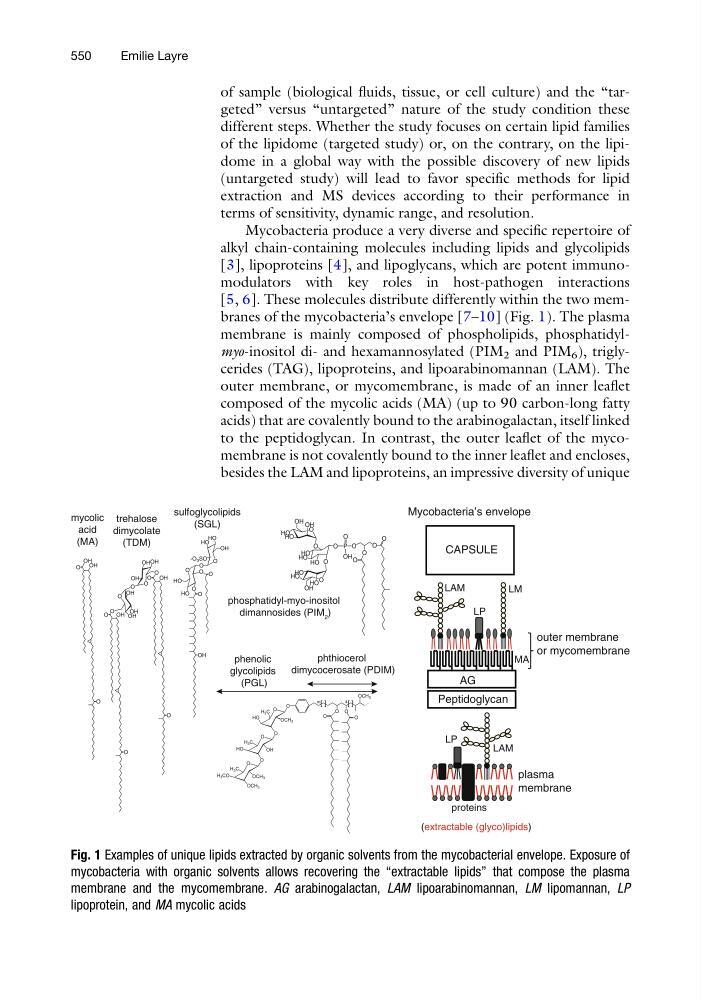
[5, 6]. These molecules distribute differently within the two membranes of the mycobacteria’s envelope [7–10] (Fig. 1). The plasma
membrane is mainly composed of phospholipids, phosphatidylmyo-inositol di- and hexamannosylated (PIM 2 and PIM 6 ), triglycerides (TAG), lipoproteins, and lipoarabinomannan (LAM). The
outer membrane, or mycomembrane, is made of an inner leaflet
composed of the mycolic acids (MA) (up to 90 carbon-long fatty
acids) that are covalently bound to the arabinogalactan, itself linked
to the peptidoglycan. In contrast, the outer leaflet of the mycomembrane is not covalently bound to the inner leaflet and encloses,
besides the LAM and lipoproteins, an impressive diversity of unique
O
OH
OH
OH
O
OH
O
O
O
OH
OH
OH
O
O
O
OH
O
O
OH
O
OH
O
O
O
HO
HO
O
-O3SO
OH
O
HO
O
O
HO
OH
sulfoglycolipids
(SGL)
mycolic
acid
(MA)
trehalose
dimycolate
(TDM)
H
P O
O
O
O
O
O
OH
HO
HO
HO
O
O
O
HO
O
O
HO
OH
OH
O
HO
HO
OH
phosphatidyl-myo-inositol
dimannosides (PIM 2 )
phthiocerol
dimycocerosate (PDIM)
phenolic
glycolipids
(PGL)
O
HO
OCH3
H3C
O
O
HO
OH
H3C
O
O
H3CO
OCH3
OCH3
H3C
O
O
OCH3
O
O
O
4 [ ]
m [ ]
outer membrane
or mycomembrane
plasma
membrane
AG
Peptidoglycan
CAPSULE
(extractable (glyco)lipids)
MA
LAM
LAM
LM
LP
LP
proteins
Mycobacteria’s envelope
Fig. 1 Examples of unique lipids extracted by organic solvents from the mycobacterial envelope. Exposure of
mycobacteria with organic solvents allows recovering the “extractable lipids” that compose the plasma
membrane and the mycomembrane. AG arabinogalactan, LAM lipoarabinomannan, LM lipomannan, LP
lipoprotein, and MA mycolic acids
550
Emilie Layre
different steps. Whether the study focuses on certain lipid families
of the lipidome (targeted study) or, on the contrary, on the lipidome in a global way with the possible discovery of new lipids
(untargeted study) will lead to favor specific methods for lipid
extraction and MS devices according to their performance in
terms of sensitivity, dynamic range, and resolution.
Mycobacteria produce a very diverse and specific repertoire of
alkyl chain-containing molecules including lipids and glycolipids
[3], lipoproteins [4], and lipoglycans, which are potent immunomodulators with key roles in host-pathogen interactions
[5, 6]. These molecules distribute differently within the two membranes of the mycobacteria’s envelope [7–10] (Fig. 1). The plasma
membrane is mainly composed of phospholipids, phosphatidylmyo-inositol di- and hexamannosylated (PIM 2 and PIM 6 ), triglycerides (TAG), lipoproteins, and lipoarabinomannan (LAM). The
outer membrane, or mycomembrane, is made of an inner leaflet
composed of the mycolic acids (MA) (up to 90 carbon-long fatty
acids) that are covalently bound to the arabinogalactan, itself linked
to the peptidoglycan. In contrast, the outer leaflet of the mycomembrane is not covalently bound to the inner leaflet and encloses,
besides the LAM and lipoproteins, an impressive diversity of unique
O
OH
OH
OH
O
OH
O
O
O
OH
OH
OH
O
O
O
OH
O
O
OH
O
OH
O
O
O
HO
HO
O
-O3SO
OH
O
HO
O
O
HO
OH
sulfoglycolipids
(SGL)
mycolic
acid
(MA)
trehalose
dimycolate
(TDM)
H
P O
O
O
O
O
O
OH
HO
HO
HO
O
O
O
HO
O
O
HO
OH
OH
O
HO
HO
OH
phosphatidyl-myo-inositol
dimannosides (PIM 2 )
phthiocerol
dimycocerosate (PDIM)
phenolic
glycolipids
(PGL)
O
HO
OCH3
H3C
O
O
HO
OH
H3C
O
O
H3CO
OCH3
OCH3
H3C
O
O
OCH3
O
O
O
4 [ ]
m [ ]
outer membrane
or mycomembrane
plasma
membrane
AG
Peptidoglycan
CAPSULE
(extractable (glyco)lipids)
MA
LAM
LAM
LM
LP
LP
proteins
Mycobacteria’s envelope
Fig. 1 Examples of unique lipids extracted by organic solvents from the mycobacterial envelope. Exposure of
mycobacteria with organic solvents allows recovering the “extractable lipids” that compose the plasma
membrane and the mycomembrane. AG arabinogalactan, LAM lipoarabinomannan, LM lipomannan, LP
lipoprotein, and MA mycolic acids
550
Emilie Layre