

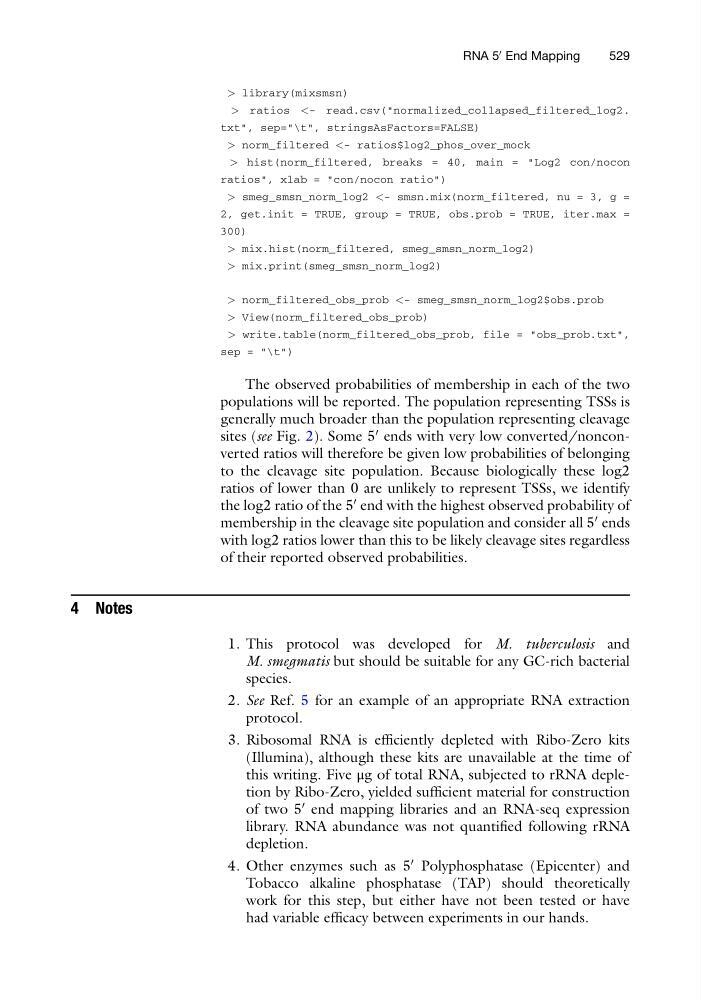
> library(mixsmsn)
> ratios <- read.csv("normalized_collapsed_filtered_log2.
txt", sep="\t", stringsAsFactors=FALSE)
> norm_filtered <- ratios$log2_phos_over_mock
> hist(norm_filtered, breaks = 40, main = "Log2 con/nocon
ratios", xlab = "con/nocon ratio")
> smeg_smsn_norm_log2 <- smsn.mix(norm_filtered, nu = 3, g =
2, get.init = TRUE, group = TRUE, obs.prob = TRUE, iter.max =
300)
> mix.hist(norm_filtered, smeg_smsn_norm_log2)
> mix.print(smeg_smsn_norm_log2)
> norm_filtered_obs_prob <- smeg_smsn_norm_log2$obs.prob
> View(norm_filtered_obs_prob)
> write.table(norm_filtered_obs_prob, file = "obs_prob.txt",
sep = "\t")
The observed probabilities of membership in each of the two
populations will be reported. The population representing TSSs is
generally much broader than the population representing cleavage
sites (see Fig. 2). Some 5
0 ends with very low converted/nonconverted ratios will therefore be given low probabilities of belonging
to the cleavage site population. Because biologically these log2
ratios of lower than 0 are unlikely to represent TSSs, we identify
the log2 ratio of the 5
0 end with the highest observed probability of
membership in the cleavage site population and consider all 5
0 ends
with log2 ratios lower than this to be likely cleavage sites regardless
of their reported observed probabilities.
4 Notes
1. This protocol was developed for M. tuberculosis and
M. smegmatis but should be suitable for any GC-rich bacterial
species.
2. See Ref. 5 for an example of an appropriate RNA extraction
protocol.
3. Ribosomal RNA is efficiently depleted with Ribo-Zero kits
(Illumina), although these kits are unavailable at the time of
this writing. Five μg of total RNA, subjected to rRNA depletion by Ribo-Zero, yielded sufficient material for construction
of two 5
0 end mapping libraries and an RNA-seq expression
library. RNA abundance was not quantified following rRNA
depletion.
4. Other enzymes such as 5
0 Polyphosphatase (Epicenter) and
Tobacco alkaline phosphatase (TAP) should theoretically
work for this step, but either have not been tested or have
had variable efficacy between experiments in our hands.
RNA 5
0
End Mapping
529
> ratios <- read.csv("normalized_collapsed_filtered_log2.
txt", sep="\t", stringsAsFactors=FALSE)
> norm_filtered <- ratios$log2_phos_over_mock
> hist(norm_filtered, breaks = 40, main = "Log2 con/nocon
ratios", xlab = "con/nocon ratio")
> smeg_smsn_norm_log2 <- smsn.mix(norm_filtered, nu = 3, g =
2, get.init = TRUE, group = TRUE, obs.prob = TRUE, iter.max =
300)
> mix.hist(norm_filtered, smeg_smsn_norm_log2)
> mix.print(smeg_smsn_norm_log2)
> norm_filtered_obs_prob <- smeg_smsn_norm_log2$obs.prob
> View(norm_filtered_obs_prob)
> write.table(norm_filtered_obs_prob, file = "obs_prob.txt",
sep = "\t")
The observed probabilities of membership in each of the two
populations will be reported. The population representing TSSs is
generally much broader than the population representing cleavage
sites (see Fig. 2). Some 5
0 ends with very low converted/nonconverted ratios will therefore be given low probabilities of belonging
to the cleavage site population. Because biologically these log2
ratios of lower than 0 are unlikely to represent TSSs, we identify
the log2 ratio of the 5
0 end with the highest observed probability of
membership in the cleavage site population and consider all 5
0 ends
with log2 ratios lower than this to be likely cleavage sites regardless
of their reported observed probabilities.
4 Notes
1. This protocol was developed for M. tuberculosis and
M. smegmatis but should be suitable for any GC-rich bacterial
species.
2. See Ref. 5 for an example of an appropriate RNA extraction
protocol.
3. Ribosomal RNA is efficiently depleted with Ribo-Zero kits
(Illumina), although these kits are unavailable at the time of
this writing. Five μg of total RNA, subjected to rRNA depletion by Ribo-Zero, yielded sufficient material for construction
of two 5
0 end mapping libraries and an RNA-seq expression
library. RNA abundance was not quantified following rRNA
depletion.
4. Other enzymes such as 5
0 Polyphosphatase (Epicenter) and
Tobacco alkaline phosphatase (TAP) should theoretically
work for this step, but either have not been tested or have
had variable efficacy between experiments in our hands.
RNA 5
0
End Mapping
529