

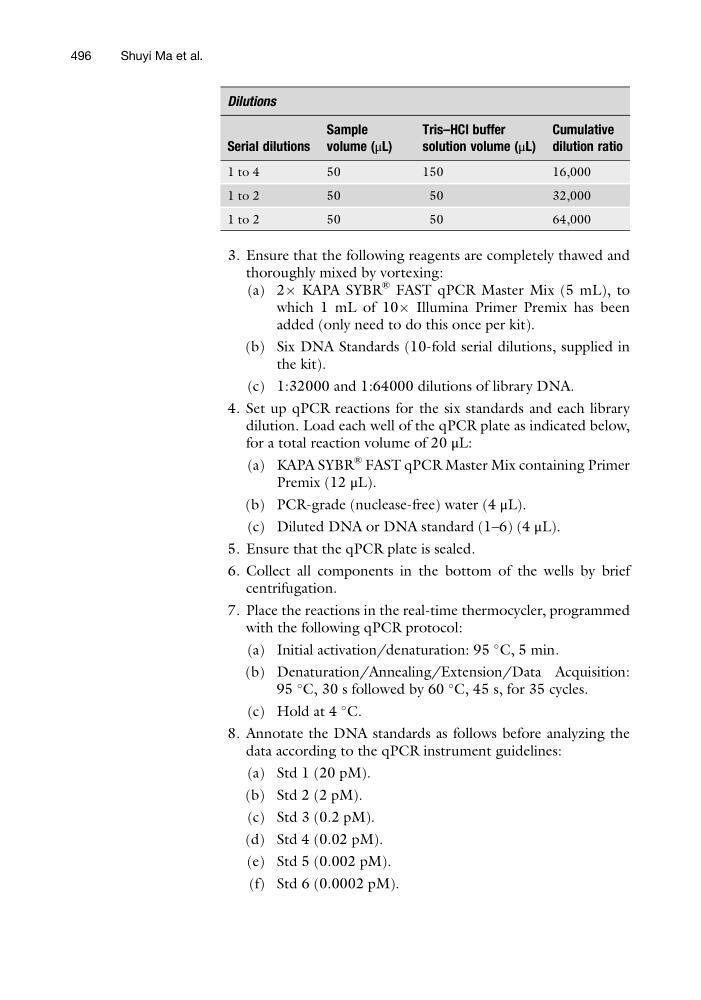
Dilutions
Serial dilutions
Sample
volume (μL)
Tris–HCl buffer
solution volume (μL)
Cumulative
dilution ratio
1 to 4
50
150
16,000
1 to 2
50
50
32,000
1 to 2
50
50
64,000
3. Ensure that the following reagents are completely thawed and
thoroughly mixed by vortexing:
(a) 2Â KAPA SYBR
® FAST qPCR Master Mix (5 mL), to
which 1 mL of 10Â Illumina Primer Premix has been
added (only need to do this once per kit).
(b) Six DNA Standards (10-fold serial dilutions, supplied in
the kit).
(c) 1:32000 and 1:64000 dilutions of library DNA.
4. Set up qPCR reactions for the six standards and each library
dilution. Load each well of the qPCR plate as indicated below,
for a total reaction volume of 20 μL:
(a) KAPA SYBR
® FAST qPCR Master Mix containing Primer
Premix (12 μL).
(b) PCR-grade (nuclease-free) water (4 μL).
(c) Diluted DNA or DNA standard (1–6) (4 μL).
5. Ensure that the qPCR plate is sealed.
6. Collect all components in the bottom of the wells by brief
centrifugation.
7. Place the reactions in the real-time thermocycler, programmed
with the following qPCR protocol:
(a) Initial activation/denaturation: 95
C, 5 min.
(b) Denaturation/Annealing/Extension/Data Acquisition:
95
C, 30 s followed by 60
C, 45 s, for 35 cycles.
(c) Hold at 4
C.
8. Annotate the DNA standards as follows before analyzing the
data according to the qPCR instrument guidelines:
(a) Std 1 (20 pM).
(b) Std 2 (2 pM).
(c) Std 3 (0.2 pM).
(d) Std 4 (0.02 pM).
(e) Std 5 (0.002 pM).
(f) Std 6 (0.0002 pM).
496
Shuyi Ma et al.
Serial dilutions
Sample
volume (μL)
Tris–HCl buffer
solution volume (μL)
Cumulative
dilution ratio
1 to 4
50
150
16,000
1 to 2
50
50
32,000
1 to 2
50
50
64,000
3. Ensure that the following reagents are completely thawed and
thoroughly mixed by vortexing:
(a) 2Â KAPA SYBR
® FAST qPCR Master Mix (5 mL), to
which 1 mL of 10Â Illumina Primer Premix has been
added (only need to do this once per kit).
(b) Six DNA Standards (10-fold serial dilutions, supplied in
the kit).
(c) 1:32000 and 1:64000 dilutions of library DNA.
4. Set up qPCR reactions for the six standards and each library
dilution. Load each well of the qPCR plate as indicated below,
for a total reaction volume of 20 μL:
(a) KAPA SYBR
® FAST qPCR Master Mix containing Primer
Premix (12 μL).
(b) PCR-grade (nuclease-free) water (4 μL).
(c) Diluted DNA or DNA standard (1–6) (4 μL).
5. Ensure that the qPCR plate is sealed.
6. Collect all components in the bottom of the wells by brief
centrifugation.
7. Place the reactions in the real-time thermocycler, programmed
with the following qPCR protocol:
(a) Initial activation/denaturation: 95
C, 5 min.
(b) Denaturation/Annealing/Extension/Data Acquisition:
95
C, 30 s followed by 60
C, 45 s, for 35 cycles.
(c) Hold at 4
C.
8. Annotate the DNA standards as follows before analyzing the
data according to the qPCR instrument guidelines:
(a) Std 1 (20 pM).
(b) Std 2 (2 pM).
(c) Std 3 (0.2 pM).
(d) Std 4 (0.02 pM).
(e) Std 5 (0.002 pM).
(f) Std 6 (0.0002 pM).
496
Shuyi Ma et al.