

17. Label lids of Qubit assay tubes for the number of sample plus
2 standards. Prepare Qubit working solution by diluting Qubit
dsDNA HS reagent 1:200 with Qubit dsDNA HS Buffer in a
50 mL plastic tube and allow for 200μL/sample or standard.
18. Add 190μL of Qubit working solution to each standard tube
and add 199μL of Qubit working solution to each sample tube.
19. Add 10μL of each standard to the appropriate tube and 1μL of
each sample. Mix by vortexing for 2–3 min, take care not to
create bubbles. Briefly spin tubes down in a microfuge. Incubate at room temperature for 2 min.
20. Select ‘DNA’ on the Qubit 3.0 Fluorometer and then ‘ds High
Sensitivity’ as the assay. Press ‘Read Standards’ to proceed;
insert tube containing standard #1 and press ‘Read standard’,
remove tube when read is complete, and insert tube containing
standard #2 and press ‘Read standard’. When complete, press
‘Run samples’, select the sample volume (1μL) and units
(ng/μL), insert a sample tube and press ‘Read tube’, remove
tube when reading is complete, and insert next sample, until all
are read.
21. Samples can be stored overnight in the fridge at 4 ˚C or at
À20 ˚C for longer terms.
3.8 Pooling Samples
for Multiplexed
Sequencing
1. Use the concentration as determined by Qubit, and the size, as
determined using TapeStation to calculate the molarity of each
Post-Index Amplified sample (see Notes 24 and 25).
2. Combine the Post-Index Amplified samples so that each is
representative in equimolar amounts in the library pool and
use the below formula to determine the volume of each sample
to use:
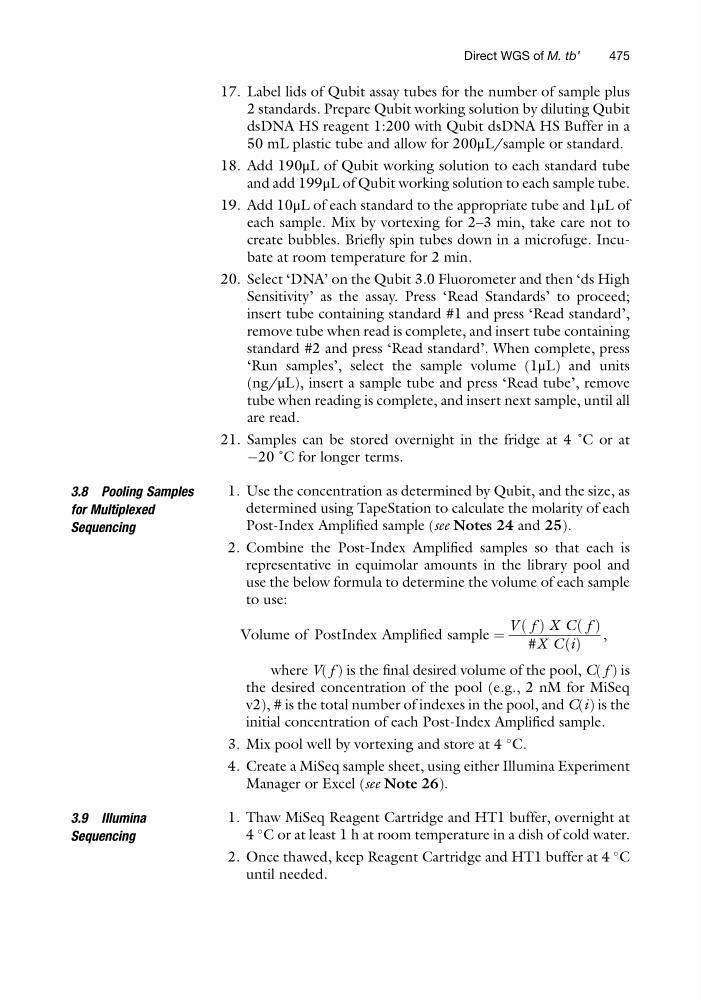
Volume of PostIndex Amplified sample ¼
V f
ð Þ X C f
ð Þ
#X C i
ð Þ
,
where V( f ) is the final desired volume of the pool, C( f ) is
the desired concentration of the pool (e.g., 2 nM for MiSeq
v2), # is the total number of indexes in the pool, and C(i) is the
initial concentration of each Post-Index Amplified sample.
3. Mix pool well by vortexing and store at 4
C.
4. Create a MiSeq sample sheet, using either Illumina Experiment
Manager or Excel (see Note 26).
3.9 Illumina
Sequencing
1. Thaw MiSeq Reagent Cartridge and HT1 buffer, overnight at
4
C or at least 1 h at room temperature in a dish of cold water.
2. Once thawed, keep Reagent Cartridge and HT1 buffer at 4
C
until needed.
Direct WGS of M. tb’
475
2 standards. Prepare Qubit working solution by diluting Qubit
dsDNA HS reagent 1:200 with Qubit dsDNA HS Buffer in a
50 mL plastic tube and allow for 200μL/sample or standard.
18. Add 190μL of Qubit working solution to each standard tube
and add 199μL of Qubit working solution to each sample tube.
19. Add 10μL of each standard to the appropriate tube and 1μL of
each sample. Mix by vortexing for 2–3 min, take care not to
create bubbles. Briefly spin tubes down in a microfuge. Incubate at room temperature for 2 min.
20. Select ‘DNA’ on the Qubit 3.0 Fluorometer and then ‘ds High
Sensitivity’ as the assay. Press ‘Read Standards’ to proceed;
insert tube containing standard #1 and press ‘Read standard’,
remove tube when read is complete, and insert tube containing
standard #2 and press ‘Read standard’. When complete, press
‘Run samples’, select the sample volume (1μL) and units
(ng/μL), insert a sample tube and press ‘Read tube’, remove
tube when reading is complete, and insert next sample, until all
are read.
21. Samples can be stored overnight in the fridge at 4 ˚C or at
À20 ˚C for longer terms.
3.8 Pooling Samples
for Multiplexed
Sequencing
1. Use the concentration as determined by Qubit, and the size, as
determined using TapeStation to calculate the molarity of each
Post-Index Amplified sample (see Notes 24 and 25).
2. Combine the Post-Index Amplified samples so that each is
representative in equimolar amounts in the library pool and
use the below formula to determine the volume of each sample
to use:
Volume of PostIndex Amplified sample ¼
V f
ð Þ X C f
ð Þ
#X C i
ð Þ
,
where V( f ) is the final desired volume of the pool, C( f ) is
the desired concentration of the pool (e.g., 2 nM for MiSeq
v2), # is the total number of indexes in the pool, and C(i) is the
initial concentration of each Post-Index Amplified sample.
3. Mix pool well by vortexing and store at 4
C.
4. Create a MiSeq sample sheet, using either Illumina Experiment
Manager or Excel (see Note 26).
3.9 Illumina
Sequencing
1. Thaw MiSeq Reagent Cartridge and HT1 buffer, overnight at
4
C or at least 1 h at room temperature in a dish of cold water.
2. Once thawed, keep Reagent Cartridge and HT1 buffer at 4
C
until needed.
Direct WGS of M. tb’
475