

ubiquity of such sequence-based taxonomic methods but also their
acceptability to the scientific community as a valid technique for the
elucidation of bacterial taxonomy.
Thus, despite the fact that DDH has not yet been replaced as
the “official” gold standard, all indications point to in silico analysis
via WGS-enabled OGRI representing the new de facto gold
standard.
4.4 Recent
WGS-Enabled
Taxonomic Changes
As mentioned in the Introduction to this chapter, WGS has allowed
science to probe deeper than ever before into the natural world
around us. Among the new information that can be obtained
through WGS-based genomic analysis is a true understanding of
the phylogenomic relationships of bacterial organisms. Numerous
recent taxonomic changes have been enabled by WGS, mostly
through comparative analysis using OGRI techniques. A few such
changes are described in this section.
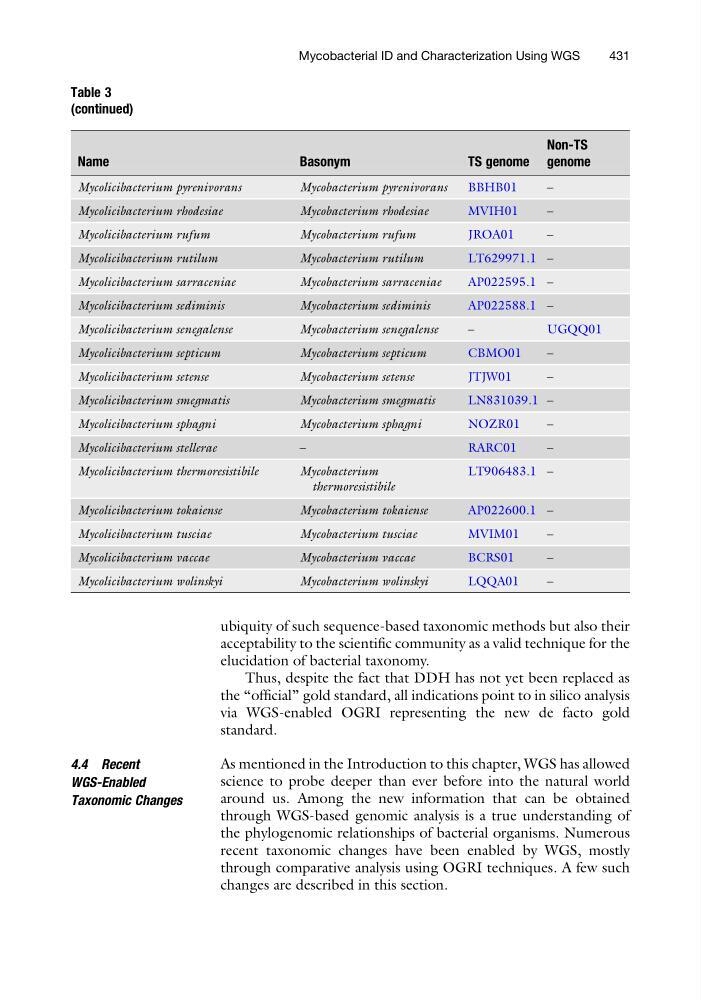
Table 3
(continued)
Name
Basonym
TS genome
Non-TS
genome
Mycolicibacterium pyrenivorans
Mycobacterium pyrenivorans
BBHB01
–
Mycolicibacterium rhodesiae
Mycobacterium rhodesiae
MVIH01
–
Mycolicibacterium rufum
Mycobacterium rufum
JROA01
–
Mycolicibacterium rutilum
Mycobacterium rutilum
LT629971.1 –
Mycolicibacterium sarraceniae
Mycobacterium sarraceniae
AP022595.1 –
Mycolicibacterium sediminis
Mycobacterium sediminis
AP022588.1 –
Mycolicibacterium senegalense
Mycobacterium senegalense
–
UGQQ01
Mycolicibacterium septicum
Mycobacterium septicum
CBMO01
–
Mycolicibacterium setense
Mycobacterium setense
JTJW01
–
Mycolicibacterium smegmatis
Mycobacterium smegmatis
LN831039.1 –
Mycolicibacterium sphagni
Mycobacterium sphagni
NOZR01
–
Mycolicibacterium stellerae
–
RARC01
–
Mycolicibacterium thermoresistibile
Mycobacterium
thermoresistibile
LT906483.1 –
Mycolicibacterium tokaiense
Mycobacterium tokaiense
AP022600.1 –
Mycolicibacterium tusciae
Mycobacterium tusciae
MVIM01
–
Mycolicibacterium vaccae
Mycobacterium vaccae
BCRS01
–
Mycolicibacterium wolinskyi
Mycobacterium wolinskyi
LQQA01
–
Mycobacterial ID and Characterization Using WGS
431
acceptability to the scientific community as a valid technique for the
elucidation of bacterial taxonomy.
Thus, despite the fact that DDH has not yet been replaced as
the “official” gold standard, all indications point to in silico analysis
via WGS-enabled OGRI representing the new de facto gold
standard.
4.4 Recent
WGS-Enabled
Taxonomic Changes
As mentioned in the Introduction to this chapter, WGS has allowed
science to probe deeper than ever before into the natural world
around us. Among the new information that can be obtained
through WGS-based genomic analysis is a true understanding of
the phylogenomic relationships of bacterial organisms. Numerous
recent taxonomic changes have been enabled by WGS, mostly
through comparative analysis using OGRI techniques. A few such
changes are described in this section.
Table 3
(continued)
Name
Basonym
TS genome
Non-TS
genome
Mycolicibacterium pyrenivorans
Mycobacterium pyrenivorans
BBHB01
–
Mycolicibacterium rhodesiae
Mycobacterium rhodesiae
MVIH01
–
Mycolicibacterium rufum
Mycobacterium rufum
JROA01
–
Mycolicibacterium rutilum
Mycobacterium rutilum
LT629971.1 –
Mycolicibacterium sarraceniae
Mycobacterium sarraceniae
AP022595.1 –
Mycolicibacterium sediminis
Mycobacterium sediminis
AP022588.1 –
Mycolicibacterium senegalense
Mycobacterium senegalense
–
UGQQ01
Mycolicibacterium septicum
Mycobacterium septicum
CBMO01
–
Mycolicibacterium setense
Mycobacterium setense
JTJW01
–
Mycolicibacterium smegmatis
Mycobacterium smegmatis
LN831039.1 –
Mycolicibacterium sphagni
Mycobacterium sphagni
NOZR01
–
Mycolicibacterium stellerae
–
RARC01
–
Mycolicibacterium thermoresistibile
Mycobacterium
thermoresistibile
LT906483.1 –
Mycolicibacterium tokaiense
Mycobacterium tokaiense
AP022600.1 –
Mycolicibacterium tusciae
Mycobacterium tusciae
MVIM01
–
Mycolicibacterium vaccae
Mycobacterium vaccae
BCRS01
–
Mycolicibacterium wolinskyi
Mycobacterium wolinskyi
LQQA01
–
Mycobacterial ID and Characterization Using WGS
431