

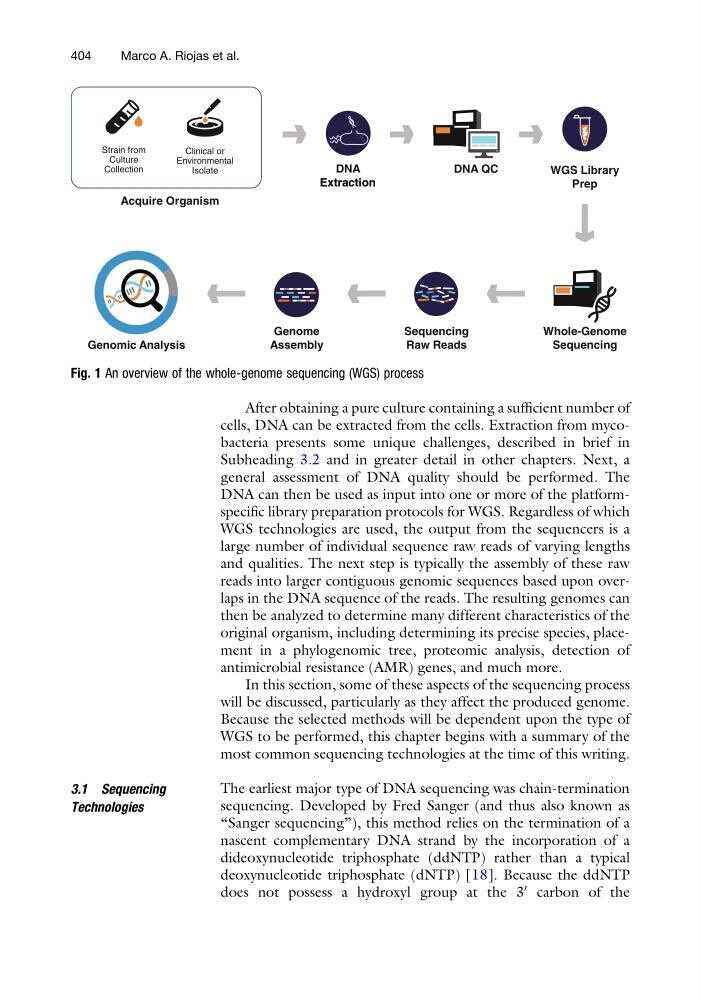
After obtaining a pure culture containing a sufficient number of
cells, DNA can be extracted from the cells. Extraction from mycobacteria presents some unique challenges, described in brief in
Subheading 3.2 and in greater detail in other chapters. Next, a
general assessment of DNA quality should be performed. The
DNA can then be used as input into one or more of the platformspecific library preparation protocols for WGS. Regardless of which
WGS technologies are used, the output from the sequencers is a
large number of individual sequence raw reads of varying lengths
and qualities. The next step is typically the assembly of these raw
reads into larger contiguous genomic sequences based upon overlaps in the DNA sequence of the reads. The resulting genomes can
then be analyzed to determine many different characteristics of the
original organism, including determining its precise species, placement in a phylogenomic tree, proteomic analysis, detection of
antimicrobial resistance (AMR) genes, and much more.
In this section, some of these aspects of the sequencing process
will be discussed, particularly as they affect the produced genome.
Because the selected methods will be dependent upon the type of
WGS to be performed, this chapter begins with a summary of the
most common sequencing technologies at the time of this writing.
3.1 Sequencing
Technologies
The earliest major type of DNA sequencing was chain-termination
sequencing. Developed by Fred Sanger (and thus also known as
“Sanger sequencing”), this method relies on the termination of a
nascent complementary DNA strand by the incorporation of a
dideoxynucleotide triphosphate (ddNTP) rather than a typical
deoxynucleotide triphosphate (dNTP) [18]. Because the ddNTP
does not possess a hydroxyl group at the 3
0 carbon of the
DNA
Extraction
Acquire Organism
Strain from
Culture
Collection
Clinical or
Environmental
Isolate
Genome
Assembly
Genomic Analysis
Extraction
DNA QC
WGS Library
Prep
Whole-Genome
Sequencing
Sequencing
Raw Reads
Fig. 1 An overview of the whole-genome sequencing (WGS) process
404
Marco A. Riojas et al.
cells, DNA can be extracted from the cells. Extraction from mycobacteria presents some unique challenges, described in brief in
Subheading 3.2 and in greater detail in other chapters. Next, a
general assessment of DNA quality should be performed. The
DNA can then be used as input into one or more of the platformspecific library preparation protocols for WGS. Regardless of which
WGS technologies are used, the output from the sequencers is a
large number of individual sequence raw reads of varying lengths
and qualities. The next step is typically the assembly of these raw
reads into larger contiguous genomic sequences based upon overlaps in the DNA sequence of the reads. The resulting genomes can
then be analyzed to determine many different characteristics of the
original organism, including determining its precise species, placement in a phylogenomic tree, proteomic analysis, detection of
antimicrobial resistance (AMR) genes, and much more.
In this section, some of these aspects of the sequencing process
will be discussed, particularly as they affect the produced genome.
Because the selected methods will be dependent upon the type of
WGS to be performed, this chapter begins with a summary of the
most common sequencing technologies at the time of this writing.
3.1 Sequencing
Technologies
The earliest major type of DNA sequencing was chain-termination
sequencing. Developed by Fred Sanger (and thus also known as
“Sanger sequencing”), this method relies on the termination of a
nascent complementary DNA strand by the incorporation of a
dideoxynucleotide triphosphate (ddNTP) rather than a typical
deoxynucleotide triphosphate (dNTP) [18]. Because the ddNTP
does not possess a hydroxyl group at the 3
0 carbon of the
DNA
Extraction
Acquire Organism
Strain from
Culture
Collection
Clinical or
Environmental
Isolate
Genome
Assembly
Genomic Analysis
Extraction
DNA QC
WGS Library
Prep
Whole-Genome
Sequencing
Sequencing
Raw Reads
Fig. 1 An overview of the whole-genome sequencing (WGS) process
404
Marco A. Riojas et al.