

Enrichment, and 400 μL of a 50 mg/mL solution of kanamycin. Mix solution and pour plates.
6. 30 mL inkwell (VWR).
7. 250 mL inkwell (VWR).
3 Methods
3.1 Design of
CRISPRi sgRNA
Targeting Sequence
Oligonucleotides
(sgRNA Oligos)
Here we describe the sgRNA design work-flow. To assist in this
process, we provide a web-based sgRNA design tool at:
https://pebble.rockefeller.edu/tools/sgrna-design/
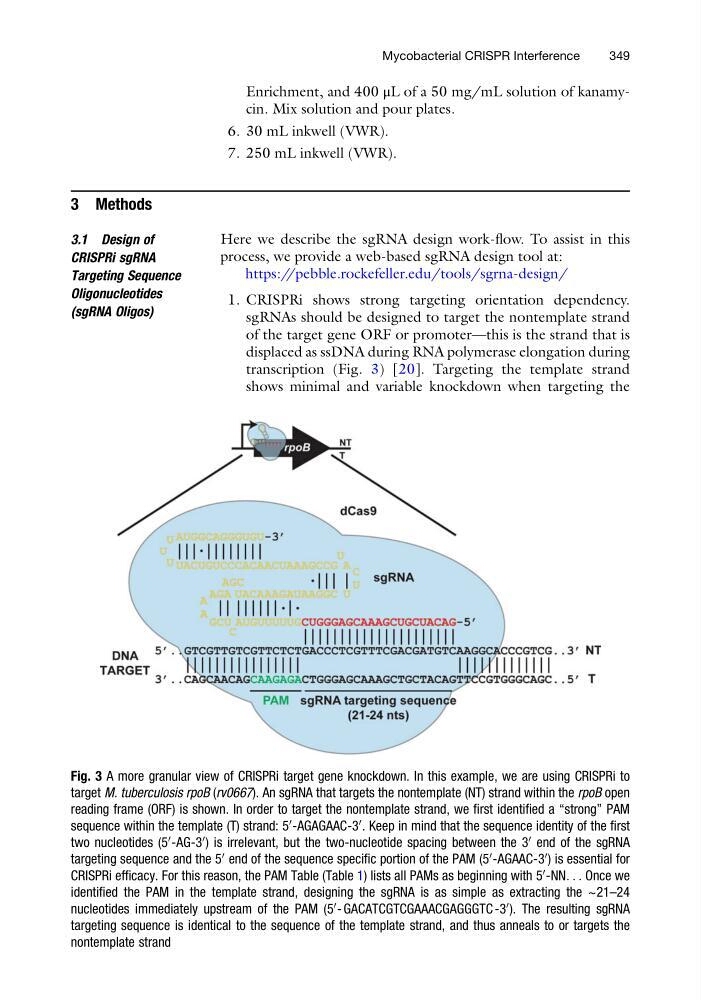
1. CRISPRi shows strong targeting orientation dependency.
sgRNAs should be designed to target the nontemplate strand
of the target gene ORF or promoter—this is the strand that is
displaced as ssDNA during RNA polymerase elongation during
transcription (Fig. 3) [20]. Targeting the template strand
shows minimal and variable knockdown when targeting the
Fig. 3 A more granular view of CRISPRi target gene knockdown. In this example, we are using CRISPRi to
target M. tuberculosis rpoB (rv0667). An sgRNA that targets the nontemplate (NT) strand within the rpoB open
reading frame (ORF) is shown. In order to target the nontemplate strand, we first identified a “strong” PAM
sequence within the template (T) strand: 5
0
-AGAGAAC-3
0
. Keep in mind that the sequence identity of the first
two nucleotides (5
0
-AG-3
0
) is irrelevant, but the two-nucleotide spacing between the 3
0
end of the sgRNA
targeting sequence and the 5
0
end of the sequence specific portion of the PAM (5
0
-AGAAC-3
0
) is essential for
CRISPRi efficacy. For this reason, the PAM Table (Table 1) lists all PAMs as beginning with 5
0
-NN. . . Once we
identified the PAM in the template strand, designing the sgRNA is as simple as extracting the ~21–24
nucleotides immediately upstream of the PAM (5
0
- GACATCGTCGAAACGAGGGTC -3
0
). The resulting sgRNA
targeting sequence is identical to the sequence of the template strand, and thus anneals to or targets the
nontemplate strand
Mycobacterial CRISPR Interference
349
6. 30 mL inkwell (VWR).
7. 250 mL inkwell (VWR).
3 Methods
3.1 Design of
CRISPRi sgRNA
Targeting Sequence
Oligonucleotides
(sgRNA Oligos)
Here we describe the sgRNA design work-flow. To assist in this
process, we provide a web-based sgRNA design tool at:
https://pebble.rockefeller.edu/tools/sgrna-design/
1. CRISPRi shows strong targeting orientation dependency.
sgRNAs should be designed to target the nontemplate strand
of the target gene ORF or promoter—this is the strand that is
displaced as ssDNA during RNA polymerase elongation during
transcription (Fig. 3) [20]. Targeting the template strand
shows minimal and variable knockdown when targeting the
Fig. 3 A more granular view of CRISPRi target gene knockdown. In this example, we are using CRISPRi to
target M. tuberculosis rpoB (rv0667). An sgRNA that targets the nontemplate (NT) strand within the rpoB open
reading frame (ORF) is shown. In order to target the nontemplate strand, we first identified a “strong” PAM
sequence within the template (T) strand: 5
0
-AGAGAAC-3
0
. Keep in mind that the sequence identity of the first
two nucleotides (5
0
-AG-3
0
) is irrelevant, but the two-nucleotide spacing between the 3
0
end of the sgRNA
targeting sequence and the 5
0
end of the sequence specific portion of the PAM (5
0
-AGAAC-3
0
) is essential for
CRISPRi efficacy. For this reason, the PAM Table (Table 1) lists all PAMs as beginning with 5
0
-NN. . . Once we
identified the PAM in the template strand, designing the sgRNA is as simple as extracting the ~21–24
nucleotides immediately upstream of the PAM (5
0
- GACATCGTCGAAACGAGGGTC -3
0
). The resulting sgRNA
targeting sequence is identical to the sequence of the template strand, and thus anneals to or targets the
nontemplate strand
Mycobacterial CRISPR Interference
349