

function mutants. But as with gene deletion, TnSeq as currently
implemented in M. tuberculosis is limited to analysis of genes nonessential for in vitro growth [7, 8]. Lastly, none of these methods
provide a simple mechanism to simultaneously modulate multiple
genes in order to elucidate genetic interactions.
To complement existing genetic tools, we recently developed
an optimized CRISPR interference (CRISPRi) system for targeted
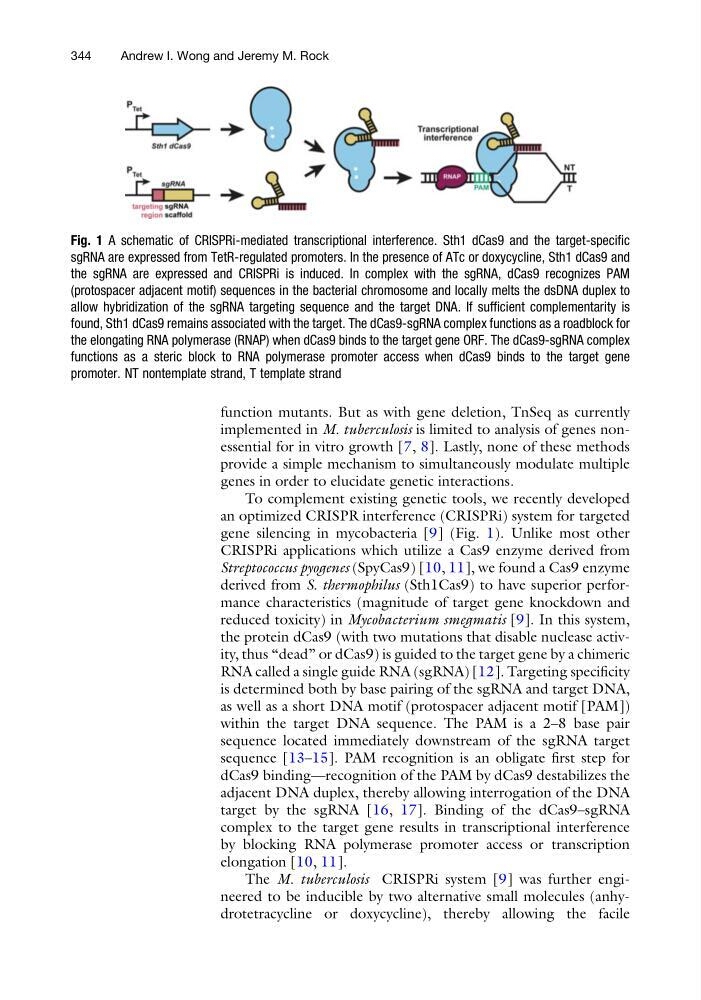
gene silencing in mycobacteria [9] (Fig. 1). Unlike most other
CRISPRi applications which utilize a Cas9 enzyme derived from
Streptococcus pyogenes (SpyCas9) [10, 11], we found a Cas9 enzyme
derived from S. thermophilus (Sth1Cas9) to have superior performance characteristics (magnitude of target gene knockdown and
reduced toxicity) in Mycobacterium smegmatis [9]. In this system,
the protein dCas9 (with two mutations that disable nuclease activity, thus “dead” or dCas9) is guided to the target gene by a chimeric
RNA called a single guide RNA (sgRNA) [12]. Targeting specificity
is determined both by base pairing of the sgRNA and target DNA,
as well as a short DNA motif (protospacer adjacent motif [PAM])
within the target DNA sequence. The PAM is a 2–8 base pair
sequence located immediately downstream of the sgRNA target
sequence [13–15]. PAM recognition is an obligate first step for
dCas9 binding—recognition of the PAM by dCas9 destabilizes the
adjacent DNA duplex, thereby allowing interrogation of the DNA
target by the sgRNA [16, 17]. Binding of the dCas9–sgRNA
complex to the target gene results in transcriptional interference
by blocking RNA polymerase promoter access or transcription
elongation [10, 11].
The M. tuberculosis CRISPRi system [9] was further engineered to be inducible by two alternative small molecules (anhydrotetracycline or doxycycline), thereby allowing the facile
Fig. 1 A schematic of CRISPRi-mediated transcriptional interference. Sth1 dCas9 and the target-specific
sgRNA are expressed from TetR-regulated promoters. In the presence of ATc or doxycycline, Sth1 dCas9 and
the sgRNA are expressed and CRISPRi is induced. In complex with the sgRNA, dCas9 recognizes PAM
(protospacer adjacent motif) sequences in the bacterial chromosome and locally melts the dsDNA duplex to
allow hybridization of the sgRNA targeting sequence and the target DNA. If sufficient complementarity is
found, Sth1 dCas9 remains associated with the target. The dCas9-sgRNA complex functions as a roadblock for
the elongating RNA polymerase (RNAP) when dCas9 binds to the target gene ORF. The dCas9-sgRNA complex
functions as a steric block to RNA polymerase promoter access when dCas9 binds to the target gene
promoter. NT nontemplate strand, T template strand
344
Andrew I. Wong and Jeremy M. Rock
implemented in M. tuberculosis is limited to analysis of genes nonessential for in vitro growth [7, 8]. Lastly, none of these methods
provide a simple mechanism to simultaneously modulate multiple
genes in order to elucidate genetic interactions.
To complement existing genetic tools, we recently developed
an optimized CRISPR interference (CRISPRi) system for targeted
gene silencing in mycobacteria [9] (Fig. 1). Unlike most other
CRISPRi applications which utilize a Cas9 enzyme derived from
Streptococcus pyogenes (SpyCas9) [10, 11], we found a Cas9 enzyme
derived from S. thermophilus (Sth1Cas9) to have superior performance characteristics (magnitude of target gene knockdown and
reduced toxicity) in Mycobacterium smegmatis [9]. In this system,
the protein dCas9 (with two mutations that disable nuclease activity, thus “dead” or dCas9) is guided to the target gene by a chimeric
RNA called a single guide RNA (sgRNA) [12]. Targeting specificity
is determined both by base pairing of the sgRNA and target DNA,
as well as a short DNA motif (protospacer adjacent motif [PAM])
within the target DNA sequence. The PAM is a 2–8 base pair
sequence located immediately downstream of the sgRNA target
sequence [13–15]. PAM recognition is an obligate first step for
dCas9 binding—recognition of the PAM by dCas9 destabilizes the
adjacent DNA duplex, thereby allowing interrogation of the DNA
target by the sgRNA [16, 17]. Binding of the dCas9–sgRNA
complex to the target gene results in transcriptional interference
by blocking RNA polymerase promoter access or transcription
elongation [10, 11].
The M. tuberculosis CRISPRi system [9] was further engineered to be inducible by two alternative small molecules (anhydrotetracycline or doxycycline), thereby allowing the facile
Fig. 1 A schematic of CRISPRi-mediated transcriptional interference. Sth1 dCas9 and the target-specific
sgRNA are expressed from TetR-regulated promoters. In the presence of ATc or doxycycline, Sth1 dCas9 and
the sgRNA are expressed and CRISPRi is induced. In complex with the sgRNA, dCas9 recognizes PAM
(protospacer adjacent motif) sequences in the bacterial chromosome and locally melts the dsDNA duplex to
allow hybridization of the sgRNA targeting sequence and the target DNA. If sufficient complementarity is
found, Sth1 dCas9 remains associated with the target. The dCas9-sgRNA complex functions as a roadblock for
the elongating RNA polymerase (RNAP) when dCas9 binds to the target gene ORF. The dCas9-sgRNA complex
functions as a steric block to RNA polymerase promoter access when dCas9 binds to the target gene
promoter. NT nontemplate strand, T template strand
344
Andrew I. Wong and Jeremy M. Rock