

10. Transfer to a sterile container that will hold the final culture
volume (calculated in step 2).
11. Add M7H9 up to the final culture volume (calculated in step
2).
12. Transfer up to 50 mL of culture from step 11 to a pipetting
reservoir.
13. Add 40μL of the pooled culture to each well of clear polystyrene 384-well assay plates containing test compounds (see
Notes 4 and 5).
14. Repeat steps 12 and 13 until all assay plates have been filled.
15. Incubate the assay plates at 37
C in a humidified container
without shaking for 14 days.
3.3 Stopping
the Assay
1. Read OD 600 of plates.
2. Add 40μL of 10% (v/v) DMSO, optionally containing 2.6 fM
spike-in plasmid 1, to each well of the 384-well assay plates.
3. Seal each plate with foil and replace its lid.
4. Transfer plates to aerosol-tight secondary containment and
incubate for 2 h at 80
C.
5. Remove the assay plates from biosafety level 3 containment.
6. If desired, make 15μL aliquots in 384-well PCR plates.
7. Store at À80
C until ready for further processing.
3.4 Barcode
Amplification
1. Thaw an aliquot of each assay plate (see step 7 under
Subheading 3.3).
2. Use a thermocycler to heat at 98
C for 10 min.
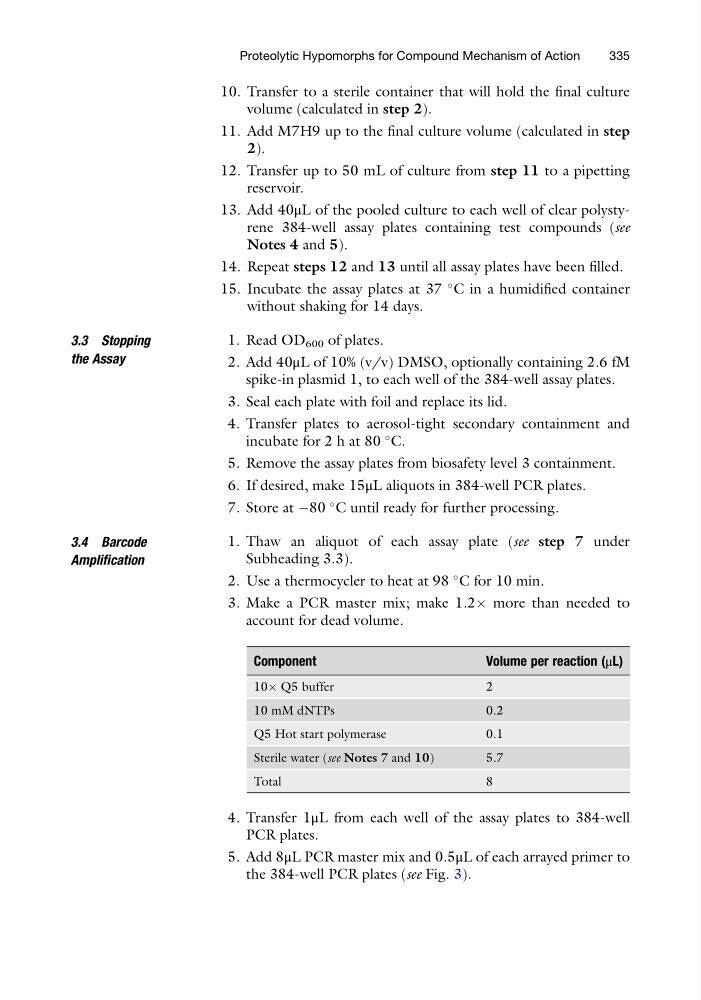
3. Make a PCR master mix; make 1.2Â more than needed to
account for dead volume.
Component
Volume per reaction (μL)
10Â Q5 buffer
2
10 mM dNTPs
0.2
Q5 Hot start polymerase
0.1
Sterile water (see Notes 7 and 10)
5.7
Total
8
4. Transfer 1μL from each well of the assay plates to 384-well
PCR plates.
5. Add 8μL PCR master mix and 0.5μL of each arrayed primer to
the 384-well PCR plates (see Fig. 3).
Proteolytic Hypomorphs for Compound Mechanism of Action
335
volume (calculated in step 2).
11. Add M7H9 up to the final culture volume (calculated in step
2).
12. Transfer up to 50 mL of culture from step 11 to a pipetting
reservoir.
13. Add 40μL of the pooled culture to each well of clear polystyrene 384-well assay plates containing test compounds (see
Notes 4 and 5).
14. Repeat steps 12 and 13 until all assay plates have been filled.
15. Incubate the assay plates at 37
C in a humidified container
without shaking for 14 days.
3.3 Stopping
the Assay
1. Read OD 600 of plates.
2. Add 40μL of 10% (v/v) DMSO, optionally containing 2.6 fM
spike-in plasmid 1, to each well of the 384-well assay plates.
3. Seal each plate with foil and replace its lid.
4. Transfer plates to aerosol-tight secondary containment and
incubate for 2 h at 80
C.
5. Remove the assay plates from biosafety level 3 containment.
6. If desired, make 15μL aliquots in 384-well PCR plates.
7. Store at À80
C until ready for further processing.
3.4 Barcode
Amplification
1. Thaw an aliquot of each assay plate (see step 7 under
Subheading 3.3).
2. Use a thermocycler to heat at 98
C for 10 min.
3. Make a PCR master mix; make 1.2Â more than needed to
account for dead volume.
Component
Volume per reaction (μL)
10Â Q5 buffer
2
10 mM dNTPs
0.2
Q5 Hot start polymerase
0.1
Sterile water (see Notes 7 and 10)
5.7
Total
8
4. Transfer 1μL from each well of the assay plates to 384-well
PCR plates.
5. Add 8μL PCR master mix and 0.5μL of each arrayed primer to
the 384-well PCR plates (see Fig. 3).
Proteolytic Hypomorphs for Compound Mechanism of Action
335