

2.3 Stopping
the Assay
1. 10% (v/v) DMSO.
2. Foil adhesive plate seals.
3. Aerosol-tight secondary containment for heat-sterilizing assay
plates (see Note 6).
4. Optional: 26 fM spike-in plasmid 1 in water (10Â stock) (see
Note 1 and 7).
5. Optional: 384-well PCR plates to contain aliquots.
2.4 Barcode
Amplification
1. 384-well PCR plates.
2. Reagent reservoirs.
3. Half-skirt 96-well PCR plates.
4. 10μM forward and reverse primers arrayed in 96-well PCR
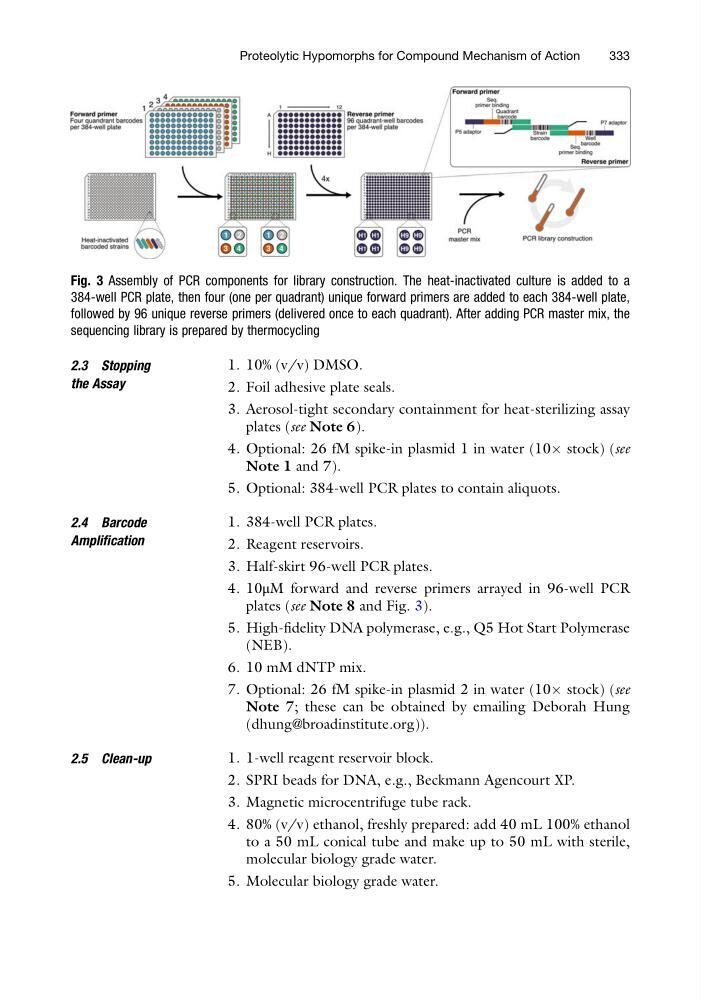
plates (see Note 8 and Fig. 3).
5. High-fidelity DNA polymerase, e.g., Q5 Hot Start Polymerase
(NEB).
6. 10 mM dNTP mix.
7. Optional: 26 fM spike-in plasmid 2 in water (10Â stock) (see
Note 7; these can be obtained by emailing Deborah Hung
(dhung@broadinstitute.org)).
2.5 Clean-up
1. 1-well reagent reservoir block.
2. SPRI beads for DNA, e.g., Beckmann Agencourt XP.
3. Magnetic microcentrifuge tube rack.
4. 80% (v/v) ethanol, freshly prepared: add 40 mL 100% ethanol
to a 50 mL conical tube and make up to 50 mL with sterile,
molecular biology grade water.
5. Molecular biology grade water.
Fig. 3 Assembly of PCR components for library construction. The heat-inactivated culture is added to a
384-well PCR plate, then four (one per quadrant) unique forward primers are added to each 384-well plate,
followed by 96 unique reverse primers (delivered once to each quadrant). After adding PCR master mix, the
sequencing library is prepared by thermocycling
Proteolytic Hypomorphs for Compound Mechanism of Action
333
the Assay
1. 10% (v/v) DMSO.
2. Foil adhesive plate seals.
3. Aerosol-tight secondary containment for heat-sterilizing assay
plates (see Note 6).
4. Optional: 26 fM spike-in plasmid 1 in water (10Â stock) (see
Note 1 and 7).
5. Optional: 384-well PCR plates to contain aliquots.
2.4 Barcode
Amplification
1. 384-well PCR plates.
2. Reagent reservoirs.
3. Half-skirt 96-well PCR plates.
4. 10μM forward and reverse primers arrayed in 96-well PCR
plates (see Note 8 and Fig. 3).
5. High-fidelity DNA polymerase, e.g., Q5 Hot Start Polymerase
(NEB).
6. 10 mM dNTP mix.
7. Optional: 26 fM spike-in plasmid 2 in water (10Â stock) (see
Note 7; these can be obtained by emailing Deborah Hung
(dhung@broadinstitute.org)).
2.5 Clean-up
1. 1-well reagent reservoir block.
2. SPRI beads for DNA, e.g., Beckmann Agencourt XP.
3. Magnetic microcentrifuge tube rack.
4. 80% (v/v) ethanol, freshly prepared: add 40 mL 100% ethanol
to a 50 mL conical tube and make up to 50 mL with sterile,
molecular biology grade water.
5. Molecular biology grade water.
Fig. 3 Assembly of PCR components for library construction. The heat-inactivated culture is added to a
384-well PCR plate, then four (one per quadrant) unique forward primers are added to each 384-well plate,
followed by 96 unique reverse primers (delivered once to each quadrant). After adding PCR master mix, the
sequencing library is prepared by thermocycling
Proteolytic Hypomorphs for Compound Mechanism of Action
333