

T-G, G-G, or T-T mismatches once the oligo anneals to the
template strand of the replication fork. Such mismatches are
recognized and repaired by the mycobacterial MMR system
and are thus not easily transferred to the chromosome by
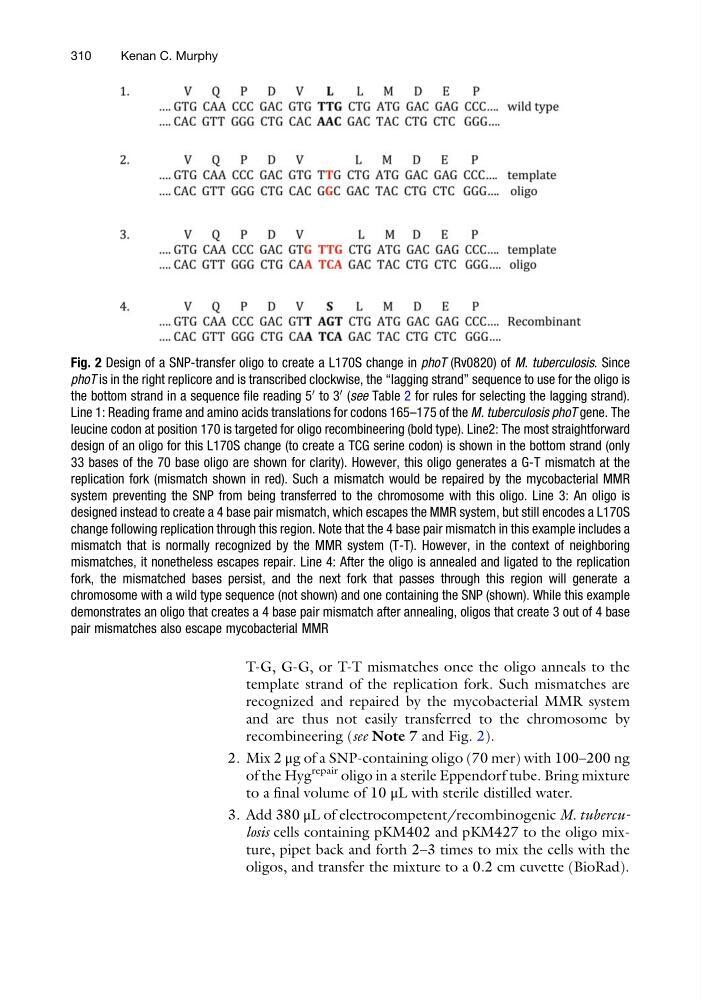
recombineering (see Note 7 and Fig. 2).
2. Mix 2 μg of a SNP-containing oligo (70 mer) with 100–200 ng
of the Hyg
repair oligo in a sterile Eppendorf tube. Bring mixture
to a final volume of 10 μL with sterile distilled water.
3. Add 380 μL of electrocompetent/recombinogenic M. tuberculosis cells containing pKM402 and pKM427 to the oligo mixture, pipet back and forth 2–3 times to mix the cells with the
oligos, and transfer the mixture to a 0.2 cm cuvette (BioRad).
Fig. 2 Design of a SNP-transfer oligo to create a L170S change in phoT (Rv0820) of M. tuberculosis. Since
phoT is in the right replicore and is transcribed clockwise, the “lagging strand” sequence to use for the oligo is
the bottom strand in a sequence file reading 5
0
to 3
0
(see Table 2 for rules for selecting the lagging strand).
Line 1: Reading frame and amino acids translations for codons 165–175 of the M. tuberculosis phoT gene. The
leucine codon at position 170 is targeted for oligo recombineering (bold type). Line2: The most straightforward
design of an oligo for this L170S change (to create a TCG serine codon) is shown in the bottom strand (only
33 bases of the 70 base oligo are shown for clarity). However, this oligo generates a G-T mismatch at the
replication fork (mismatch shown in red). Such a mismatch would be repaired by the mycobacterial MMR
system preventing the SNP from being transferred to the chromosome with this oligo. Line 3: An oligo is
designed instead to create a 4 base pair mismatch, which escapes the MMR system, but still encodes a L170S
change following replication through this region. Note that the 4 base pair mismatch in this example includes a
mismatch that is normally recognized by the MMR system (T-T). However, in the context of neighboring
mismatches, it nonetheless escapes repair. Line 4: After the oligo is annealed and ligated to the replication
fork, the mismatched bases persist, and the next fork that passes through this region will generate a
chromosome with a wild type sequence (not shown) and one containing the SNP (shown). While this example
demonstrates an oligo that creates a 4 base pair mismatch after annealing, oligos that create 3 out of 4 base
pair mismatches also escape mycobacterial MMR
310
Kenan C. Murphy
template strand of the replication fork. Such mismatches are
recognized and repaired by the mycobacterial MMR system
and are thus not easily transferred to the chromosome by
recombineering (see Note 7 and Fig. 2).
2. Mix 2 μg of a SNP-containing oligo (70 mer) with 100–200 ng
of the Hyg
repair oligo in a sterile Eppendorf tube. Bring mixture
to a final volume of 10 μL with sterile distilled water.
3. Add 380 μL of electrocompetent/recombinogenic M. tuberculosis cells containing pKM402 and pKM427 to the oligo mixture, pipet back and forth 2–3 times to mix the cells with the
oligos, and transfer the mixture to a 0.2 cm cuvette (BioRad).
Fig. 2 Design of a SNP-transfer oligo to create a L170S change in phoT (Rv0820) of M. tuberculosis. Since
phoT is in the right replicore and is transcribed clockwise, the “lagging strand” sequence to use for the oligo is
the bottom strand in a sequence file reading 5
0
to 3
0
(see Table 2 for rules for selecting the lagging strand).
Line 1: Reading frame and amino acids translations for codons 165–175 of the M. tuberculosis phoT gene. The
leucine codon at position 170 is targeted for oligo recombineering (bold type). Line2: The most straightforward
design of an oligo for this L170S change (to create a TCG serine codon) is shown in the bottom strand (only
33 bases of the 70 base oligo are shown for clarity). However, this oligo generates a G-T mismatch at the
replication fork (mismatch shown in red). Such a mismatch would be repaired by the mycobacterial MMR
system preventing the SNP from being transferred to the chromosome with this oligo. Line 3: An oligo is
designed instead to create a 4 base pair mismatch, which escapes the MMR system, but still encodes a L170S
change following replication through this region. Note that the 4 base pair mismatch in this example includes a
mismatch that is normally recognized by the MMR system (T-T). However, in the context of neighboring
mismatches, it nonetheless escapes repair. Line 4: After the oligo is annealed and ligated to the replication
fork, the mismatched bases persist, and the next fork that passes through this region will generate a
chromosome with a wild type sequence (not shown) and one containing the SNP (shown). While this example
demonstrates an oligo that creates a 4 base pair mismatch after annealing, oligos that create 3 out of 4 base
pair mismatches also escape mycobacterial MMR
310
Kenan C. Murphy