

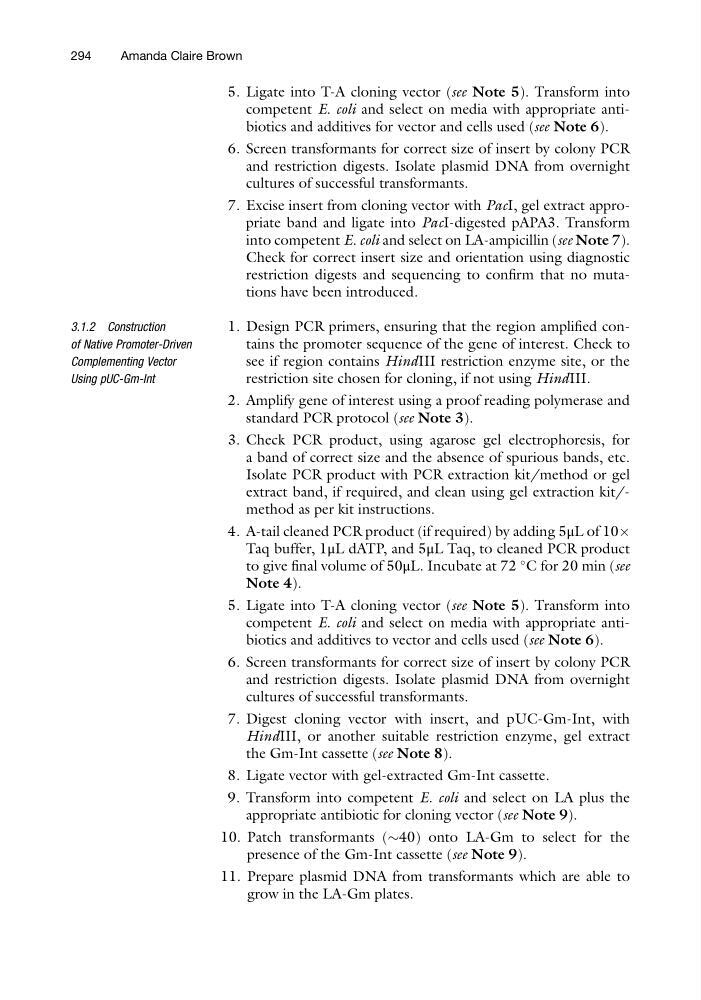
5. Ligate into T-A cloning vector (see Note 5). Transform into
competent E. coli and select on media with appropriate antibiotics and additives for vector and cells used (see Note 6).
6. Screen transformants for correct size of insert by colony PCR
and restriction digests. Isolate plasmid DNA from overnight
cultures of successful transformants.
7. Excise insert from cloning vector with PacI, gel extract appropriate band and ligate into PacI-digested pAPA3. Transform
into competent E. coli and select on LA-ampicillin (see Note 7).
Check for correct insert size and orientation using diagnostic
restriction digests and sequencing to confirm that no mutations have been introduced.
3.1.2 Construction
of Native Promoter-Driven
Complementing Vector
Using pUC-Gm-Int
1. Design PCR primers, ensuring that the region amplified contains the promoter sequence of the gene of interest. Check to
see if region contains HindIII restriction enzyme site, or the
restriction site chosen for cloning, if not using HindIII.
2. Amplify gene of interest using a proof reading polymerase and
standard PCR protocol (see Note 3).
3. Check PCR product, using agarose gel electrophoresis, for
a band of correct size and the absence of spurious bands, etc.
Isolate PCR product with PCR extraction kit/method or gel
extract band, if required, and clean using gel extraction kit/method as per kit instructions.
4. A-tail cleaned PCR product (if required) by adding 5μL of 10Â
Taq buffer, 1μL dATP, and 5μL Taq, to cleaned PCR product
to give final volume of 50μL. Incubate at 72
C for 20 min (see
Note 4).
5. Ligate into T-A cloning vector (see Note 5). Transform into
competent E. coli and select on media with appropriate antibiotics and additives to vector and cells used (see Note 6).
6. Screen transformants for correct size of insert by colony PCR
and restriction digests. Isolate plasmid DNA from overnight
cultures of successful transformants.
7. Digest cloning vector with insert, and pUC-Gm-Int, with
HindIII, or another suitable restriction enzyme, gel extract
the Gm-Int cassette (see Note 8).
8. Ligate vector with gel-extracted Gm-Int cassette.
9. Transform into competent E. coli and select on LA plus the
appropriate antibiotic for cloning vector (see Note 9).
10. Patch transformants ($40) onto LA-Gm to select for the
presence of the Gm-Int cassette (see Note 9).
11. Prepare plasmid DNA from transformants which are able to
grow in the LA-Gm plates.
294
Amanda Claire Brown
competent E. coli and select on media with appropriate antibiotics and additives for vector and cells used (see Note 6).
6. Screen transformants for correct size of insert by colony PCR
and restriction digests. Isolate plasmid DNA from overnight
cultures of successful transformants.
7. Excise insert from cloning vector with PacI, gel extract appropriate band and ligate into PacI-digested pAPA3. Transform
into competent E. coli and select on LA-ampicillin (see Note 7).
Check for correct insert size and orientation using diagnostic
restriction digests and sequencing to confirm that no mutations have been introduced.
3.1.2 Construction
of Native Promoter-Driven
Complementing Vector
Using pUC-Gm-Int
1. Design PCR primers, ensuring that the region amplified contains the promoter sequence of the gene of interest. Check to
see if region contains HindIII restriction enzyme site, or the
restriction site chosen for cloning, if not using HindIII.
2. Amplify gene of interest using a proof reading polymerase and
standard PCR protocol (see Note 3).
3. Check PCR product, using agarose gel electrophoresis, for
a band of correct size and the absence of spurious bands, etc.
Isolate PCR product with PCR extraction kit/method or gel
extract band, if required, and clean using gel extraction kit/method as per kit instructions.
4. A-tail cleaned PCR product (if required) by adding 5μL of 10Â
Taq buffer, 1μL dATP, and 5μL Taq, to cleaned PCR product
to give final volume of 50μL. Incubate at 72
C for 20 min (see
Note 4).
5. Ligate into T-A cloning vector (see Note 5). Transform into
competent E. coli and select on media with appropriate antibiotics and additives to vector and cells used (see Note 6).
6. Screen transformants for correct size of insert by colony PCR
and restriction digests. Isolate plasmid DNA from overnight
cultures of successful transformants.
7. Digest cloning vector with insert, and pUC-Gm-Int, with
HindIII, or another suitable restriction enzyme, gel extract
the Gm-Int cassette (see Note 8).
8. Ligate vector with gel-extracted Gm-Int cassette.
9. Transform into competent E. coli and select on LA plus the
appropriate antibiotic for cloning vector (see Note 9).
10. Patch transformants ($40) onto LA-Gm to select for the
presence of the Gm-Int cassette (see Note 9).
11. Prepare plasmid DNA from transformants which are able to
grow in the LA-Gm plates.
294
Amanda Claire Brown