

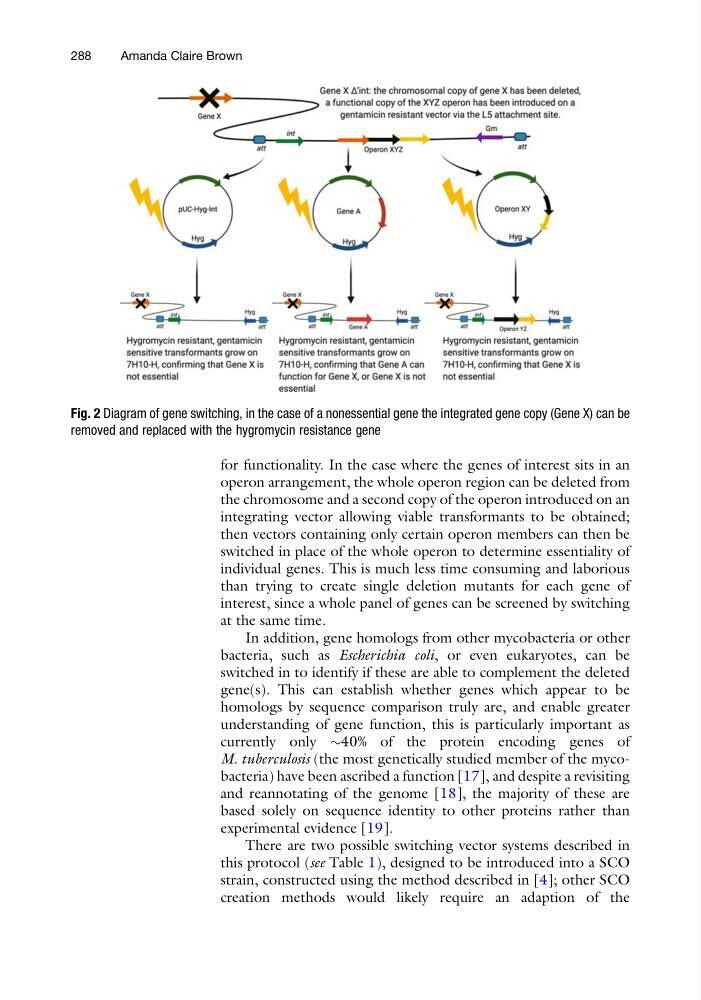
for functionality. In the case where the genes of interest sits in an
operon arrangement, the whole operon region can be deleted from
the chromosome and a second copy of the operon introduced on an
integrating vector allowing viable transformants to be obtained;
then vectors containing only certain operon members can then be
switched in place of the whole operon to determine essentiality of
individual genes. This is much less time consuming and laborious
than trying to create single deletion mutants for each gene of
interest, since a whole panel of genes can be screened by switching
at the same time.
In addition, gene homologs from other mycobacteria or other
bacteria, such as Escherichia coli, or even eukaryotes, can be
switched in to identify if these are able to complement the deleted
gene(s). This can establish whether genes which appear to be
homologs by sequence comparison truly are, and enable greater
understanding of gene function, this is particularly important as
currently only $40% of the protein encoding genes of
M. tuberculosis (the most genetically studied member of the mycobacteria) have been ascribed a function [17], and despite a revisiting
and reannotating of the genome [18], the majority of these are
based solely on sequence identity to other proteins rather than
experimental evidence [19].
There are two possible switching vector systems described in
this protocol (see Table 1), designed to be introduced into a SCO
strain, constructed using the method described in [4]; other SCO
creation methods would likely require an adaption of the
Fig. 2 Diagram of gene switching, in the case of a nonessential gene the integrated gene copy (Gene X) can be
removed and replaced with the hygromycin resistance gene
288
Amanda Claire Brown
operon arrangement, the whole operon region can be deleted from
the chromosome and a second copy of the operon introduced on an
integrating vector allowing viable transformants to be obtained;
then vectors containing only certain operon members can then be
switched in place of the whole operon to determine essentiality of
individual genes. This is much less time consuming and laborious
than trying to create single deletion mutants for each gene of
interest, since a whole panel of genes can be screened by switching
at the same time.
In addition, gene homologs from other mycobacteria or other
bacteria, such as Escherichia coli, or even eukaryotes, can be
switched in to identify if these are able to complement the deleted
gene(s). This can establish whether genes which appear to be
homologs by sequence comparison truly are, and enable greater
understanding of gene function, this is particularly important as
currently only $40% of the protein encoding genes of
M. tuberculosis (the most genetically studied member of the mycobacteria) have been ascribed a function [17], and despite a revisiting
and reannotating of the genome [18], the majority of these are
based solely on sequence identity to other proteins rather than
experimental evidence [19].
There are two possible switching vector systems described in
this protocol (see Table 1), designed to be introduced into a SCO
strain, constructed using the method described in [4]; other SCO
creation methods would likely require an adaption of the
Fig. 2 Diagram of gene switching, in the case of a nonessential gene the integrated gene copy (Gene X) can be
removed and replaced with the hygromycin resistance gene
288
Amanda Claire Brown