

9. Tighten the screw cap lids and seal around the lid and tube with
parafilm (see Note 9). The cultures can now be removed from
the anaerobic cabinet.
10. Melt paraffin wax by heating to >70
C. Wear thick protective
gloves and exercise due care when handling hot wax.
11. Seal the lids to the tubes with the molten paraffin wax and
insure that there are no bubbles or holes where oxygen may
permeate. Be careful to insure that while you are sealing you do
not introduce oxygen to the hypoxic atmosphere of the culture
tube; if oxygen is introduced, a blue color will start to reappear.
Avoid heat shock by applying molten wax only to the lid and
join to the glass tube, do not cover the entire tube in wax.
12. Incubate in an orbital incubator at 37
C with shaking at
100–120 rpm.
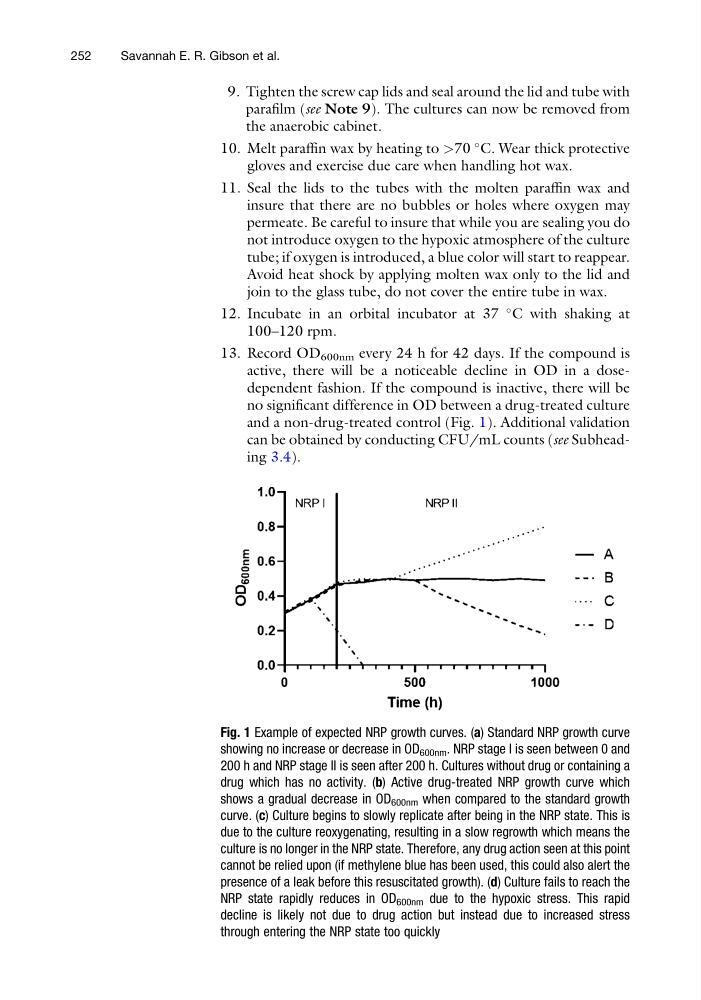
13. Record OD 600nm every 24 h for 42 days. If the compound is
active, there will be a noticeable decline in OD in a dosedependent fashion. If the compound is inactive, there will be
no significant difference in OD between a drug-treated culture
and a non-drug-treated control (Fig. 1). Additional validation
can be obtained by conducting CFU/mL counts (see Subheading 3.4).
Fig. 1 Example of expected NRP growth curves. (a) Standard NRP growth curve
showing no increase or decrease in OD 600nm . NRP stage I is seen between 0 and
200 h and NRP stage II is seen after 200 h. Cultures without drug or containing a
drug which has no activity. (b) Active drug-treated NRP growth curve which
shows a gradual decrease in OD 600nm when compared to the standard growth
curve. (c) Culture begins to slowly replicate after being in the NRP state. This is
due to the culture reoxygenating, resulting in a slow regrowth which means the
culture is no longer in the NRP state. Therefore, any drug action seen at this point
cannot be relied upon (if methylene blue has been used, this could also alert the
presence of a leak before this resuscitated growth). (d) Culture fails to reach the
NRP state rapidly reduces in OD 600nm due to the hypoxic stress. This rapid
decline is likely not due to drug action but instead due to increased stress
through entering the NRP state too quickly
252
Savannah E. R. Gibson et al.
parafilm (see Note 9). The cultures can now be removed from
the anaerobic cabinet.
10. Melt paraffin wax by heating to >70
C. Wear thick protective
gloves and exercise due care when handling hot wax.
11. Seal the lids to the tubes with the molten paraffin wax and
insure that there are no bubbles or holes where oxygen may
permeate. Be careful to insure that while you are sealing you do
not introduce oxygen to the hypoxic atmosphere of the culture
tube; if oxygen is introduced, a blue color will start to reappear.
Avoid heat shock by applying molten wax only to the lid and
join to the glass tube, do not cover the entire tube in wax.
12. Incubate in an orbital incubator at 37
C with shaking at
100–120 rpm.
13. Record OD 600nm every 24 h for 42 days. If the compound is
active, there will be a noticeable decline in OD in a dosedependent fashion. If the compound is inactive, there will be
no significant difference in OD between a drug-treated culture
and a non-drug-treated control (Fig. 1). Additional validation
can be obtained by conducting CFU/mL counts (see Subheading 3.4).
Fig. 1 Example of expected NRP growth curves. (a) Standard NRP growth curve
showing no increase or decrease in OD 600nm . NRP stage I is seen between 0 and
200 h and NRP stage II is seen after 200 h. Cultures without drug or containing a
drug which has no activity. (b) Active drug-treated NRP growth curve which
shows a gradual decrease in OD 600nm when compared to the standard growth
curve. (c) Culture begins to slowly replicate after being in the NRP state. This is
due to the culture reoxygenating, resulting in a slow regrowth which means the
culture is no longer in the NRP state. Therefore, any drug action seen at this point
cannot be relied upon (if methylene blue has been used, this could also alert the
presence of a leak before this resuscitated growth). (d) Culture fails to reach the
NRP state rapidly reduces in OD 600nm due to the hypoxic stress. This rapid
decline is likely not due to drug action but instead due to increased stress
through entering the NRP state too quickly
252
Savannah E. R. Gibson et al.