

81
Miscanthus Production
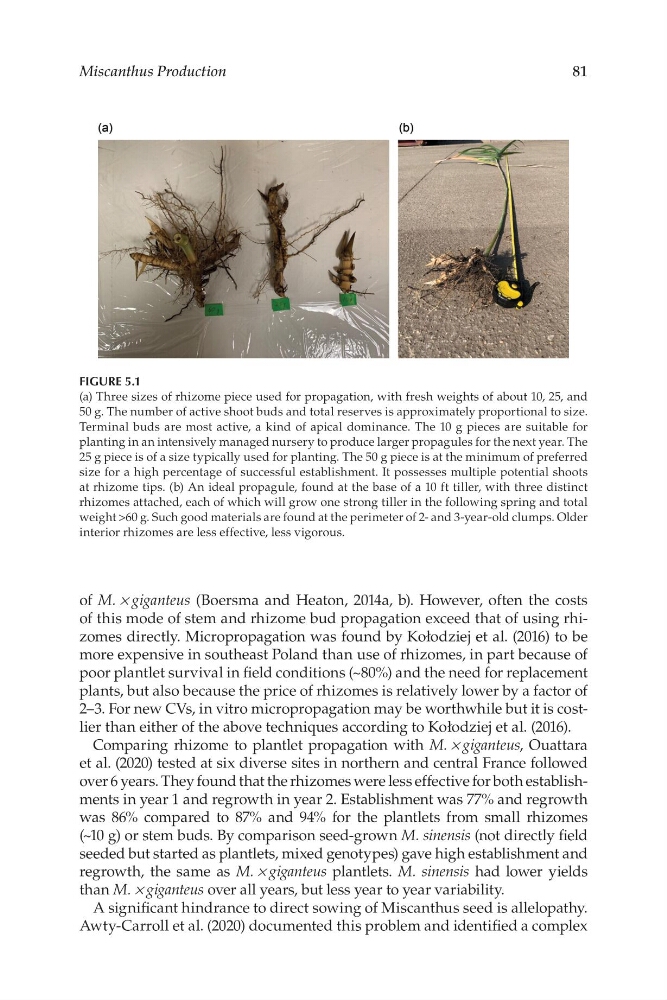
FIGURE 5.1
(a) Three sizes of rhizome piece used for propagation, with fresh weights of about 10, 25, and
50 g. The number of active shoot buds and total reserves is approximately proportional to size.
Terminal buds are most active, a kind of apical dominance. The 10 g pieces are suitable for
planting in an intensively managed nursery to produce larger propagules for the next year. The
25 g piece is of a size typically used for planting. The 50 g piece is at the minimum of preferred
size for a high percentage of successful establishment. It possesses multiple potential shoots
at rhizome tips. (b) An ideal propagule, found at the base of a 10 ft tiller, with three distinct
rhizomes attached, each of which will grow one strong tiller in the following spring and total
weight >60 g. Such good materials are found at the perimeter of 2- and 3-year-old clumps. Older
interior rhizomes are less effective, less vigorous.
of M. × giganteus (Boersma and Heaton, 2014a, b). However, often the costs
of this mode of stem and rhizome bud propagation exceed that of using rhizomes directly. Micropropagation was found by Kołodziej et al. (2016) to be
more expensive in southeast Poland than use of rhizomes, in part because of
poor plantlet survival in field conditions (~80%) and the need for replacement
plants, but also because the price of rhizomes is relatively lower by a factor of
2–3. For new CVs, in vitro micropropagation may be worthwhile but it is costlier than either of the above techniques according to Kołodziej et al. (2016).
Comparing rhizome to plantlet propagation with M. × giganteus, Ouattara
et al. (2020) tested at six diverse sites in northern and central France followed
over 6 years. They found that the rhizomes were less effective for both establishments in year 1 and regrowth in year 2. Establishment was 77% and regrowth
was 86% compared to 87% and 94% for the plantlets from small rhizomes
(~10 g) or stem buds. By comparison seed-grown M. sinensis (not directly field
seeded but started as plantlets, mixed genotypes) gave high establishment and
regrowth, the same as M. × giganteus plantlets. M. sinensis had lower yields
than M. × giganteus over all years, but less year to year variability.
A significant hindrance to direct sowing of Miscanthus seed is allelopathy.
Awty-Carroll et al. (2020) documented this problem and identified a complex