

14
Phytotechnology with Biomass Production
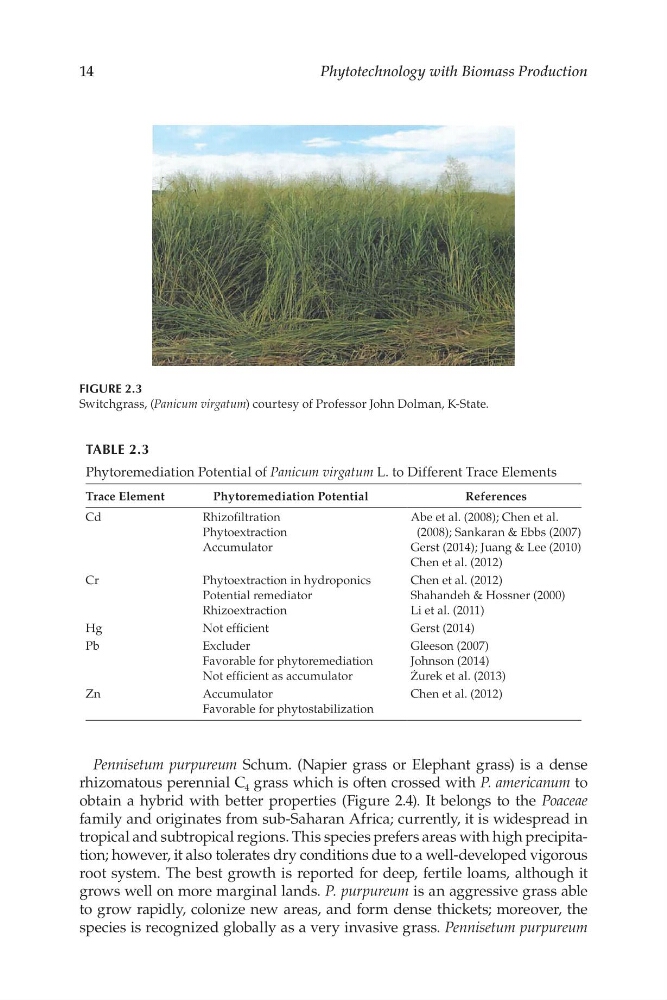
FIGURE 2.3
Switchgrass, (Panicum virgatum) courtesy of Professor John Dolman, K-State.
TABLE 2.3
Phytoremediation Potential of Panicum virgatum L. to Different Trace Elements
Trace Element
Phytoremediation Potential
References
Cd
Rhizofiltration
Abe et al. (2008); Chen et al.
Phytoextraction
Accumulator
(2008); Sankaran & Ebbs (2007)
Gerst (2014); Juang & Lee (2010)
Chen et al. (2012)
Cr
Phytoextraction in hydroponics
Potential remediator
Rhizoextraction
Chen et al. (2012)
Shahandeh & Hossner (2000)
Li et al. (2011)
Hg
Not efficient
Gerst (2014)
Pb
Excluder
Favorable for phytoremediation
Not efficient as accumulator
Gleeson (2007)
Johnson (2014)
Żurek et al. (2013)
Zn
Accumulator
Chen et al. (2012)
Favorable for phytostabilization
Pennisetum purpureum Schum. (Napier grass or Elephant grass) is a dense
rhizomatous perennial C 4 grass which is often crossed with P. americanum to
obtain a hybrid with better properties (Figure 2.4). It belongs to the Poaceae
family and originates from sub-Saharan Africa; currently, it is widespread in
tropical and subtropical regions. This species prefers areas with high precipitation; however, it also tolerates dry conditions due to a well-developed vigorous
root system. The best growth is reported for deep, fertile loams, although it
grows well on more marginal lands. P. purpureum is an aggressive grass able
to grow rapidly, colonize new areas, and form dense thickets; moreover, the
species is recognized globally as a very invasive grass. Pennisetum purpureum
Phytotechnology with Biomass Production
FIGURE 2.3
Switchgrass, (Panicum virgatum) courtesy of Professor John Dolman, K-State.
TABLE 2.3
Phytoremediation Potential of Panicum virgatum L. to Different Trace Elements
Trace Element
Phytoremediation Potential
References
Cd
Rhizofiltration
Abe et al. (2008); Chen et al.
Phytoextraction
Accumulator
(2008); Sankaran & Ebbs (2007)
Gerst (2014); Juang & Lee (2010)
Chen et al. (2012)
Cr
Phytoextraction in hydroponics
Potential remediator
Rhizoextraction
Chen et al. (2012)
Shahandeh & Hossner (2000)
Li et al. (2011)
Hg
Not efficient
Gerst (2014)
Pb
Excluder
Favorable for phytoremediation
Not efficient as accumulator
Gleeson (2007)
Johnson (2014)
Żurek et al. (2013)
Zn
Accumulator
Chen et al. (2012)
Favorable for phytostabilization
Pennisetum purpureum Schum. (Napier grass or Elephant grass) is a dense
rhizomatous perennial C 4 grass which is often crossed with P. americanum to
obtain a hybrid with better properties (Figure 2.4). It belongs to the Poaceae
family and originates from sub-Saharan Africa; currently, it is widespread in
tropical and subtropical regions. This species prefers areas with high precipitation; however, it also tolerates dry conditions due to a well-developed vigorous
root system. The best growth is reported for deep, fertile loams, although it
grows well on more marginal lands. P. purpureum is an aggressive grass able
to grow rapidly, colonize new areas, and form dense thickets; moreover, the
species is recognized globally as a very invasive grass. Pennisetum purpureum