

205
Miscanthus for Bio-based Products
11.2.3 Composites, Building Materials, Cement
The construction industry relies on a diverse array of board products in
which lignocellulose fibers and particles take a variety of forms. These
products include plywood, particleboard, fiberboard, and strand board. All
of these products typically involve the use of some kind of bonding agent.
Typical fiberboard compositions are similar to 82% of wood/lignocellulose,
9% of resin, 1% of paraffin, and 8% of water.
Fiberboard and particleboard can be produced from Miscanthus and used
as insulation and paneling (Tajuddin et al., 2016). Particleboard from this crop
has good qualities when produced by hot pressing and steam processes. The
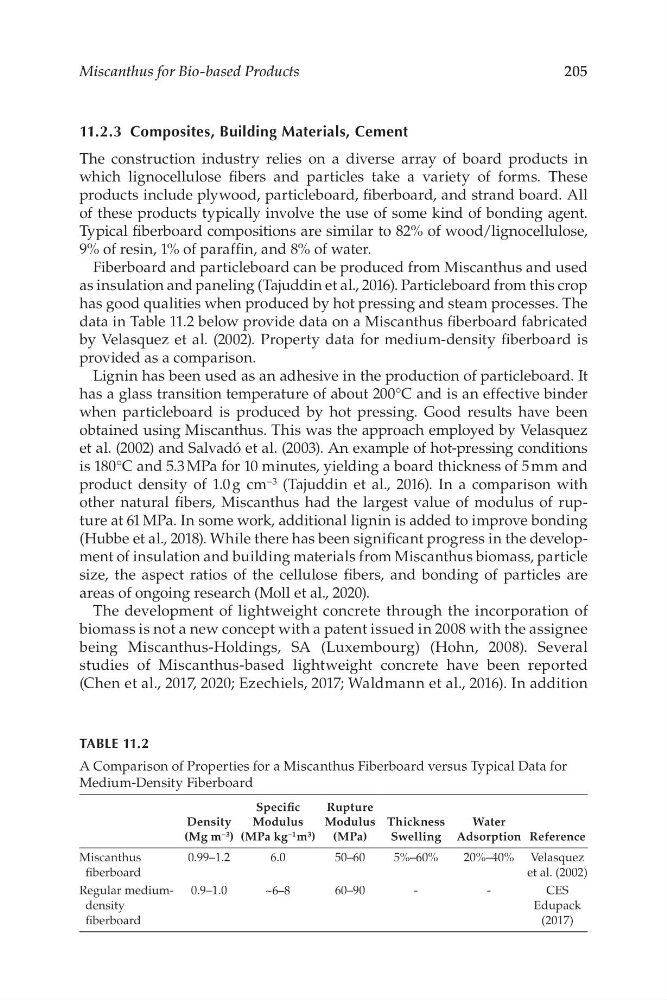
data in Table 11.2 below provide data on a Miscanthus fiberboard fabricated
by Velasquez et al. (2002). Property data for medium-density fiberboard is
provided as a comparison.
Lignin has been used as an adhesive in the production of particleboard. It
has a glass transition temperature of about 200°C and is an effective binder
when particleboard is produced by hot pressing. Good results have been
obtained using Miscanthus. This was the approach employed by Velasquez
et al. (2002) and Salvadó et al. (2003). An example of hot-pressing conditions
is 180°C and 5.3 MPa for 10 minutes, yielding a board thickness of 5 mm and
product density of 1.0 g cm −3 (Tajuddin et al., 2016). In a comparison with
other natural fibers, Miscanthus had the largest value of modulus of rupture at 61 MPa. In some work, additional lignin is added to improve bonding
(Hubbe et al., 2018). While there has been significant progress in the development of insulation and building materials from Miscanthus biomass, particle
size, the aspect ratios of the cellulose fibers, and bonding of particles are
areas of ongoing research (Moll et al., 2020).
The development of lightweight concrete through the incorporation of
biomass is not a new concept with a patent issued in 2008 with the assignee
being Miscanthus-Holdings, SA (Luxembourg) (Hohn, 2008). Several
studies of Miscanthus-based lightweight concrete have been reported
(Chen et al., 2017, 2020; Ezechiels, 2017; Waldmann et al., 2016). In addition
TABLE 11.2
A Comparison of Properties for a Miscanthus Fiberboard versus Typical Data for
Medium-Density Fiberboard
Specific
Density
Modulus
(Mg m −3 ) (MPa kg −1 m 3 )
Rupture
Modulus
(MPa)
Thickness
Swelling
Water
Adsorption Reference
Miscanthus
fiberboard
0.99–1.2
6.0
50–60
5%–60%
20%–40% Velasquez
et al. (2002)
Regular mediumdensity
fiberboard
0.9–1.0
~6–8
60–90
-
-
CES
Edupack
(2017)