

148
Phytotechnology with Biomass Production
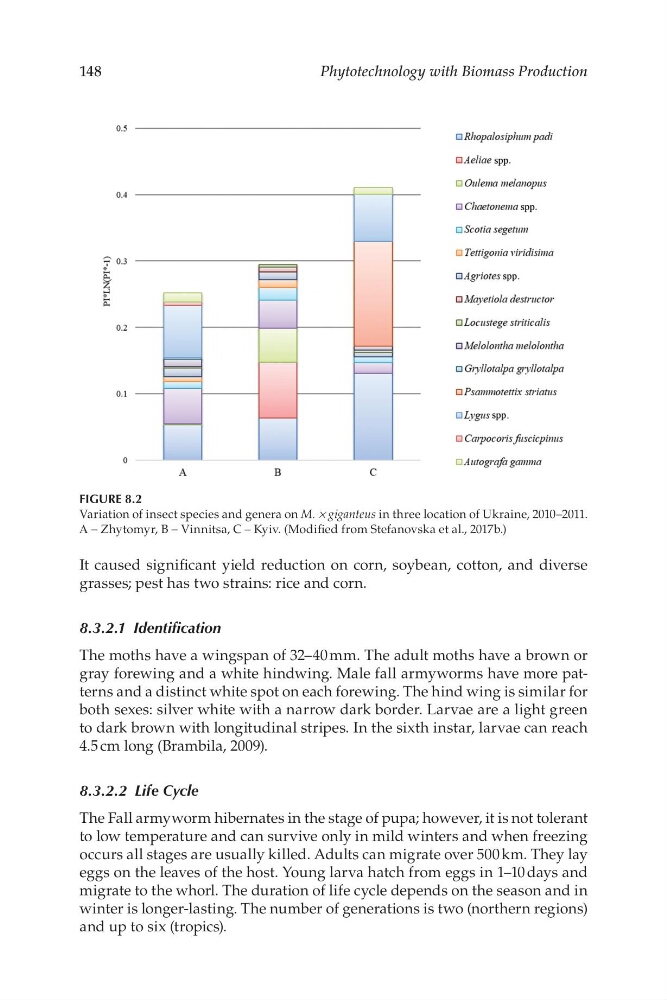
FIGURE 8.2
Variation of insect species and genera on M. × giganteus in three location of Ukraine, 2010–2011.
А − Zhytomyr, B − Vinnitsa, C – Kyiv. (Modified from Stefanovska et al., 2017b.)
It caused significant yield reduction on corn, soybean, cotton, and diverse
grasses; pest has two strains: rice and corn.
8.3.2.1 Identification
The moths have a wingspan of 32–40 mm. The adult moths have a brown or
gray forewing and a white hindwing. Male fall armyworms have more patterns and a distinct white spot on each forewing. The hind wing is similar for
both sexes: silver white with a narrow dark border. Larvae are a light green
to dark brown with longitudinal stripes. In the sixth instar, larvae can reach
4.5 cm long (Brambila, 2009).
8.3.2.2 Life Cycle
The Fall armyworm hibernates in the stage of pupa; however, it is not tolerant
to low temperature and can survive only in mild winters and when freezing
occurs all stages are usually killed. Adults can migrate over 500 km. They lay
eggs on the leaves of the host. Young larva hatch from eggs in 1–10 days and
migrate to the whorl. The duration of life cycle depends on the season and in
winter is longer-lasting. The number of generations is two (northern regions)
and up to six (tropics).
Phytotechnology with Biomass Production
FIGURE 8.2
Variation of insect species and genera on M. × giganteus in three location of Ukraine, 2010–2011.
А − Zhytomyr, B − Vinnitsa, C – Kyiv. (Modified from Stefanovska et al., 2017b.)
It caused significant yield reduction on corn, soybean, cotton, and diverse
grasses; pest has two strains: rice and corn.
8.3.2.1 Identification
The moths have a wingspan of 32–40 mm. The adult moths have a brown or
gray forewing and a white hindwing. Male fall armyworms have more patterns and a distinct white spot on each forewing. The hind wing is similar for
both sexes: silver white with a narrow dark border. Larvae are a light green
to dark brown with longitudinal stripes. In the sixth instar, larvae can reach
4.5 cm long (Brambila, 2009).
8.3.2.2 Life Cycle
The Fall armyworm hibernates in the stage of pupa; however, it is not tolerant
to low temperature and can survive only in mild winters and when freezing
occurs all stages are usually killed. Adults can migrate over 500 km. They lay
eggs on the leaves of the host. Young larva hatch from eggs in 1–10 days and
migrate to the whorl. The duration of life cycle depends on the season and in
winter is longer-lasting. The number of generations is two (northern regions)
and up to six (tropics).