

129
Plant-Microbe Associations
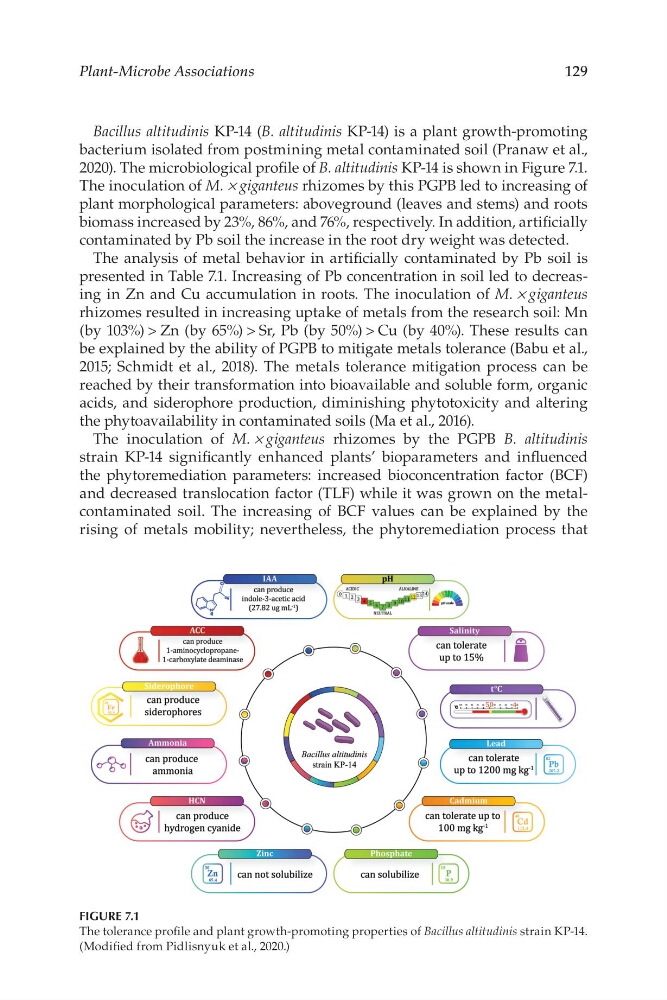
Bacillus altitudinis KP-14 (B. altitudinis KP-14) is a plant growth-promoting
bacterium isolated from postmining metal contaminated soil (Pranaw et al.,
2020). The microbiological profile of B. altitudinis KP-14 is shown in Figure 7.1.
The inoculation of M. × giganteus rhizomes by this PGPB led to increasing of
plant morphological parameters: aboveground (leaves and stems) and roots
biomass increased by 23%, 86%, and 76%, respectively. In addition, artificially
contaminated by Pb soil the increase in the root dry weight was detected.
The analysis of metal behavior in artificially contaminated by Pb soil is
presented in Table 7.1. Increasing of Pb concentration in soil led to decreasing in Zn and Cu accumulation in roots. The inoculation of M. × giganteus
rhizomes resulted in increasing uptake of metals from the research soil: Mn
(by 103%) > Zn (by 65%) > Sr, Pb (by 50%) > Cu (by 40%). These results can
be explained by the ability of PGPB to mitigate metals tolerance (Babu et al.,
2015; Schmidt et al., 2018). The metals tolerance mitigation process can be
reached by their transformation into bioavailable and soluble form, organic
acids, and siderophore production, diminishing phytotoxicity and altering
the phytoavailability in contaminated soils (Ma et al., 2016).
The inoculation of M. × giganteus rhizomes by the PGPB B. altitudinis
strain KP-14 significantly enhanced plants’ bioparameters and influenced
the phytoremediation parameters: increased bioconcentration factor (BCF)
and decreased translocation factor (TLF) while it was grown on the metalcontaminated soil. The increasing of BCF values can be explained by the
rising of metals mobility; nevertheless, the phytoremediation process that
FIGURE 7.1
The tolerance profile and plant growth-promoting properties of Bacillus altitudinis strain KP-14.
(Modified from Pidlisnyuk et al., 2020.)
Plant-Microbe Associations
Bacillus altitudinis KP-14 (B. altitudinis KP-14) is a plant growth-promoting
bacterium isolated from postmining metal contaminated soil (Pranaw et al.,
2020). The microbiological profile of B. altitudinis KP-14 is shown in Figure 7.1.
The inoculation of M. × giganteus rhizomes by this PGPB led to increasing of
plant morphological parameters: aboveground (leaves and stems) and roots
biomass increased by 23%, 86%, and 76%, respectively. In addition, artificially
contaminated by Pb soil the increase in the root dry weight was detected.
The analysis of metal behavior in artificially contaminated by Pb soil is
presented in Table 7.1. Increasing of Pb concentration in soil led to decreasing in Zn and Cu accumulation in roots. The inoculation of M. × giganteus
rhizomes resulted in increasing uptake of metals from the research soil: Mn
(by 103%) > Zn (by 65%) > Sr, Pb (by 50%) > Cu (by 40%). These results can
be explained by the ability of PGPB to mitigate metals tolerance (Babu et al.,
2015; Schmidt et al., 2018). The metals tolerance mitigation process can be
reached by their transformation into bioavailable and soluble form, organic
acids, and siderophore production, diminishing phytotoxicity and altering
the phytoavailability in contaminated soils (Ma et al., 2016).
The inoculation of M. × giganteus rhizomes by the PGPB B. altitudinis
strain KP-14 significantly enhanced plants’ bioparameters and influenced
the phytoremediation parameters: increased bioconcentration factor (BCF)
and decreased translocation factor (TLF) while it was grown on the metalcontaminated soil. The increasing of BCF values can be explained by the
rising of metals mobility; nevertheless, the phytoremediation process that
FIGURE 7.1
The tolerance profile and plant growth-promoting properties of Bacillus altitudinis strain KP-14.
(Modified from Pidlisnyuk et al., 2020.)