

83
Miscanthus Production
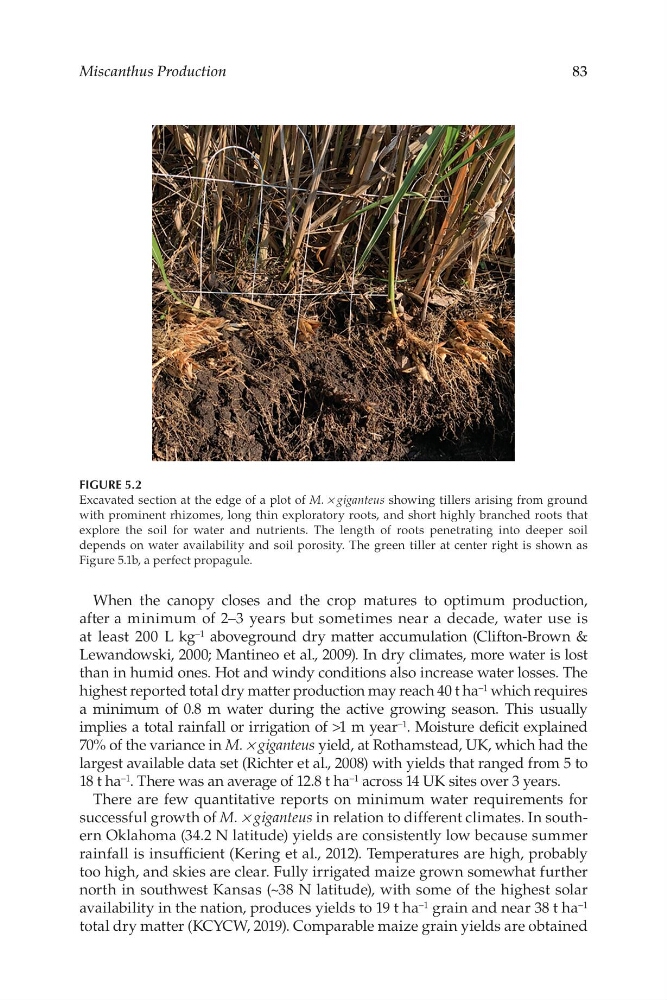
FIGURE 5.2
Excavated section at the edge of a plot of M. × giganteus showing tillers arising from ground
with prominent rhizomes, long thin exploratory roots, and short highly branched roots that
explore the soil for water and nutrients. The length of roots penetrating into deeper soil
depends on water availability and soil porosity. The green tiller at center right is shown as
Figure 5.1b, a perfect propagule.
When the canopy closes and the crop matures to optimum production,
after a minimum of 2–3 years but sometimes near a decade, water use is
at least 200 L kg −1 aboveground dry matter accumulation (Clifton-Brown &
Lewandowski, 2000; Mantineo et al., 2009). In dry climates, more water is lost
than in humid ones. Hot and windy conditions also increase water losses. The
highest reported total dry matter production may reach 40 t ha −1 which requires
a minimum of 0.8 m water during the active growing season. This usually
implies a total rainfall or irrigation of >1 m year −1 . Moisture deficit explained
70% of the variance in M. × giganteus yield, at Rothamstead, UK, which had the
largest available data set (Richter et al., 2008) with yields that ranged from 5 to
18 t ha −1 . There was an average of 12.8 t ha −1 across 14 UK sites over 3 years.
There are few quantitative reports on minimum water requirements for
successful growth of M. × giganteus in relation to different climates. In southern Oklahoma (34.2 N latitude) yields are consistently low because summer
rainfall is insufficient (Kering et al., 2012). Temperatures are high, probably
too high, and skies are clear. Fully irrigated maize grown somewhat further
north in southwest Kansas (~38 N latitude), with some of the highest solar
availability in the nation, produces yields to 19 t ha −1 grain and near 38 t ha −1
total dry matter (KCYCW, 2019). Comparable maize grain yields are obtained
Miscanthus Production
FIGURE 5.2
Excavated section at the edge of a plot of M. × giganteus showing tillers arising from ground
with prominent rhizomes, long thin exploratory roots, and short highly branched roots that
explore the soil for water and nutrients. The length of roots penetrating into deeper soil
depends on water availability and soil porosity. The green tiller at center right is shown as
Figure 5.1b, a perfect propagule.
When the canopy closes and the crop matures to optimum production,
after a minimum of 2–3 years but sometimes near a decade, water use is
at least 200 L kg −1 aboveground dry matter accumulation (Clifton-Brown &
Lewandowski, 2000; Mantineo et al., 2009). In dry climates, more water is lost
than in humid ones. Hot and windy conditions also increase water losses. The
highest reported total dry matter production may reach 40 t ha −1 which requires
a minimum of 0.8 m water during the active growing season. This usually
implies a total rainfall or irrigation of >1 m year −1 . Moisture deficit explained
70% of the variance in M. × giganteus yield, at Rothamstead, UK, which had the
largest available data set (Richter et al., 2008) with yields that ranged from 5 to
18 t ha −1 . There was an average of 12.8 t ha −1 across 14 UK sites over 3 years.
There are few quantitative reports on minimum water requirements for
successful growth of M. × giganteus in relation to different climates. In southern Oklahoma (34.2 N latitude) yields are consistently low because summer
rainfall is insufficient (Kering et al., 2012). Temperatures are high, probably
too high, and skies are clear. Fully irrigated maize grown somewhat further
north in southwest Kansas (~38 N latitude), with some of the highest solar
availability in the nation, produces yields to 19 t ha −1 grain and near 38 t ha −1
total dry matter (KCYCW, 2019). Comparable maize grain yields are obtained