

66
Trace Elements in Abiotic and Biotic Environments
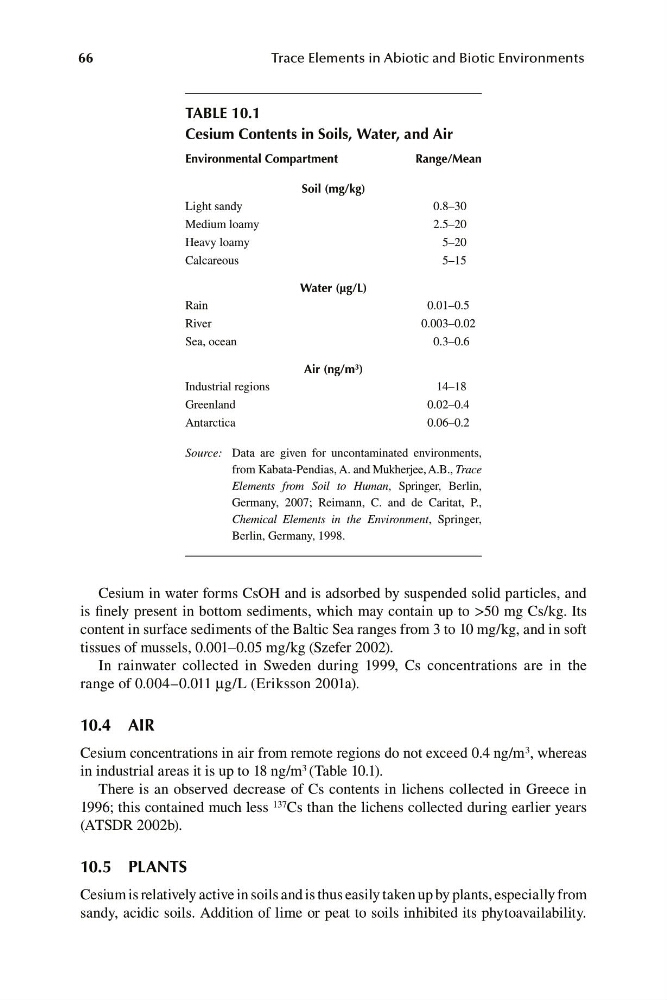
TABLE 10.1
Cesium Contents in Soils, Water, and Air
Environmental Compartment
Range/Mean
Soil (mg/kg)
Light sandy
0.8–30
Medium loamy
2.5–20
Heavy loamy
5–20
Calcareous
5–15
Water (μg/L)
Rain
0.01–0.5
River
0.003–0.02
Sea, ocean
0.3–0.6
Air (ng/m 3 )
Industrial regions
14–18
Greenland
0.02–0.4
Antarctica
0.06–0.2
Source: Data are given for uncontaminated environments,
from Kabata-Pendias, A. and Mukherjee, A.B., Trace
Elements from Soil to Human, Springer, Berlin,
Germany, 2007; Reimann, C. and de Caritat, P.,
Chemical Elements in the Environ ment, Springer,
Berlin, Germany, 1998.
Cesium in water forms CsOH and is adsorbed by suspended solid particles, and
is finely present in bottom sediments, which may contain up to >50 mg Cs/kg. Its
content in surface sediments of the Baltic Sea ranges from 3 to 10 mg/kg, and in soft
tissues of mussels, 0.001–0.05 mg/kg (Szefer 2002).
In rainwater collected in Sweden during 1999, Cs concentrations are in the
range of 0.004–0.011 μg/L (Eriksson 2001a).
10.4 AIR
Cesium concentrations in air from remote regions do not exceed 0.4 ng/m 3 , whereas
in industrial areas it is up to 18 ng/m 3 (Table 10.1).
There is an observed decrease of Cs contents in lichens collected in Greece in
1996; this contained much less 137 Cs than the lichens collected during earlier years
(ATSDR 2002b).
10.5 PLANTS
Cesium is relatively active in soils and is thus easily taken up by plants, especially from
sandy, acidic soils. Addition of lime or peat to soils inhibited its phytoavailability.