

60
Trace Elements in Abiotic and Biotic Environments
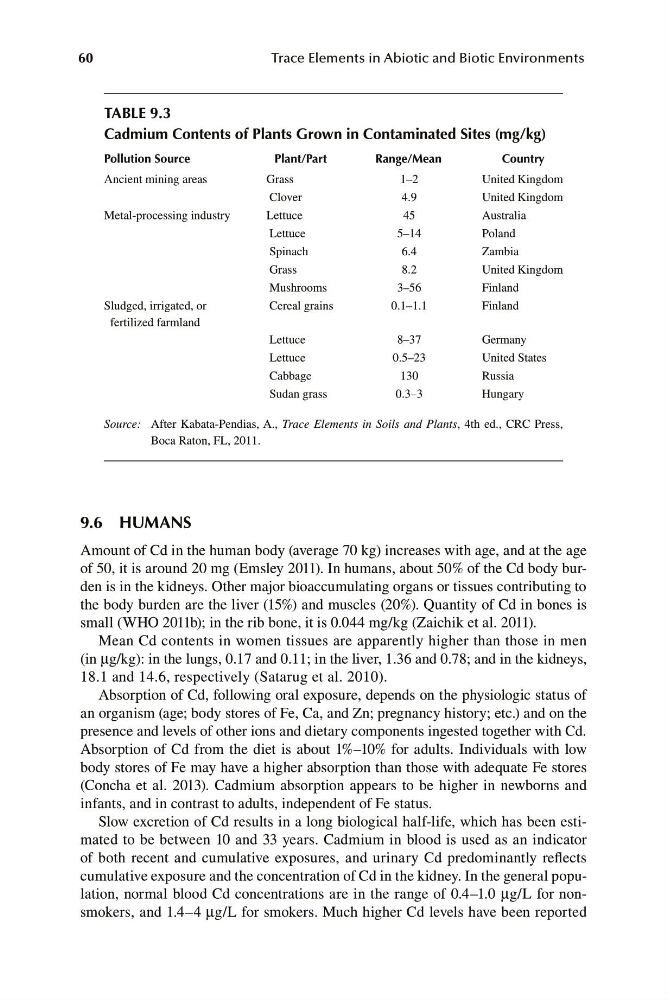
TABLE 9.3
Cadmium Contents of Plants Grown in Contaminated Sites (mg/kg)
Pollution Source
Plant/Part
Range/Mean
Country
Ancient mining areas
Grass
1–2
United Kingdom
Clover
4.9
United Kingdom
Metal-processing industry
Lettuce
45
Australia
Lettuce
5–14
Poland
Spinach
6.4
Zambia
Grass
8.2
United Kingdom
Mushrooms
3–56
Finland
Sludged, irrigated, or
fertilized farmland
Cereal grains
0.1–1.1
Finland
Lettuce
8–37
Germany
Lettuce
0.5–23
United States
Cabbage
130
Russia
Sudan grass
0.3–3
Hungary
Source: After Kabata-Pendias, A., Trace Elements in Soils and Plants, 4th ed., CRC Press,
Boca Raton, FL, 2011.
9.6 HUMANS
Amount of Cd in the human body (average 70 kg) increases with age, and at the age
of 50, it is around 20 mg (Emsley 2011). In humans, about 50% of the Cd body burden is in the kidneys. Other major bioaccumulating organs or tissues contributing to
the body burden are the liver (15%) and muscles (20%). Quantity of Cd in bones is
small (WHO 2011b); in the rib bone, it is 0.044 mg/kg (Zaichik et al. 2011).
Mean Cd contents in women tissues are apparently higher than those in men
(in μg/kg): in the lungs, 0.17 and 0.11; in the liver, 1.36 and 0.78; and in the kidneys,
18.1 and 14.6, respectively (Satarug et al. 2010).
Absorption of Cd, following oral exposure, depends on the physiologic status of
an organism (age; body stores of Fe, Ca, and Zn; pregnancy history; etc.) and on the
presence and levels of other ions and dietary components ingested together with Cd.
Absorption of Cd from the diet is about 1%–10% for adults. Individuals with low
body stores of Fe may have a higher absorption than those with adequate Fe stores
(Concha et al. 2013). Cadmium absorption appears to be higher in newborns and
infants, and in contrast to adults, independent of Fe status.
Slow excretion of Cd results in a long biological half-life, which has been estimated to be between 10 and 33 years. Cadmium in blood is used as an indicator
of both recent and cumulative exposures, and urinary Cd predominantly reflects
cumulative exposure and the concentration of Cd in the kidney. In the general population, normal blood Cd concentrations are in the range of 0.4–1.0 μg/L for nonsmokers, and 1.4–4 μg/L for smokers. Much higher Cd levels have been reported