

51
Bromine [Br, 35]
is very similar to I, it can take the place of I, which results in less I for the thyroid
gland, and may also increase the elimination of I from the body.
One type of Br compounds, diphenyl ether (PBDE), appears to be building up in
people living in the United States. PBDEs are used in electronic equipment and furniture. The United States is the world’s largest producer of PBDEs. Americans have 10
to 20 times more PBDEs in the body than the Europeans. Europeans have double the
amount of PBDEs than the Japanese (West 2008).
BFRs, including PBDEs, have been used at increasing levels in home furnishings
and electronics over the past 25 years. BFRs are ubiquitous industrial chemicals,
and many of them are produced in large volumes. Due to this fact, several BFRs are
found in quantifiable levels in wildlife, as well as in humans (Darnerud 2003). High
PBDE levels have been detected in food, household dust, and indoor air, with subsequent appearance in animal and human tissues. When these data are considered
in the combination with the stage-dependent effects of thyroid hormone on brain
development, which are also implicated in autistic brains, a hypothesis that PBDEs
might also serve as autism risk factors emerges to seem to be true (Messer 2010).
Some Br compounds were classified by International Agency for Research on
Cancer (IARC) as potentially carcinogens: K bromate group 2B; bromochloroacetic
acid group 2B; bromochloroacetonitrile group 3; bromodichloromethane group 2B;
bromoethane group 3; and bromoform group 3 (IARC 2013).
Methyl bromide is widely used for fumigating postharvest commodities, such as
wheat and cereals, spices, nuts, dried and fresh fruits, and tobacco. Methyl bromide
concentrations usually decrease rapidly after aeration and residues are not detectable
after some weeks. Some foods, such as nuts, seeds, and fatty foods, such as cheese,
tend to retain methyl bromide and inorganic bromide.
In postharvest fumigation, it is possible that methyl bromide itself, as well as
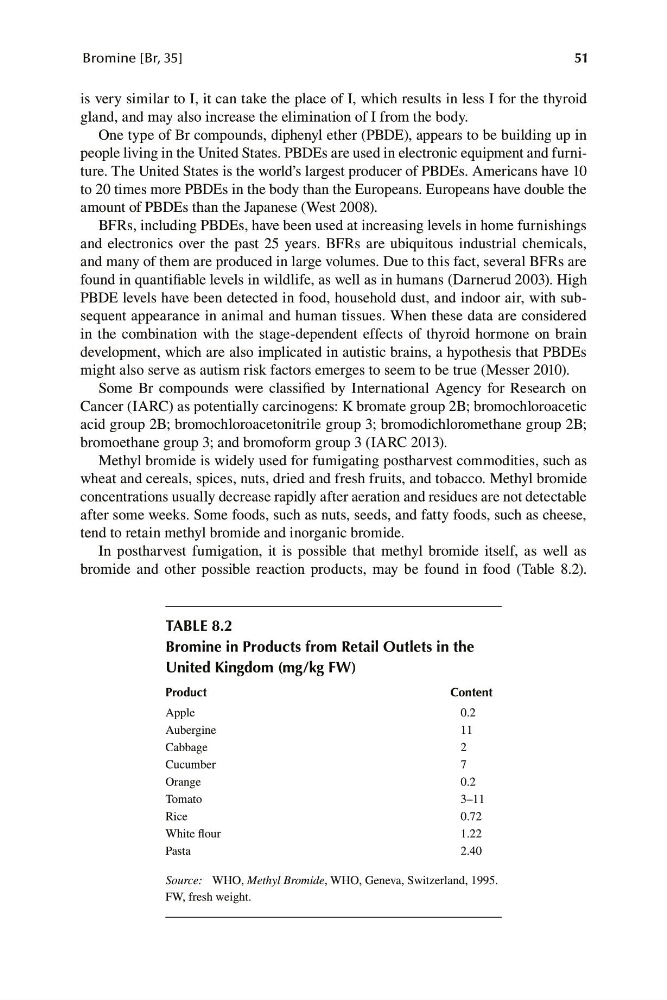
bromide and other possible reaction products, may be found in food (Table 8.2).
TABLE 8.2
Bromine in Products from Retail Outlets in the
United Kingdom (mg/kg FW)
Product
Content
Apple
Aubergine
Cabbage
Cucumber
0.2
11
2
7
Orange
Tomato
0.2
3–11
Rice
0.72
White flour
1.22
Pasta
2.40
Source: WHO, Methyl Bromide, WHO, Geneva, Switzerland, 1995.
FW, fresh weight.