

48
Trace Elements in Abiotic and Biotic Environments
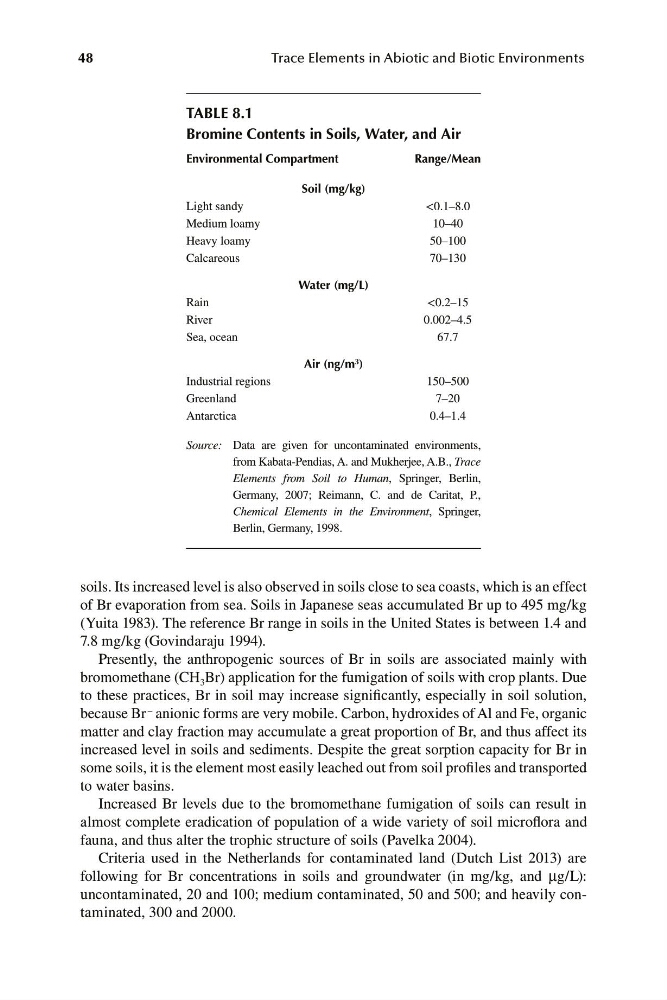
TABLE 8.1
Bromine Contents in Soils, Water, and Air
Environmental Compartment
Range/Mean
Soil (mg/kg)
Light sandy
<0.1–8.0
Medium loamy
10–40
Heavy loamy
50–100
Calcareous
70–130
Water (mg/L)
Rain
<0.2–15
River
0.002–4.5
Sea, ocean
67.7
Air (ng/m 3 )
Industrial regions
150–500
Greenland
7–20
Antarctica
0.4–1.4
Source: Data are given for uncontaminated environments,
from Kabata-Pendias, A. and Mukherjee, A.B., Trace
Elements from Soil to Human, Springer, Berlin,
Germany, 2007; Reimann, C. and de Caritat, P.,
Chemical Elements in the Environment, Springer,
Berlin, Germany, 1998.
soils. Its increased level is also observed in soils close to sea coasts, which is an effect
of Br evaporation from sea. Soils in Japanese seas accumulated Br up to 495 mg/kg
(Yuita 1983). The reference Br range in soils in the United States is between 1.4 and
7.8 mg/kg (Govindaraju 1994).
Presently, the anthropogenic sources of Br in soils are associated mainly with
bromomethane (CH 3 Br) application for the fumigation of soils with crop plants. Due
to these practices, Br in soil may increase significantly, especially in soil solution,
because Br – anionic forms are very mobile. Carbon, hydroxides of Al and Fe, organic
matter and clay fraction may accumulate a great proportion of Br, and thus affect its
increased level in soils and sediments. Despite the great sorption capacity for Br in
some soils, it is the element most easily leached out from soil profiles and transported
to water basins.
Increased Br levels due to the bromomethane fumigation of soils can result in
almost complete eradication of population of a wide variety of soil microflora and
fauna, and thus alter the trophic structure of soils (Pavelka 2004).
Criteria used in the Netherlands for contaminated land (Dutch List 2013) are
following for Br concentrations in soils and groundwater (in mg/kg, and μg/L):
uncontaminated, 20 and 100; medium contaminated, 50 and 500; and heavily contaminated, 300 and 2000.