

38
Trace Elements in Abiotic and Biotic Environments
TABLE 6.2
Bismuth in Foodstuffs (μg/kg FW)
Product
Content
Food of Plant Origin
Bread
<1
Miscellaneous cereals
<1
Sugar and preserves
5
Vegetables
0.5
Potatoes
0.4
Fruits
0.3
Food of Animal Origin
Meat products
<0.5
Poultry
<0.5
Fish
0.6
Milk
2.0
Dairy products
6.4
Source: Rose, M. et al., Food Addit. Contam., 27,
1380–1404, 2010. With permission.
FW, fresh weight.
After the ingestion of inorganic Bi, the intestinal microbiota, in particular
methanoarchaea, are capable of methylating inorganic Bi to soluble, partially methylated compounds, such as monomethyl (MMBi) and dimethylbismuth (DMBi), as
well as volatile trimethylbismuth (TMBi). TMBi is characterized by a higher volatility and hydrophobicity in comparison with inorganic Bi, and can be therefore easily distributed inside the human body, and is able to pass the blood–brain barrier
(Bialek et al. 2011).
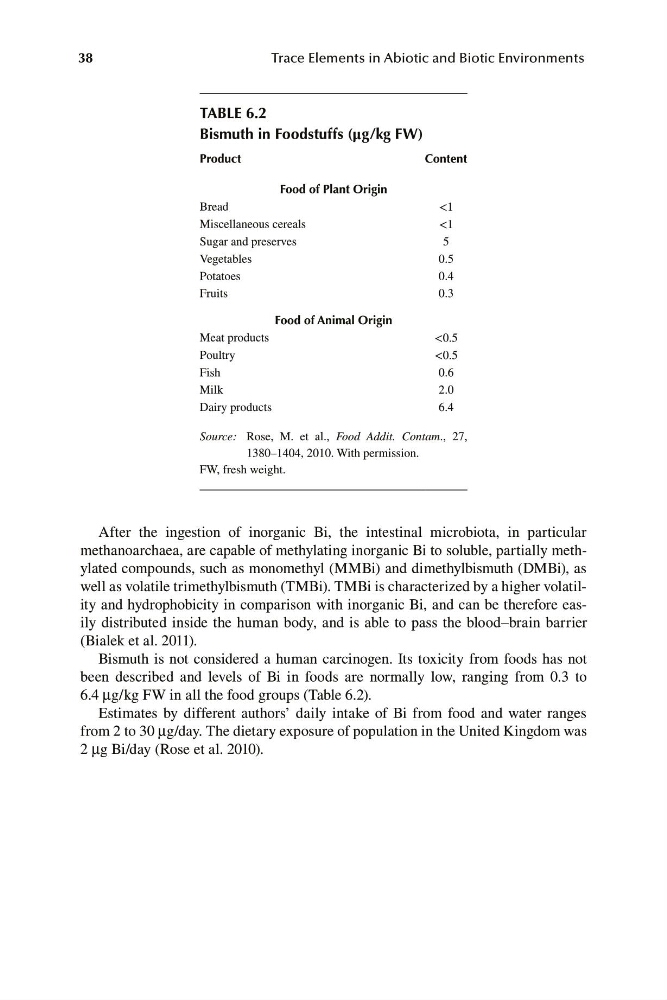
Bismuth is not considered a human carcinogen. Its toxicity from foods has not
been described and levels of Bi in foods are normally low, ranging from 0.3 to
6.4 μg/kg FW in all the food groups (Table 6.2).
Estimates by different authors’ daily intake of Bi from food and water ranges
from 2 to 30 μg/day. The dietary exposure of population in the United Kingdom was
2 μg Bi/day (Rose et al. 2010).
Trace Elements in Abiotic and Biotic Environments
TABLE 6.2
Bismuth in Foodstuffs (μg/kg FW)
Product
Content
Food of Plant Origin
Bread
<1
Miscellaneous cereals
<1
Sugar and preserves
5
Vegetables
0.5
Potatoes
0.4
Fruits
0.3
Food of Animal Origin
Meat products
<0.5
Poultry
<0.5
Fish
0.6
Milk
2.0
Dairy products
6.4
Source: Rose, M. et al., Food Addit. Contam., 27,
1380–1404, 2010. With permission.
FW, fresh weight.
After the ingestion of inorganic Bi, the intestinal microbiota, in particular
methanoarchaea, are capable of methylating inorganic Bi to soluble, partially methylated compounds, such as monomethyl (MMBi) and dimethylbismuth (DMBi), as
well as volatile trimethylbismuth (TMBi). TMBi is characterized by a higher volatility and hydrophobicity in comparison with inorganic Bi, and can be therefore easily distributed inside the human body, and is able to pass the blood–brain barrier
(Bialek et al. 2011).
Bismuth is not considered a human carcinogen. Its toxicity from foods has not
been described and levels of Bi in foods are normally low, ranging from 0.3 to
6.4 μg/kg FW in all the food groups (Table 6.2).
Estimates by different authors’ daily intake of Bi from food and water ranges
from 2 to 30 μg/day. The dietary exposure of population in the United Kingdom was
2 μg Bi/day (Rose et al. 2010).