

30
Trace Elements in Abiotic and Biotic Environments
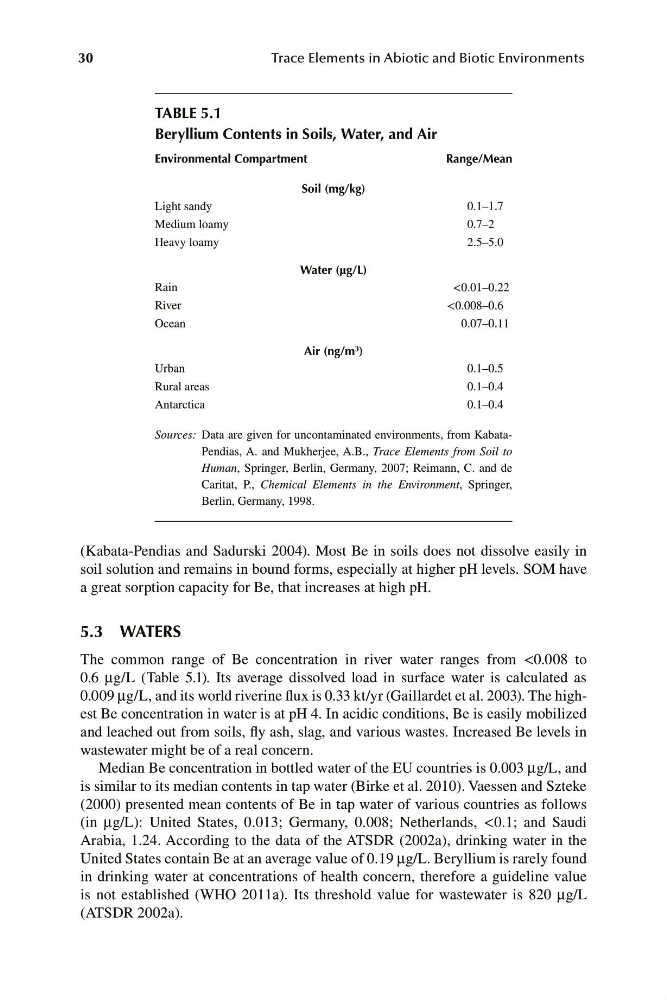
TABLE 5.1
Beryllium Contents in Soils, Water, and Air
Environmental Compartment
Range/Mean
Soil (mg/kg)
Light sandy
0.1–1.7
Medium loamy
0.7–2
Heavy loamy
2.5–5.0
Water (μg/L)
Rain
<0.01–0.22
River
<0.008–0.6
Ocean
0.07–0.11
Air (ng/m 3 )
Urban
0.1–0.5
Rural areas
0.1–0.4
Antarctica
0.1–0.4
Sources: Data are given for uncontaminated environments, from KabataPendias, A. and Mukherjee, A.B., Trace Elements from Soil to
Human, Springer, Berlin, Germany, 2007; Reimann, C. and de
Caritat, P., Chemical Elements in the Envi ronment, Springer,
Berlin, Germany, 1998.
(Kabata-Pendias and Sadurski 2004). Most Be in soils does not dissolve easily in
soil solution and remains in bound forms, especially at higher pH levels. SOM have
a great sorption capacity for Be, that increases at high pH.
5.3 WATERS
The common range of Be concentration in river water ranges from <0.008 to
0.6 μg/L (Table 5.1). Its average dissolved load in surface water is calculated as
0.009 μg/L, and its world riverine flux is 0.33 kt/yr (Gaillardet et al. 2003). The highest Be concentration in water is at pH 4. In acidic conditions, Be is easily mobilized
and leached out from soils, fly ash, slag, and various wastes. Increased Be levels in
wastewater might be of a real concern.
Median Be concentration in bottled water of the EU countries is 0.003 μg/L, and
is similar to its median contents in tap water (Birke et al. 2010). Vaessen and Szteke
(2000) presented mean contents of Be in tap water of various countries as follows
(in μg/L): United States, 0.013; Germany, 0.008; Netherlands, <0.1; and Saudi
Arabia, 1.24. According to the data of the ATSDR (2002a), drinking water in the
United States contain Be at an average value of 0.19 μg/L. Beryllium is rarely found
in drinking water at concentrations of health concern, therefore a guideline value
is not established (WHO 2011a). Its threshold value for wastewater is 820 μg/L
(ATSDR 2002a).