

Product
Content
Food of Plant Origin
Bread
0.81
Miscellaneous cereals
0.74
Potatoes
0.17
Green vegetables
Root vegetables a
Fresh fruits
0.465
0.92
0.422
Fruits a
1.29
Sweeteners, honey, and confectionery b
Beer, different country of origin c
Curry, samples d
0.045–5.10
0.016–0.068
0.632–5.85
Food of Animal Origin
Carcass meat
0.03
Meat products
Fish and fish products b
Eggs
Milk e
0.33
0.045–0.945
0.33
0.026
Dairy products
0.22
26
Trace Elements in Abiotic and Biotic Environments
Studies in rodents and dogs estimated an oral absorption between 7% and 85%. In
humans, once absorbed, 90% of the Ba in the body is deposited into the bones. There
is no evidence that Ba undergoes biotransformation other than as a divalent cation
(SCHER 2012).
Soluble Ba compounds would generally expect to be of greater health concern
than insoluble Ba compounds, because of their greater potential for absorption.
Various Ba compounds have different solubilities in water and body fluids, and therefore serve as variable sources of the Ba 2+ ion. This ion and the soluble compounds
of Ba (notably chloride, nitrate, and hydroxide) are toxic to humans. Although Ba
carbonate is relatively insoluble in water, it is toxic to humans, because it is soluble
in the gastrointestinal tract. However, Ba sulfate or other insoluble Ba compounds
may potentially be toxic when it is introduced into the gastrointestinal tract under
conditions where there is colon cancer or perforations of the gastrointestinal tract,
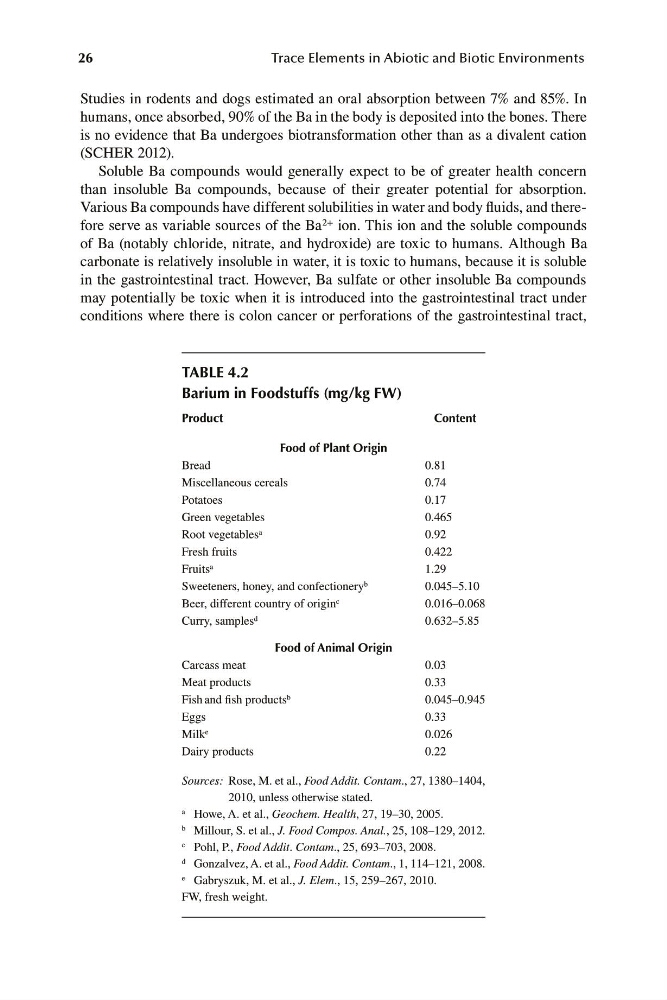
TABLE 4.2
Barium in Foodstuffs (mg/kg FW)
Sources: Rose, M. et al., Food Addit. Contam., 27, 1380–1404,
2010, unless otherwise stated.
a Howe, A. et al., Geochem. Health, 27, 19–30, 2005.
b Millour, S. et al., J. Food Compos. Anal., 25, 108–129, 2012.
c Pohl, P., Food Addit. Contam., 25, 693–703, 2008.
d Gonzalvez, A. et al., Food Addit. Contam., 1, 114–121, 2008.
e Gabryszuk, M. et al., J. Elem., 15, 259–267, 2010.
FW, fresh weight.
Content
Food of Plant Origin
Bread
0.81
Miscellaneous cereals
0.74
Potatoes
0.17
Green vegetables
Root vegetables a
Fresh fruits
0.465
0.92
0.422
Fruits a
1.29
Sweeteners, honey, and confectionery b
Beer, different country of origin c
Curry, samples d
0.045–5.10
0.016–0.068
0.632–5.85
Food of Animal Origin
Carcass meat
0.03
Meat products
Fish and fish products b
Eggs
Milk e
0.33
0.045–0.945
0.33
0.026
Dairy products
0.22
26
Trace Elements in Abiotic and Biotic Environments
Studies in rodents and dogs estimated an oral absorption between 7% and 85%. In
humans, once absorbed, 90% of the Ba in the body is deposited into the bones. There
is no evidence that Ba undergoes biotransformation other than as a divalent cation
(SCHER 2012).
Soluble Ba compounds would generally expect to be of greater health concern
than insoluble Ba compounds, because of their greater potential for absorption.
Various Ba compounds have different solubilities in water and body fluids, and therefore serve as variable sources of the Ba 2+ ion. This ion and the soluble compounds
of Ba (notably chloride, nitrate, and hydroxide) are toxic to humans. Although Ba
carbonate is relatively insoluble in water, it is toxic to humans, because it is soluble
in the gastrointestinal tract. However, Ba sulfate or other insoluble Ba compounds
may potentially be toxic when it is introduced into the gastrointestinal tract under
conditions where there is colon cancer or perforations of the gastrointestinal tract,
TABLE 4.2
Barium in Foodstuffs (mg/kg FW)
Sources: Rose, M. et al., Food Addit. Contam., 27, 1380–1404,
2010, unless otherwise stated.
a Howe, A. et al., Geochem. Health, 27, 19–30, 2005.
b Millour, S. et al., J. Food Compos. Anal., 25, 108–129, 2012.
c Pohl, P., Food Addit. Contam., 25, 693–703, 2008.
d Gonzalvez, A. et al., Food Addit. Contam., 1, 114–121, 2008.
e Gabryszuk, M. et al., J. Elem., 15, 259–267, 2010.
FW, fresh weight.