

24
Trace Elements in Abiotic and Biotic Environments
TABLE 4.1
Barium Contents in Soils, Water, and Air
Environmental Compartment
Range/Mean
Soil (mg/kg)
Light sandy
85–780
Medium loamy
200–1500
Heavy loamy
200–1500
Organic
10–700
Water (μg/L)
Rain
0.33–1.2
River
4.0–73
Sea, ocean
2.0–15
Air (ng/m 3 )
Urban
>100
Rural areas
0.2–90
Antarctica
0.02–0.73
Sources: Data are given for uncontaminated environments, from KabataPendias, A. and Mukherjee, A.B., Trace Elements from Soil to
Human, Springer, Berlin, Germany, 2007; Reimann, C. and de
Caritat, P., Chemical Elements in the Environment, Springer,
Berlin, Germany, 1998.
for Ba. Often, Ba occurs as hollandite, an easily soluble mineral, which affected its
mobility, and, in aridic soils, its upward migration.
Barium source may be from some aerial deposition, especially from the surroundings of P-fertilizer plants. In most cases, Ba input from aerial sources and with P
fertilizers increases its output (leaching and plant uptake), and the Ba budget in rural
soils is slowly increasing. Barium is found in most land soils at low levels; however,
it may be at higher levels at hazardous waste sites.
4.3 WATERS
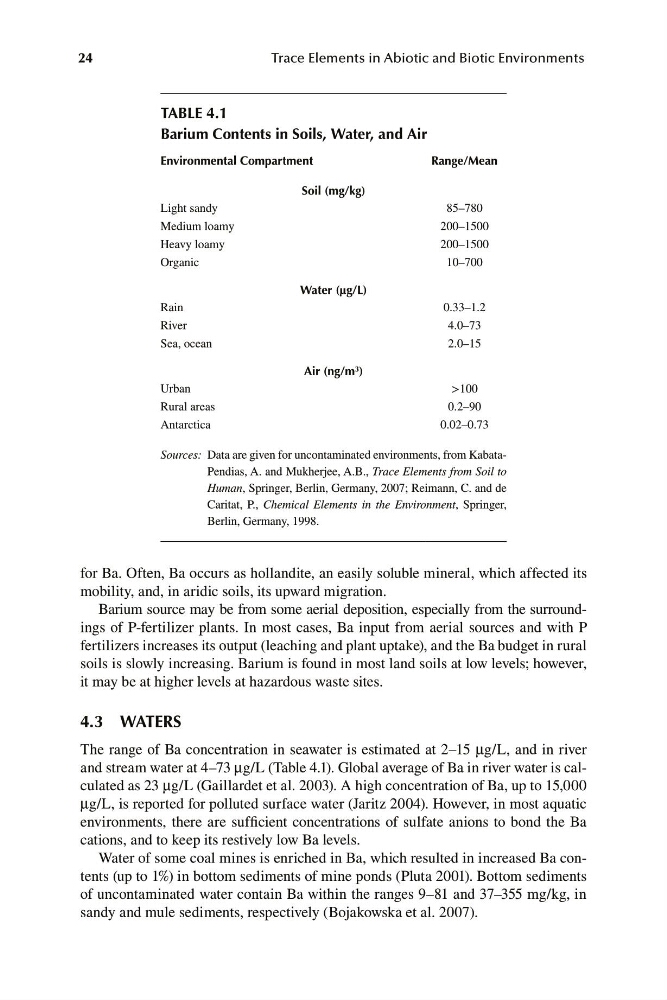
The range of Ba concentration in seawater is estimated at 2–15 μg/L, and in river
and stream water at 4–73 μg/L (Table 4.1). Global average of Ba in river water is calculated as 23 μg/L (Gaillardet et al. 2003). A high concentration of Ba, up to 15,000
μg/L, is reported for polluted surface water (Jaritz 2004). However, in most aquatic
environments, there are sufficient concentrations of sulfate anions to bond the Ba
cations, and to keep its restively low Ba levels.
Water of some coal mines is enriched in Ba, which resulted in increased Ba contents (up to 1%) in bottom sediments of mine ponds (Pluta 2001). Bottom sediments
of uncontaminated water contain Ba within the ranges 9–81 and 37–355 mg/kg, in
sandy and mule sediments, respectively (Bojakowska et al. 2007).