

21
Arsenic [As, 33]
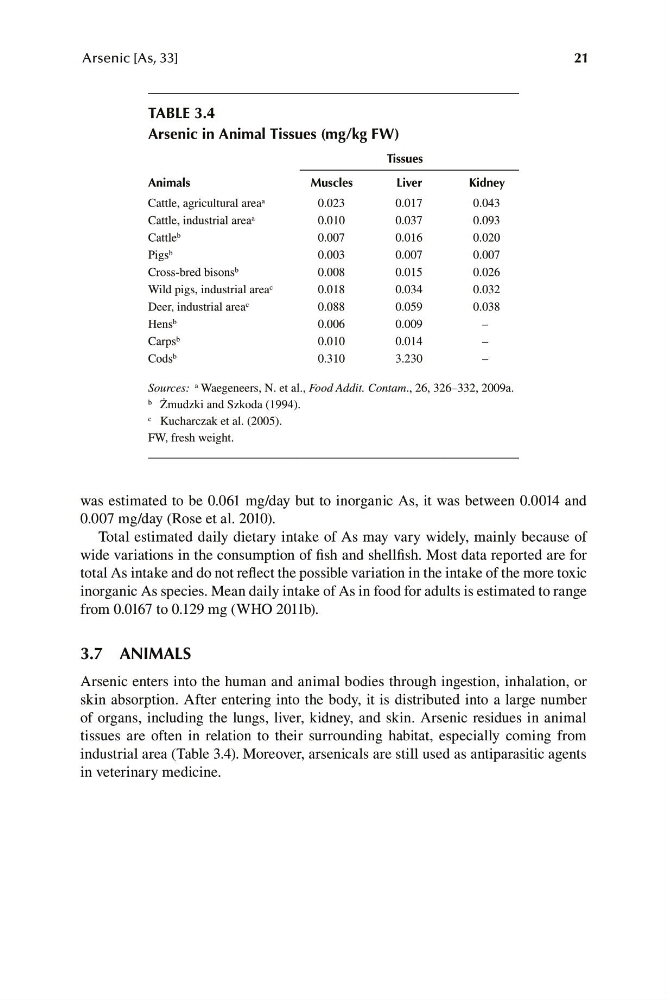
TABLE 3.4
Arsenic in Animal Tissues (mg/kg FW)
Tissues
Animals
Muscles
Liver
Kidney
Cattle, agricultural area a
0.023
0.017
0.043
Cattle, industrial area a
0.010
0.037
0.093
Cattle b
0.007
0.016
0.020
Pigs b
0.003
0.007
0.007
Cross-bred bisons b
0.008
0.015
0.026
Wild pigs, industrial area c
0.018
0.034
0.032
Deer, industrial area c
0.088
0.059
0.038
Hens b
0.006
0.009
–
Carps b
0.010
0.014
–
Cods b
0.310
3.230
–
Sources: a Waegeneers, N. et al., Food Addit. Contam., 26, 326–332, 2009a.
b Żmudzki and Szkoda (1994).
c Kucharczak et al. (2005).
FW, fresh weight.
was estimated to be 0.061 mg/day but to inorganic As, it was between 0.0014 and
0.007 mg/day (Rose et al. 2010).
Total estimated daily dietary intake of As may vary widely, mainly because of
wide variations in the consumption of fish and shellfish. Most data reported are for
total As intake and do not reflect the possible variation in the intake of the more toxic
inorganic As species. Mean daily intake of As in food for adults is estimated to range
from 0.0167 to 0.129 mg (WHO 2011b).
3.7 ANIMALS
Arsenic enters into the human and animal bodies through ingestion, inhalation, or
skin absorption. After entering into the body, it is distributed into a large number
of organs, including the lungs, liver, kidney, and skin. Arsenic residues in animal
tissues are often in relation to their surrounding habitat, especially coming from
industrial area (Table 3.4). Moreover, arsenicals are still used as antiparasitic agents
in veterinary medicine.