

Actinides
389
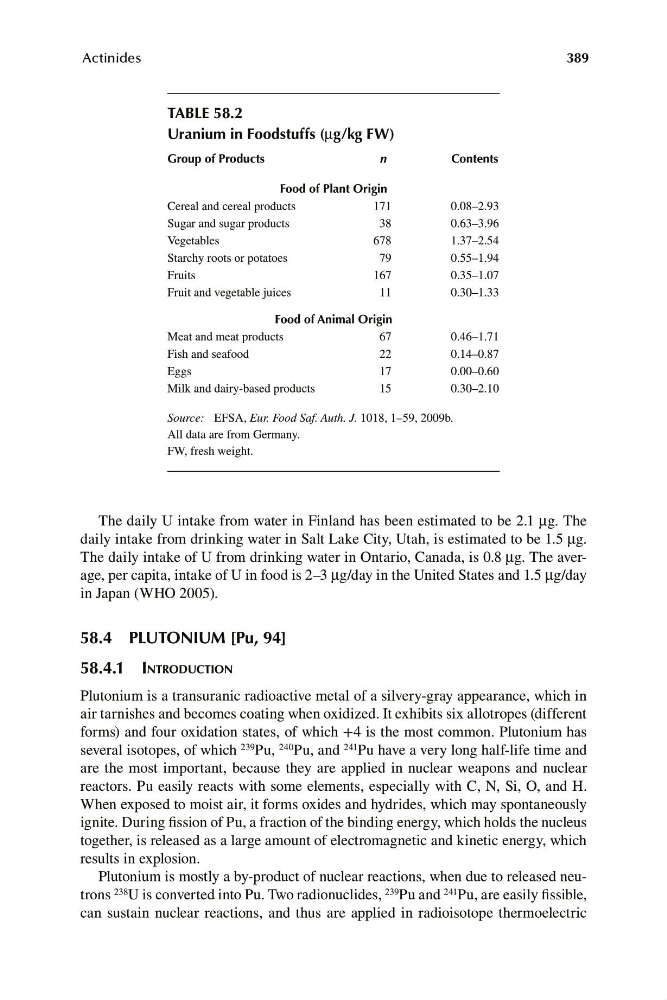
TABLE 58.2
Uranium in Foodstuffs (μg/kg FW)
Group of Products
n
Contents
Food of Plant Origin
Cereal and cereal products
171
0.08–2.93
Sugar and sugar products
38
0.63–3.96
Vegetables
678
1.37–2.54
Starchy roots or potatoes
79
0.55–1.94
Fruits
167
0.35–1.07
Fruit and vegetable juices
11
0.30–1.33
Food of Animal Origin
Meat and meat products
67
0.46–1.71
Fish and seafood
22
0.14–0.87
Eggs
17
0.00–0.60
Milk and dairy-based products
15
0.30–2.10
Source: EFSA, Eur. Food Saf. Auth. J. 1018, 1–59, 2009b.
All data are from Germany.
FW, fresh weight.
The daily U intake from water in Finland has been estimated to be 2.1 μg. The
daily intake from drinking water in Salt Lake City, Utah, is estimated to be 1.5 μg.
The daily intake of U from drinking water in Ontario, Canada, is 0.8 μg. The average, per capita, intake of U in food is 2–3 μg/day in the United States and 1.5 μg/day
in Japan (WHO 2005).
58.4 PLUTONIUM [Pu, 94]
58.4.1 INTRODUCTION
Plutonium is a transuranic radioactive metal of a silvery-gray appearance, which in
air tarnishes and becomes coating when oxidized. It exhibits six allotropes (different
forms) and four oxidation states, of which +4 is the most common. Plutonium has
several isotopes, of which 239 Pu, 240 Pu, and 241 Pu have a very long half-life time and
are the most important, because they are applied in nuclear weapons and nuclear
reactors. Pu easily reacts with some elements, especially with C, N, Si, O, and H.
When exposed to moist air, it forms oxides and hydrides, which may spontaneously
ignite. During fission of Pu, a fraction of the binding energy, which holds the nucleus
together, is released as a large amount of electromagnetic and kinetic energy, which
results in explosion.
Plutonium is mostly a by-product of nuclear reactions, when due to released neutrons 238 U is converted into Pu. Two radionuclides, 239 Pu and 241 Pu, are easily fissible,
can sustain nuclear reactions, and thus are applied in radioisotope thermoelectric
389
TABLE 58.2
Uranium in Foodstuffs (μg/kg FW)
Group of Products
n
Contents
Food of Plant Origin
Cereal and cereal products
171
0.08–2.93
Sugar and sugar products
38
0.63–3.96
Vegetables
678
1.37–2.54
Starchy roots or potatoes
79
0.55–1.94
Fruits
167
0.35–1.07
Fruit and vegetable juices
11
0.30–1.33
Food of Animal Origin
Meat and meat products
67
0.46–1.71
Fish and seafood
22
0.14–0.87
Eggs
17
0.00–0.60
Milk and dairy-based products
15
0.30–2.10
Source: EFSA, Eur. Food Saf. Auth. J. 1018, 1–59, 2009b.
All data are from Germany.
FW, fresh weight.
The daily U intake from water in Finland has been estimated to be 2.1 μg. The
daily intake from drinking water in Salt Lake City, Utah, is estimated to be 1.5 μg.
The daily intake of U from drinking water in Ontario, Canada, is 0.8 μg. The average, per capita, intake of U in food is 2–3 μg/day in the United States and 1.5 μg/day
in Japan (WHO 2005).
58.4 PLUTONIUM [Pu, 94]
58.4.1 INTRODUCTION
Plutonium is a transuranic radioactive metal of a silvery-gray appearance, which in
air tarnishes and becomes coating when oxidized. It exhibits six allotropes (different
forms) and four oxidation states, of which +4 is the most common. Plutonium has
several isotopes, of which 239 Pu, 240 Pu, and 241 Pu have a very long half-life time and
are the most important, because they are applied in nuclear weapons and nuclear
reactors. Pu easily reacts with some elements, especially with C, N, Si, O, and H.
When exposed to moist air, it forms oxides and hydrides, which may spontaneously
ignite. During fission of Pu, a fraction of the binding energy, which holds the nucleus
together, is released as a large amount of electromagnetic and kinetic energy, which
results in explosion.
Plutonium is mostly a by-product of nuclear reactions, when due to released neutrons 238 U is converted into Pu. Two radionuclides, 239 Pu and 241 Pu, are easily fissible,
can sustain nuclear reactions, and thus are applied in radioisotope thermoelectric