

368
Trace Elements in Abiotic and Biotic Environments
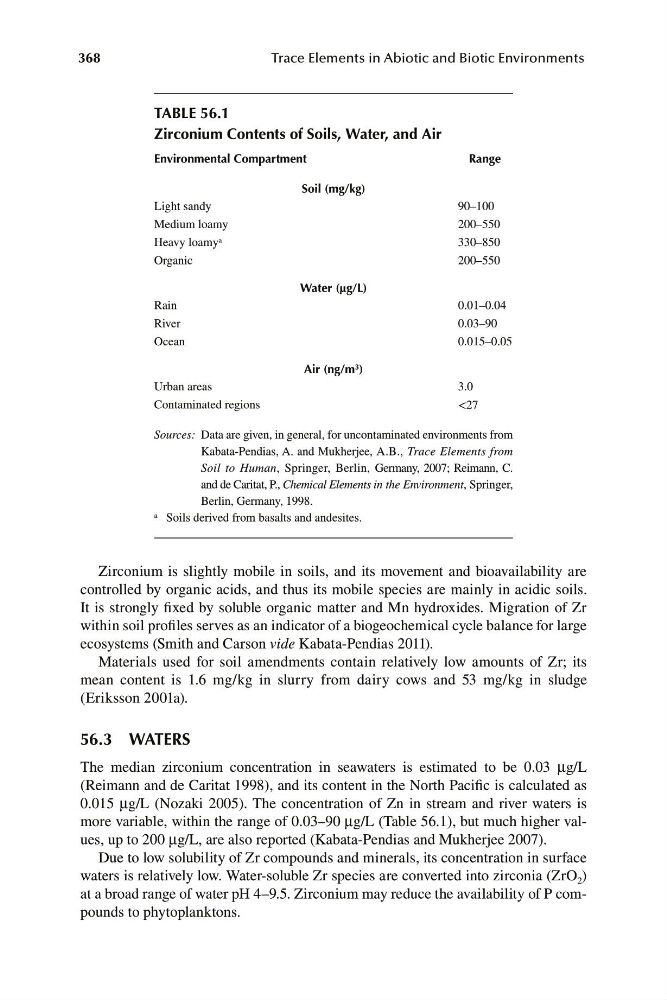
TABLE 56.1
Zirconium Contents of Soils, Water, and Air
Environmental Compartment
Range
Soil (mg/kg)
Light sandy
90–100
Medium loamy
200–550
Heavy loamy a
330–850
Organic
200–550
Water (μg/L)
Rain
0.01–0.04
River
0.03–90
Ocean
0.015–0.05
Air (ng/m 3 )
Urban areas
3.0
Contaminated regions
<27
Sources: Data are given, in general, for uncontaminated environments from
Kabata-Pendias, A. and Mukherjee, A.B., Trace Elements from
Soil to Human, Springer, Berlin, Ger many, 2007; Reimann, C.
and de Caritat, P., Chemical Ele ments in the Environment, Springer,
Berlin, Germany, 1998.
a Soils derived from basalts and andesites.
Zirconium is slightly mobile in soils, and its movement and bioavailability are
controlled by organic acids, and thus its mobile species are mainly in acidic soils.
It is strongly fixed by soluble organic matter and Mn hydroxides. Migration of Zr
within soil profiles serves as an indicator of a biogeochemical cycle balance for large
ecosystems (Smith and Carson vide Kabata-Pendias 2011).
Materials used for soil amendments contain relatively low amounts of Zr; its
mean content is 1.6 mg/kg in slurry from dairy cows and 53 mg/kg in sludge
(Eriksson 2001a).
56.3 WATERS
The median zirconium concentration in seawaters is estimated to be 0.03 μg/L
(Reimann and de Caritat 1998), and its content in the North Pacific is calculated as
0.015 μg/L (Nozaki 2005). The concentration of Zn in stream and river waters is
more variable, within the range of 0.03–90 μg/L (Table 56.1), but much higher values, up to 200 μg/L, are also reported (Kabata-Pendias and Mukherjee 2007).
Due to low solubility of Zr compounds and minerals, its concentration in surface
waters is relatively low. Water-soluble Zr species are converted into zirconia (ZrO 2 )
at a broad range of water pH 4–9.5. Zirconium may reduce the availability of P compounds to phytoplanktons.