

356
Trace Elements in Abiotic and Biotic Environments
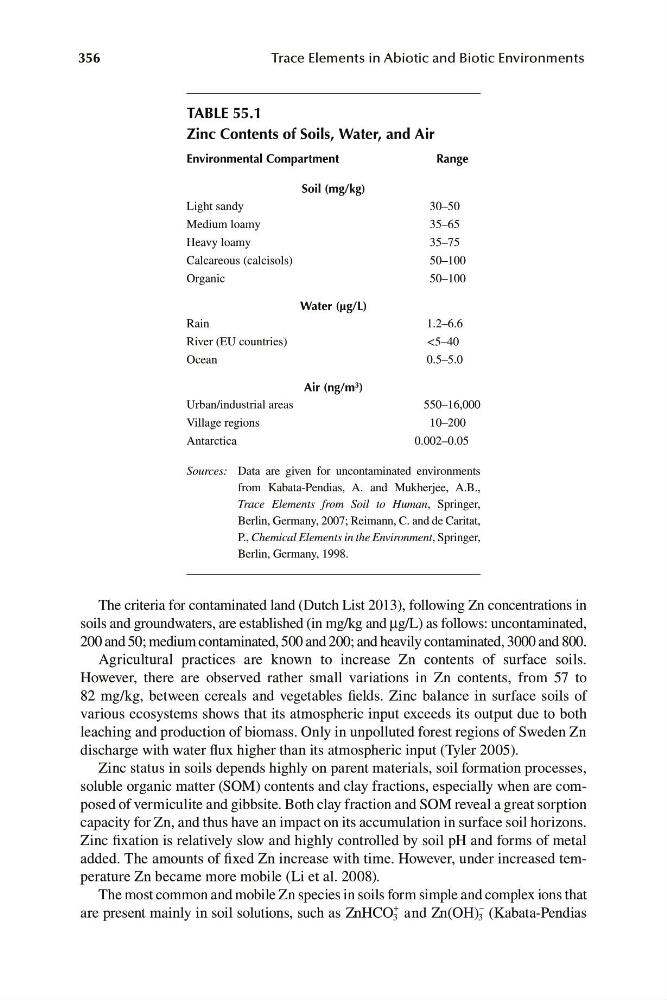
TABLE 55.1
Zinc Contents of Soils, Water, and Air
Environmental Compartment
Range
Soil (mg/kg)
Light sandy
30–50
Medium loamy
35–65
Heavy loamy
35–75
Calcareous (calcisols)
50–100
Organic
50–100
Water (μg/L)
Rain
1.2–6.6
River (EU countries)
<5–40
Ocean
0.5–5.0
Air (ng/m 3 )
Urban/industrial areas
550–16,000
Village regions
10–200
Antarctica
0.002–0.05
Sources: Data are given for uncontaminated environments
from Kabata-Pendias, A. and Mukherjee, A.B.,
Trace Elements from Soil to Human, Springer,
Berlin, Germany, 2007; Reimann, C. and de Caritat,
P., Chemical Elements in the Envi ronment, Springer,
Berlin, Germany, 1998.
The criteria for contaminated land (Dutch List 2013), following Zn concentrations in
soils and groundwaters, are established (in mg/kg and μg/L) as follows: uncontaminated,
200 and 50; medium contaminated, 500 and 200; and heavily contaminated, 3000 and 800.
Agricultural practices are known to increase Zn contents of surface soils.
However, there are observed rather small variations in Zn contents, from 57 to
82 mg/kg, between cereals and vegetables fields. Zinc balance in surface soils of
various ecosystems shows that its atmospheric input exceeds its output due to both
leaching and production of biomass. Only in unpolluted forest regions of Sweden Zn
discharge with water flux higher than its atmospheric input (Tyler 2005).
Zinc status in soils depends highly on parent materials, soil formation processes,
soluble organic matter (SOM) contents and clay fractions, especially when are composed of vermiculite and gibbsite. Both clay fraction and SOM reveal a great sorption
capacity for Zn, and thus have an impact on its accumulation in surface soil horizons.
Zinc fixation is relatively slow and highly controlled by soil pH and forms of metal
added. The amounts of fixed Zn increase with time. However, under increased temperature Zn became more mobile (Li et al. 2008).
The most common and mobile Zn species in soils form simple and complex ions that
+
are present mainly in soil solutions, such as ZnHCO 3 and Zn(OH) 3
(Kabata-Pendias