

330
Trace Elements in Abiotic and Biotic Environments
TABLE 50.1
Tin Contents of Soils, Water, and Air
Environmental Compartment
Range Mean
Soil (mg/kg)
Light sandy
<0.1–2.0
Medium loamy
0.3–2.0
Heavy loamy
0.3–4.0
Calcerous (calcisols)
<0.1–2.0
Organic
0.2–7.9
Water (μg/L)
River
0.005–1.2
Sea and ocean
0.003–0.05
Air (ng/m 3 )
Urban areas
2–800
Industrial areas
<5000
Remote regions
2–70
Sources: Data are given for uncontaminated environments from KabataPendias, A. and Mukherjee, A.B., Trace Elements from Soil to
Human, Springer, Berlin, Germany, 2007; Reimann, C. and
de Caritat, P., Chemical Elements in the Envi ronment, Springer,
Berlin, Germany, 1998.
The mobility of Sn during weathering is relatively high and pH dependent. The
common cation, Sn 2+ , is a strong reducing agent and occurs mainly in acidic and
reducing soils. The mobile Sn species follow the behavior of Fe and Al, and remain
in weathered residues with hydroxides of these metals. Inorganic Sn compounds may
be methylated by microorganisms in both soils and waters. However, these compounds are also demethylated.
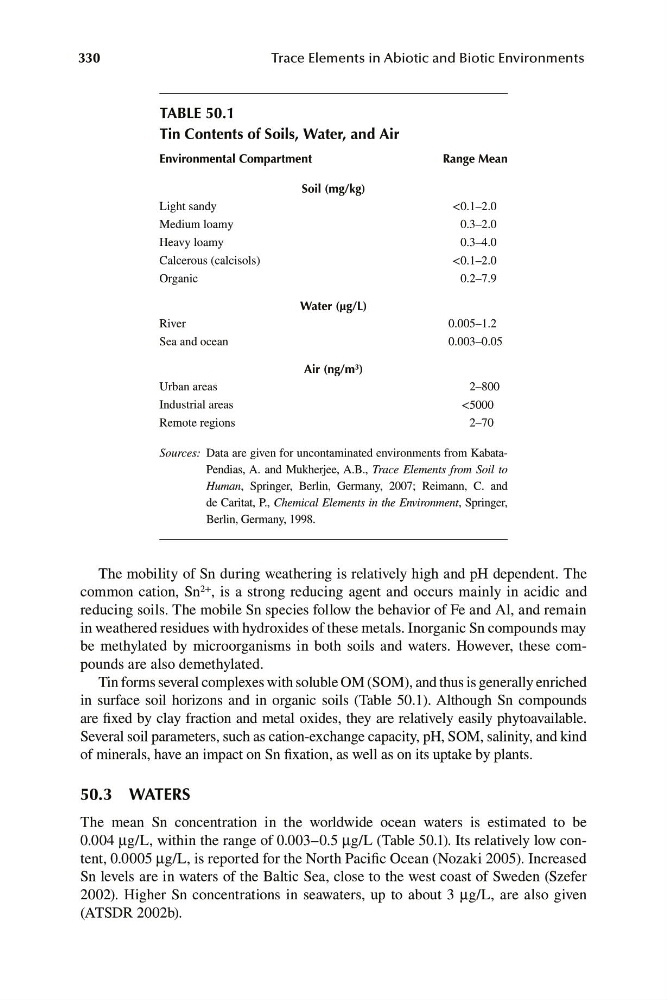
Tin forms several complexes with soluble OM (SOM), and thus is generally enriched
in surface soil horizons and in organic soils (Table 50.1). Although Sn compounds
are fixed by clay fraction and metal oxides, they are relatively easily phytoavailable.
Several soil parameters, such as cation-exchange capacity, pH, SOM, salinity, and kind
of minerals, have an impact on Sn fixation, as well as on its uptake by plants.
50.3 WATERS
The mean Sn concentration in the worldwide ocean waters is estimated to be
0.004 μg/L, within the range of 0.003–0.5 μg/L (Table 50.1). Its relatively low content, 0.0005 μg/L, is reported for the North Pacific Ocean (Nozaki 2005). Increased
Sn levels are in waters of the Baltic Sea, close to the west coast of Sweden (Szefer
2002). Higher Sn concentrations in seawaters, up to about 3 μg/L, are also given
(ATSDR 2002b).