

321
Tellurium [Te, 52]
are generally considered as less toxic, compared to inorganic, such as tellurate and
tellurite. This may in part be due to different pharmacological and pharmacokinetic
profiles, and different metabolic conversions inside the human body (Ba et al. 2010).
Organotellurium compounds are potentially toxic and lethal to rodents at low doses.
Tellurides can cause cytotoxicity, hepatotoxicity, neurotoxicity, teratogenicity, and
genotoxicity. Moreover, these compounds can inhibit sulfhydryl-containing enzymes,
such as the Na + /K + -adenosine triphosphatase (ATPase), the δ-aminolevulinic acid
dehydratase, and the squalene monooxygenase. The mechanisms of toxicity by organotellurium compounds may be related to the oxidation of thiol groups of important
biomolecules, the replacement of Se in selenoproteins, and the capacity of Te compounds to induce the formation of reactive oxygen species. Antioxidant properties
of Te compounds, including antitumor and chemoprotective effects, have also been
observed (Zemolin et al. 2013).
Despite many chemical homologies between Se and Te, a nutritional role has
never been identified for Te. Applications of organic telluranes as protease inhibitors and Te applications in disease models are the most recent contribution to the
scenario of its biological effects (Cunha et al. 2009).
Tellurium nanoparticles (TeNPs) can be used as antibacterial reagents against
Escherichia coli. Compared to Ag nanoparticles that are commonly used as antibacterial
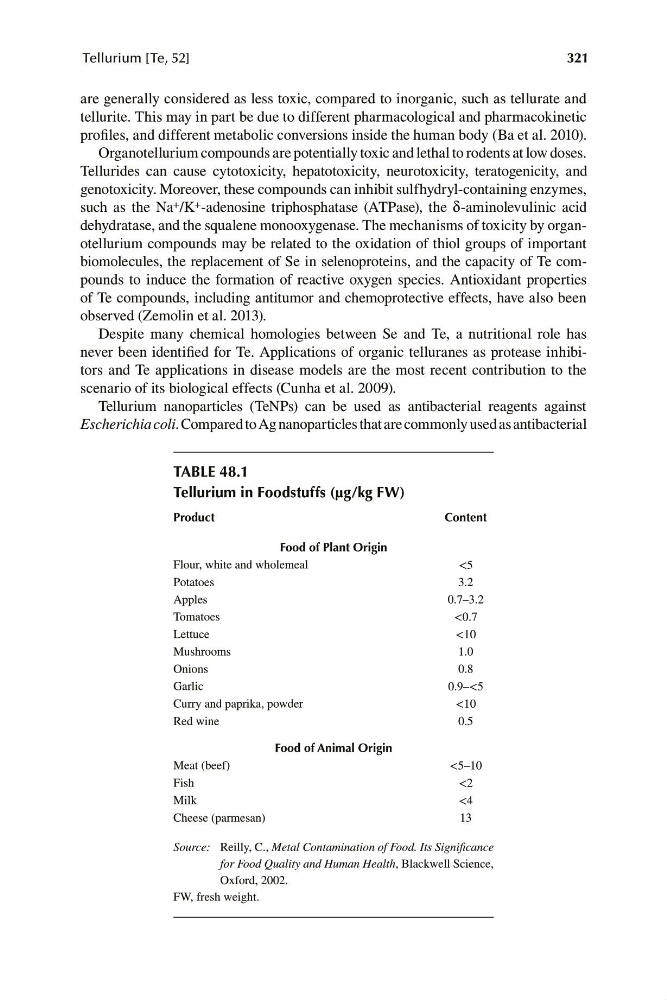
TABLE 48.1
Tellurium in Foodstuffs (μg/kg FW)
Product
Content
Food of Plant Origin
Flour, white and wholemeal
<5
Potatoes
3.2
Apples
0.7–3.2
Tomatoes
<0.7
Lettuce
<10
Mushrooms
1.0
Onions
0.8
Garlic
0.9–<5
Curry and paprika, powder
<10
Red wine
0.5
Food of Animal Origin
Meat (beef)
<5–10
Fish
<2
Milk
<4
Cheese (parmesan)
13
Source: Reilly, C., Metal Contamination of Food. Its Significance
for Food Quality and Human Health, Blackwell Science,
Oxford, 2002.
FW, fresh weight.
Tellurium [Te, 52]
are generally considered as less toxic, compared to inorganic, such as tellurate and
tellurite. This may in part be due to different pharmacological and pharmacokinetic
profiles, and different metabolic conversions inside the human body (Ba et al. 2010).
Organotellurium compounds are potentially toxic and lethal to rodents at low doses.
Tellurides can cause cytotoxicity, hepatotoxicity, neurotoxicity, teratogenicity, and
genotoxicity. Moreover, these compounds can inhibit sulfhydryl-containing enzymes,
such as the Na + /K + -adenosine triphosphatase (ATPase), the δ-aminolevulinic acid
dehydratase, and the squalene monooxygenase. The mechanisms of toxicity by organotellurium compounds may be related to the oxidation of thiol groups of important
biomolecules, the replacement of Se in selenoproteins, and the capacity of Te compounds to induce the formation of reactive oxygen species. Antioxidant properties
of Te compounds, including antitumor and chemoprotective effects, have also been
observed (Zemolin et al. 2013).
Despite many chemical homologies between Se and Te, a nutritional role has
never been identified for Te. Applications of organic telluranes as protease inhibitors and Te applications in disease models are the most recent contribution to the
scenario of its biological effects (Cunha et al. 2009).
Tellurium nanoparticles (TeNPs) can be used as antibacterial reagents against
Escherichia coli. Compared to Ag nanoparticles that are commonly used as antibacterial
TABLE 48.1
Tellurium in Foodstuffs (μg/kg FW)
Product
Content
Food of Plant Origin
Flour, white and wholemeal
<5
Potatoes
3.2
Apples
0.7–3.2
Tomatoes
<0.7
Lettuce
<10
Mushrooms
1.0
Onions
0.8
Garlic
0.9–<5
Curry and paprika, powder
<10
Red wine
0.5
Food of Animal Origin
Meat (beef)
<5–10
Fish
<2
Milk
<4
Cheese (parmesan)
13
Source: Reilly, C., Metal Contamination of Food. Its Significance
for Food Quality and Human Health, Blackwell Science,
Oxford, 2002.
FW, fresh weight.