

311
Strontium [Sr, 38]
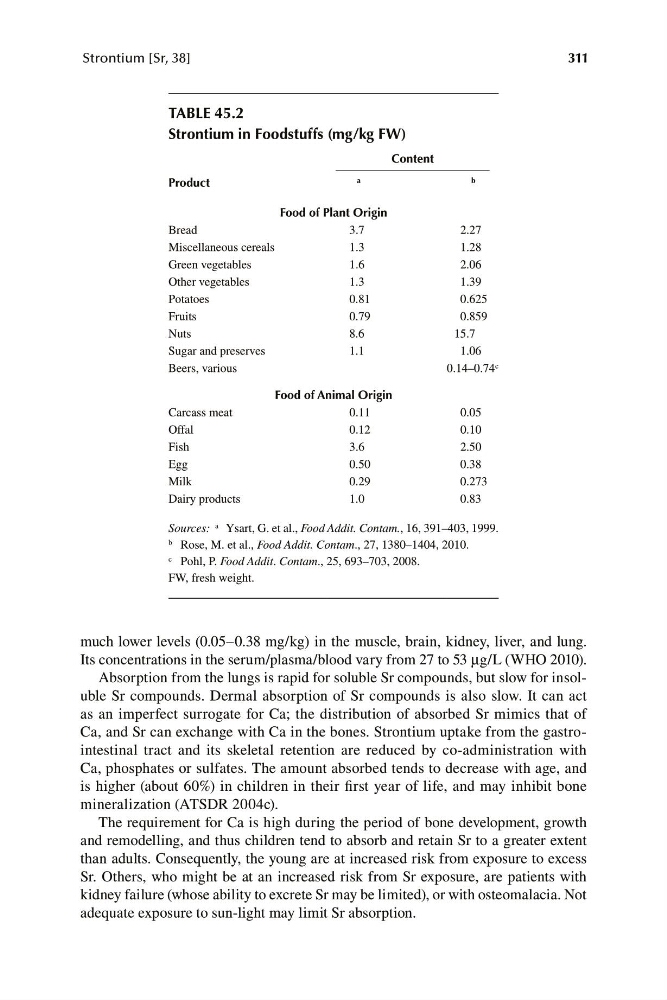
TABLE 45.2
Strontium in Foodstuffs (mg/kg FW)
Content
Product
a
b
Food of Plant Origin
Bread
3.7
2.27
Miscellaneous cereals
1.3
1.28
Green vegetables
1.6
2.06
Other vegetables
1.3
1.39
Potatoes
0.81
0.625
Fruits
0.79
0.859
Nuts
8.6
15.7
Sugar and preserves
1.1
1.06
Beers, various
0.14–0.74 c
Food of Animal Origin
Carcass meat
0.11
0.05
Offal
0.12
0.10
Fish
3.6
2.50
Egg
0.50
0.38
Milk
0.29
0.273
Dairy products
1.0
0.83
a
Sources: Ysart, G. et al., Food Addit. Contam., 16, 391–403, 1999.
b Rose, M. et al., Food Addit. Contam., 27, 1380–1404, 2010.
c Pohl, P. Food Addit. Contam., 25, 693–703, 2008.
FW, fresh weight.
much lower levels (0.05–0.38 mg/kg) in the muscle, brain, kidney, liver, and lung.
Its concentrations in the serum/plasma/blood vary from 27 to 53 μg/L (WHO 2010).
Absorption from the lungs is rapid for soluble Sr compounds, but slow for insoluble Sr compounds. Dermal absorption of Sr compounds is also slow. It can act
as an imperfect surrogate for Ca; the distribution of absorbed Sr mimics that of
Ca, and Sr can exchange with Ca in the bones. Strontium uptake from the gastrointestinal tract and its skeletal retention are reduced by co-administration with
Ca, phosphates or sulfates. The amount absorbed tends to decrease with age, and
is higher (about 60%) in children in their first year of life, and may inhibit bone
mineralization (ATSDR 2004c).
The requirement for Ca is high during the period of bone development, growth
and remodelling, and thus children tend to absorb and retain Sr to a greater extent
than adults. Consequently, the young are at increased risk from exposure to excess
Sr. Others, who might be at an increased risk from Sr exposure, are patients with
kidney failure (whose ability to excrete Sr may be limited), or with osteomalacia. Not
adequate exposure to sun-light may limit Sr absorption.