

308
Trace Elements in Abiotic and Biotic Environments
TABLE 45.1
Strontium Contents of Soils, Water, and Air (mg/kg)
Environmental Compartment
Range
Soil (mg/kg)
Light sandy
Medium loamy
Heavy loamy
Calcerous (calcisols)
Organic (histosols)
5–1000
20–1000
20–3100
5–1000
70–500
Water (μg/L)
Rain
0.5–383
River
2–238
Sea
8000 a
Air (ng/m 3 )
Urban areas
20–50
Antarctica
0.8
Sources: Data are given for uncontaminated environments from KabataPendias, A. and Mukherjee, A.B., Trace Elements from Soil to
Human, Springer, Berlin, Germany, 2007; Reimann, C. and
de Caritat, P., Chemical Elements in the Environment, Springer,
Berlin, Germany, 1998.
a Mean value.
the predominated cation, Sr 2+ , is likely to be sorbed in hydrated form by clay minerals and Fe oxides and hydroxides. In calcareous soils, Sr may be precipitated (e.g., as
strontianite), which decreases its phytoavailability. When a ratio of Ca:Sr is less than 8,
the Sr phytotoxicity may occur. Displacement of Sr by Ca in various compounds has
practical implications in the reclamation of contaminated soils. In acidic soils, Sr is
likely to be leached down, whereas in calcareous soils and soils rich in soluble OM,
it may be concentrated in the upper horizons.
The main sources of Sr pollution are from coal combustions and sulfur mining and processing. Phosphorites may contain elevated amounts of Sr, up to about
2000 mg/kg; thus, P fertilizers are a source of elevated Sr amounts in soils. Also soil
amendment materials may have increased Sr levels. The average Sr contents in these
materials are (in mg/kg) P fertilizers, 610; limestone, 610; manure, 80; communal
sludge, 75; and industrial sludge, 270.
45.3 WATERS
The median Sr concentration in seawater is calculated as 8000 μg/L. Its contents in
the North Pacific are given within the range of <500–7800 μg/L (ATSDR 2004c).
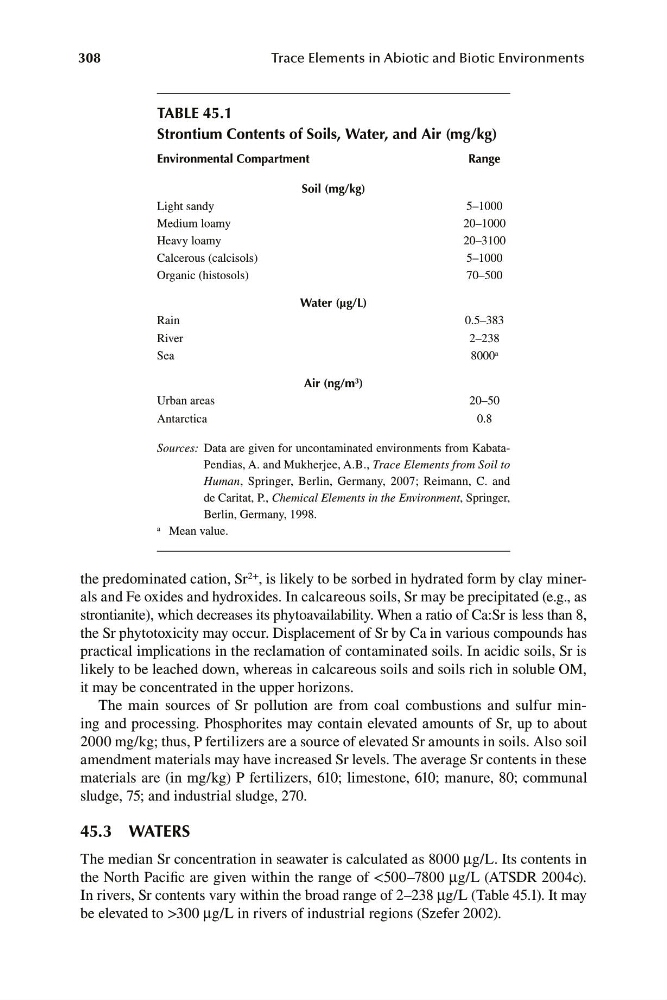
In rivers, Sr contents vary within the broad range of 2–238 μg/L (Table 45.1). It may
be elevated to >300 μg/L in rivers of industrial regions (Szefer 2002).