

282
Trace Elements in Abiotic and Biotic Environments
in larger quantities. Trace Se amounts are necessary for cellular function in humans
and animals. It is a component of the antioxidant enzymes glutathione peroxidase
and thioredoxin reductase, and in three deiodinase enzymes is involved in thyroid
hormones.
42.2 SOILS
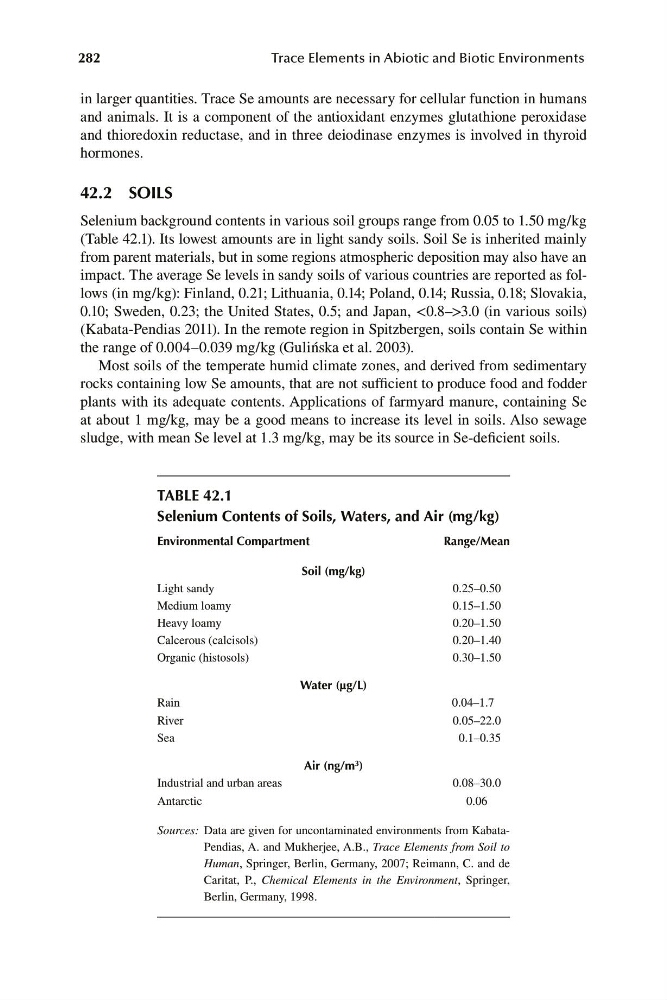
Selenium background contents in various soil groups range from 0.05 to 1.50 mg/kg
(Table 42.1). Its lowest amounts are in light sandy soils. Soil Se is inherited mainly
from parent materials, but in some regions atmospheric deposition may also have an
impact. The average Se levels in sandy soils of various countries are reported as follows (in mg/kg): Finland, 0.21; Lithuania, 0.14; Poland, 0.14; Russia, 0.18; Slovakia,
0.10; Sweden, 0.23; the United States, 0.5; and Japan, <0.8–>3.0 (in various soils)
(Kabata-Pendias 2011). In the remote region in Spitzbergen, soils contain Se within
the range of 0.004–0.039 mg/kg (Gulińska et al. 2003).
Most soils of the temperate humid climate zones, and derived from sedimentary
rocks containing low Se amounts, that are not sufficient to produce food and fodder
plants with its adequate contents. Applications of farmyard manure, containing Se
at about 1 mg/kg, may be a good means to increase its level in soils. Also sewage
sludge, with mean Se level at 1.3 mg/kg, may be its source in Se-deficient soils.
TABLE 42.1
Selenium Contents of Soils, Waters, and Air (mg/kg)
Environmental Compartment
Range/Mean
Soil (mg/kg)
Light sandy
Medium loamy
Heavy loamy
Calcerous (calcisols)
Organic (histosols)
0.25–0.50
0.15–1.50
0.20–1.50
0.20–1.40
0.30–1.50
Water (μg/L)
Rain
0.04–1.7
River
0.05–22.0
Sea
0.1–0.35
Air (ng/m 3 )
Industrial and urban areas
0.08–30.0
Antarctic
0.06
Sources: Data are given for uncontaminated environments from KabataPendias, A. and Mukherjee, A.B., Trace Elements from Soil to
Human, Springer, Berlin, Germany, 2007; Reimann, C. and de
Caritat, P., Chemical Elements in the Environment, Springer,
Berlin, Germany, 1998.