

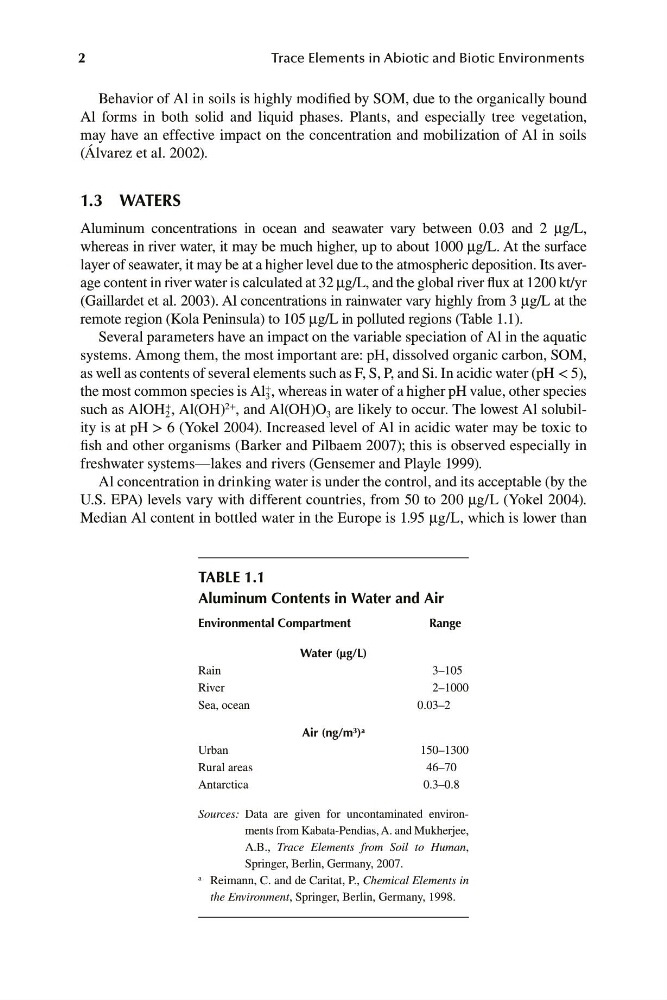
TABLE 1.1
Aluminum Contents in Water and Air
2
Trace Elements in Abiotic and Biotic Environments
Behavior of Al in soils is highly modified by SOM, due to the organically bound
Al forms in both solid and liquid phases. Plants, and especially tree vegetation,
may have an effective impact on the concentration and mobilization of Al in soils
(Álvarez et al. 2002).
1.3 WATERS
Aluminum concentrations in ocean and seawater vary between 0.03 and 2 μg/L,
whereas in river water, it may be much higher, up to about 1000 μg/L. At the surface
layer of seawater, it may be at a higher level due to the atmospheric deposition. Its average content in river water is calculated at 32 μg/L, and the global river flux at 1200 kt/yr
(Gaillardet et al. 2003). Al concentrations in rainwater vary highly from 3 μg/L at the
remote region (Kola Peninsula) to 105 μg/L in polluted regions (Table 1.1).
Several parameters have an impact on the variable speciation of Al in the aquatic
systems. Among them, the most important are: pH, dissolved organic carbon, SOM,
as well as contents of several elements such as F, S, P, and Si. In acidic water (pH < 5),
the most common species is Al +
3 , whereas in water of a higher pH value, other species
such as AlOH 2
+ , Al(OH) 2+ , and Al(OH)O 3 are likely to occur. The lowest Al solubility is at pH > 6 (Yokel 2004). Increased level of Al in acidic water may be toxic to
fish and other organisms (Barker and Pilbaem 2007); this is observed especially in
freshwater systems—lakes and rivers (Gensemer and Playle 1999).
Al concentration in drinking water is under the control, and its acceptable (by the
U.S. EPA) levels vary with different countries, from 50 to 200 μg/L (Yokel 2004).
Median Al content in bottled water in the Europe is 1.95 μg/L, which is lower than
Environmental Compartment
Range
Water (μg/L)
Rain
3–105
River
2–1000
Sea, ocean
0.03–2
Air (ng/m 3 ) a
Urban
150–1300
Rural areas
46–70
Antarctica
0.3–0.8
Sources: Data are given for uncontaminated environments from Kabata-Pendias, A. and Mukherjee,
A.B., Trace Elements from Soil to Human,
Springer, Berlin, Germany, 2007.
a Reimann, C. and de Caritat, P., Chemical Elements in
the Environment, Springer, Berlin, Germany, 1998.