

270
Trace Elements in Abiotic and Biotic Environments
properties. It only becomes toxic if the concentration in the erythrocytes or muscle
cells reaches 30% of the K contents. It has a long biological half-life.
Rubidium was used, during the nineteenth century, by European physicians in
the treatment of cardiac conditions, syphilis, and epilepsy. Clinical studies of the
effects of Rb ions on the course of manic-depressive illness, and it seems that Rb
tends to increase the length of manic phases, and possibly reduces the extremes
of mood. Rubidium did not seem to produce any severe side effects, at the dose
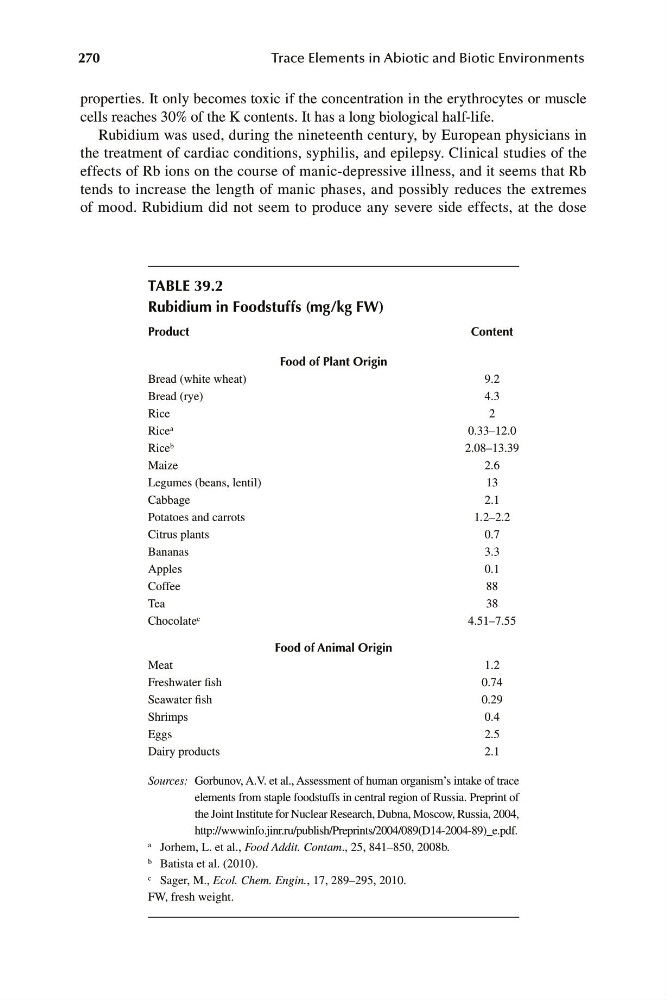
TABLE 39.2
Rubidium in Foodstuffs (mg/kg FW)
Product
Content
Food of Plant Origin
Bread (white wheat)
9.2
Bread (rye)
4.3
Rice
2
Rice a
0.33–12.0
Rice b
2.08–13.39
Maize
2.6
Legumes (beans, lentil)
13
Cabbage
2.1
Potatoes and carrots
1.2–2.2
Citrus plants
0.7
Bananas
3.3
Apples
0.1
Coffee
88
Tea
38
Chocolate c
4.51–7.55
Food of Animal Origin
Meat
1.2
Freshwater fish
0.74
Seawater fish
0.29
Shrimps
0.4
Eggs
2.5
Dairy products
2.1
Sources: Gorbunov, A.V. et al., Assessment of human organism’s intake of trace
elements from staple foodstuffs in central region of Russia. Preprint of
the Joint Institute for Nuclear Research, Dubna, Moscow, Russia, 2004,
http://wwwinfo.jinr.ru/publish/Preprints/2004/089(D14-2004-89) _e.pdf.
a Jorhem, L. et al., Food Addit. Contam., 25, 841–850, 2008b.
b Batista et al. (2010).
c Sager, M., Ecol. Chem. Engin., 17, 289–295, 2010.
FW, fresh weight.
Trace Elements in Abiotic and Biotic Environments
properties. It only becomes toxic if the concentration in the erythrocytes or muscle
cells reaches 30% of the K contents. It has a long biological half-life.
Rubidium was used, during the nineteenth century, by European physicians in
the treatment of cardiac conditions, syphilis, and epilepsy. Clinical studies of the
effects of Rb ions on the course of manic-depressive illness, and it seems that Rb
tends to increase the length of manic phases, and possibly reduces the extremes
of mood. Rubidium did not seem to produce any severe side effects, at the dose
TABLE 39.2
Rubidium in Foodstuffs (mg/kg FW)
Product
Content
Food of Plant Origin
Bread (white wheat)
9.2
Bread (rye)
4.3
Rice
2
Rice a
0.33–12.0
Rice b
2.08–13.39
Maize
2.6
Legumes (beans, lentil)
13
Cabbage
2.1
Potatoes and carrots
1.2–2.2
Citrus plants
0.7
Bananas
3.3
Apples
0.1
Coffee
88
Tea
38
Chocolate c
4.51–7.55
Food of Animal Origin
Meat
1.2
Freshwater fish
0.74
Seawater fish
0.29
Shrimps
0.4
Eggs
2.5
Dairy products
2.1
Sources: Gorbunov, A.V. et al., Assessment of human organism’s intake of trace
elements from staple foodstuffs in central region of Russia. Preprint of
the Joint Institute for Nuclear Research, Dubna, Moscow, Russia, 2004,
http://wwwinfo.jinr.ru/publish/Preprints/2004/089(D14-2004-89) _e.pdf.
a Jorhem, L. et al., Food Addit. Contam., 25, 841–850, 2008b.
b Batista et al. (2010).
c Sager, M., Ecol. Chem. Engin., 17, 289–295, 2010.
FW, fresh weight.