

268
Trace Elements in Abiotic and Biotic Environments
TABLE 39.1
Rubidium Contents of Soils, Water, and Air
Environmental Compartment
Range/Mean
Soil (mg/kg)
Light sandy
30–50
Medium loamy
55–140
Organic
<10–20
Water (μg/L)
Rain
0.08–0.2
River
0.2–6.5
Sea and ocean a
100–200
Air (ng/m 3 )
Urban areas
<1.0–<6.0
Greenland
<1.0
Sources: Data are given for uncontaminated environments, from various
sources, mainly Kabata-Pendias, A. and Mukherjee, A.B.,
Trace Elements from Soil to Human, Springer, Berlin, Germany,
2007; Reimann, C. and de Caritat, P., Chemical Elements in the
Envi ronment, Springer, Berlin, Germany, 1998.
a Gaillardet, J. et al., Treatise on Geochemistry, Elsevier, Oxford, 2003.
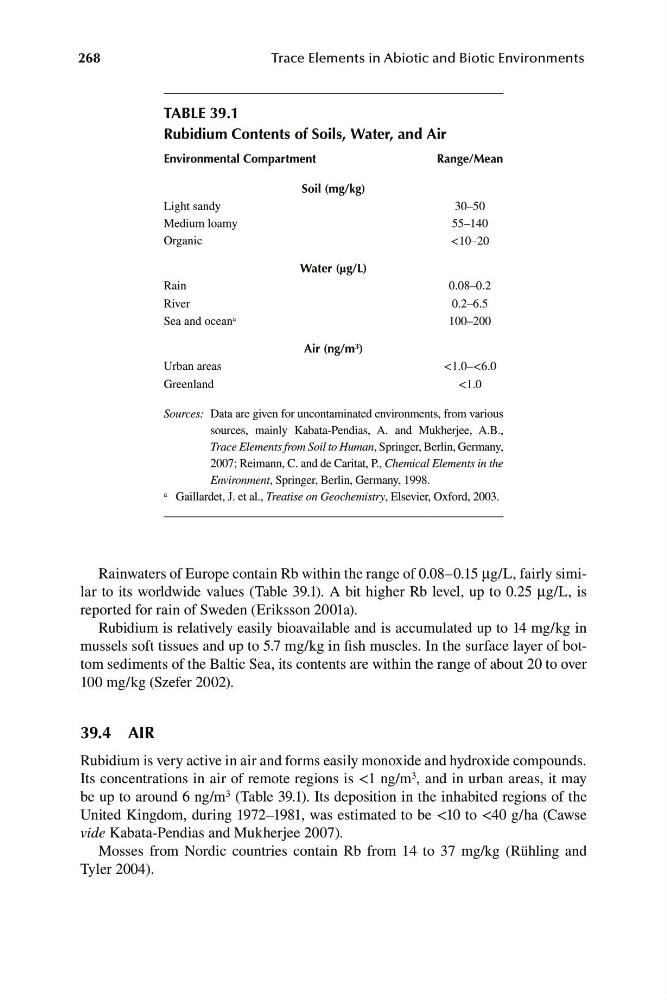
Rainwaters of Europe contain Rb within the range of 0.08–0.15 μg/L, fairly similar to its worldwide values (Table 39.1). A bit higher Rb level, up to 0.25 μg/L, is
reported for rain of Sweden (Eriksson 2001a).
Rubidium is relatively easily bioavailable and is accumulated up to 14 mg/kg in
mussels soft tissues and up to 5.7 mg/kg in fish muscles. In the surface layer of bottom sediments of the Baltic Sea, its contents are within the range of about 20 to over
100 mg/kg (Szefer 2002).
39.4 AIR
Rubidium is very active in air and forms easily monoxide and hydroxide compounds.
Its concentrations in air of remote regions is <1 ng/m 3 , and in urban areas, it may
be up to around 6 ng/m 3 (Table 39.1). Its deposition in the inhabited regions of the
United Kingdom, during 1972–1981, was estimated to be <10 to <40 g/ha (Cawse
vide Kabata-Pendias and Mukherjee 2007).
Mosses from Nordic countries contain Rb from 14 to 37 mg/kg (Rühling and
Tyler 2004).