

264
Trace Elements in Abiotic and Biotic Environments
phosphorites. In ferromanganese minerals, it may be concentrated up to 44 μg/kg,
and in some pebbles up to about 22 μg/kg. It seems to be relatively easily bioaccumulated by crustaceans, up to 12 μg/kg.
Rhodium concentration in some stream waters is about 100 ng/L (Reimann and
Caritat 1998). Rainwater collected in Sweden during 1999 contains Rh at an average
value of 1 ng/L (Eriksson 2001a).
Rhodium content of cereal grains is <1 μg/kg, whereas plants such as plantain
and moss grown along highways contain Rh within the range of 1.3–5.4 μg/kg,
respectively (Djingova vide Kabata-Pendias 2011). There are suggestions that >50%
of Rh in plants is from road soil dust attached to plant surfaces.
38.3 HUMANS
Rhodium concentration in the human body is unknown; its content in human bones
is under detection limits (Zaichik et al. 2011). Like the other noble metals, all of
which are too inert to occur as chemical compounds in nature, Rh has not been found
to play, or suspected to play, any biological role. If used in elemental form rather than
as compounds, the metal is harmless (Leikin et al. 2008).
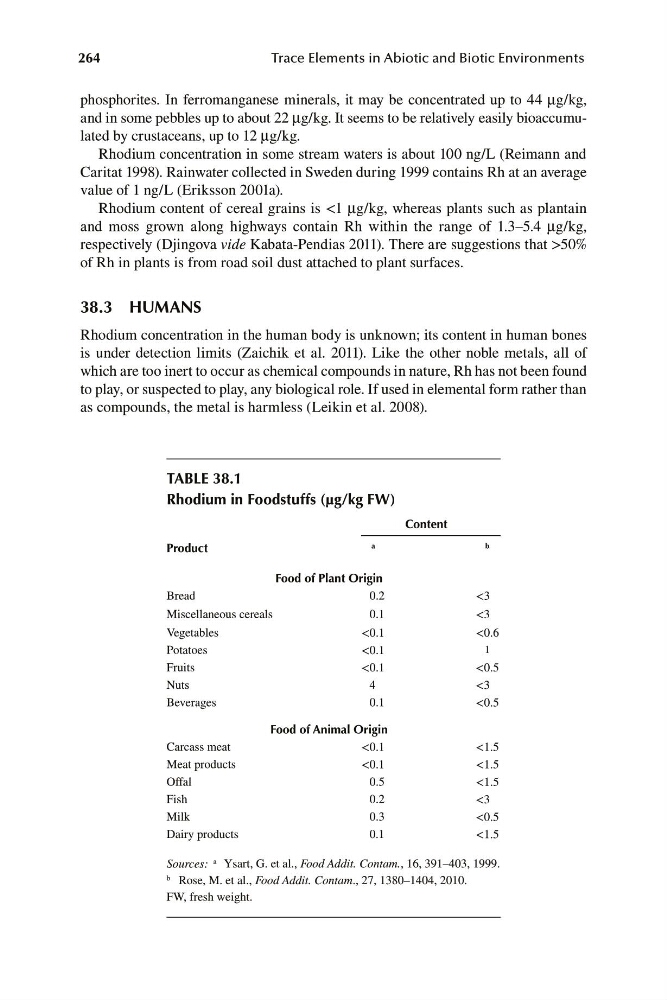
TABLE 38.1
Rhodium in Foodstuffs (μg/kg FW)
Content
Product
a
b
Food of Plant Origin
Bread
0.2
<3
Miscellaneous cereals
0.1
<3
Vegetables
<0.1
<0.6
Potatoes
<0.1
1
Fruits
<0.1
<0.5
Nuts
4
<3
Beverages
0.1
<0.5
Food of Animal Origin
Carcass meat
<0.1
<1.5
Meat products
<0.1
<1.5
Offal
0.5
<1.5
Fish
0.2
<3
Milk
0.3
<0.5
Dairy products
0.1
<1.5
a
Sources: Ysart, G. et al., Food Addit. Contam., 16, 391–403, 1999.
b Rose, M. et al., Food Addit. Contam., 27, 1380–1404, 2010.
FW, fresh weight.