

228
Trace Elements in Abiotic and Biotic Environments
In postmortem tissue samples from adults, with no occupational or iatrogenic
exposure to Ni compounds, the highest Ni concentrations were found in the lung,
bone, thyroid, and adrenals, followed by the kidney, heart, liver, brain, spleen, and
pancreas, in diminishing order. Nickel is bound to albumin, histidine, and macroglobulin, and is distributed widely throughout the tissues. It is also found in breast milk,
saliva, nails, and hair. Transplacental transfer of Ni has been demonstrated in rodents.
Nickel is present in dozens of products; thus, it might be easy, for sensitive people,
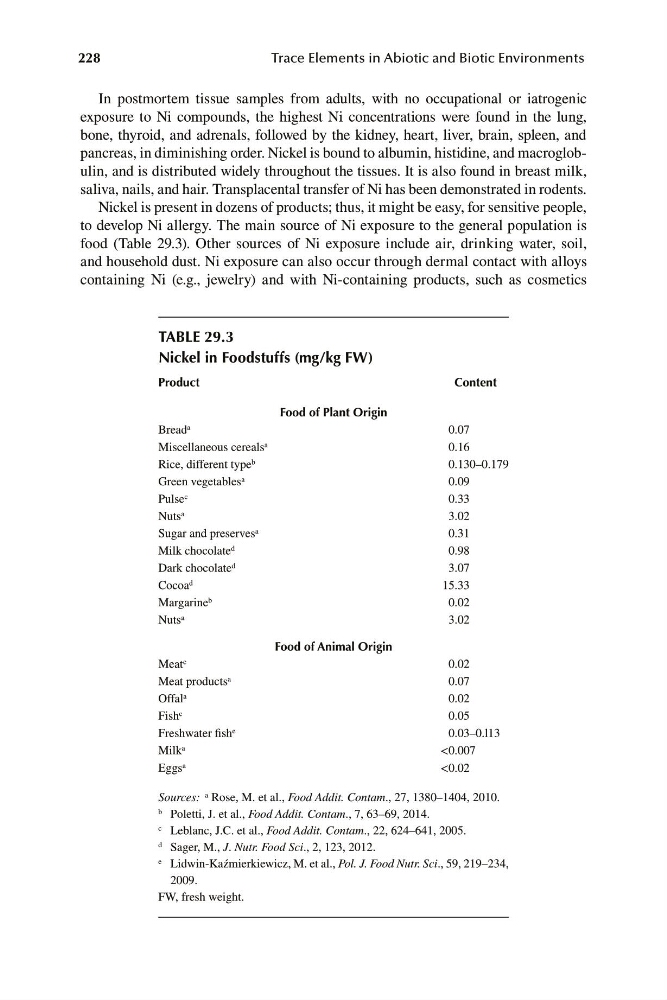
to develop Ni allergy. The main source of Ni exposure to the general population is
food (Table 29.3). Other sources of Ni exposure include air, drinking water, soil,
and household dust. Ni exposure can also occur through dermal contact with alloys
containing Ni (e.g., jewelry) and with Ni-containing products, such as cosmetics
TABLE 29.3
Nickel in Foodstuffs (mg/kg FW)
Product
Content
Food of Plant Origin
Bread a
0.07
Miscellaneous cereals a
0.16
Rice, different type b
0.130–0.179
Green vegetables a
0.09
Pulse c
0.33
Nuts a
3.02
Sugar and preserves a
0.31
Milk chocolate d
0.98
Dark chocolate d
3.07
Cocoa d
15.33
Margarine b
0.02
Nuts a
3.02
Food of Animal Origin
Meat c
0.02
Meat products a
0.07
Offal a
0.02
Fish c
0.05
Freshwater fish e
0.03–0.l13
Milk a
<0.007
Eggs a
<0.02
Sources: a Rose, M. et al., Food Addit. Contam., 27, 1380–1404, 2010.
b Poletti, J. et al., Food Addit. Contam., 7, 63–69, 2014.
c Leblanc, J.C. et al., Food Addit. Contam., 22, 624–641, 2005.
d Sager, M., J. Nutr. Food Sci., 2, 123, 2012.
e Lidwin-Kaźmierkiewicz, M. et al., Pol. J. Food Nutr. Sci., 59, 219–234,
2009.
FW, fresh weight.
Trace Elements in Abiotic and Biotic Environments
In postmortem tissue samples from adults, with no occupational or iatrogenic
exposure to Ni compounds, the highest Ni concentrations were found in the lung,
bone, thyroid, and adrenals, followed by the kidney, heart, liver, brain, spleen, and
pancreas, in diminishing order. Nickel is bound to albumin, histidine, and macroglobulin, and is distributed widely throughout the tissues. It is also found in breast milk,
saliva, nails, and hair. Transplacental transfer of Ni has been demonstrated in rodents.
Nickel is present in dozens of products; thus, it might be easy, for sensitive people,
to develop Ni allergy. The main source of Ni exposure to the general population is
food (Table 29.3). Other sources of Ni exposure include air, drinking water, soil,
and household dust. Ni exposure can also occur through dermal contact with alloys
containing Ni (e.g., jewelry) and with Ni-containing products, such as cosmetics
TABLE 29.3
Nickel in Foodstuffs (mg/kg FW)
Product
Content
Food of Plant Origin
Bread a
0.07
Miscellaneous cereals a
0.16
Rice, different type b
0.130–0.179
Green vegetables a
0.09
Pulse c
0.33
Nuts a
3.02
Sugar and preserves a
0.31
Milk chocolate d
0.98
Dark chocolate d
3.07
Cocoa d
15.33
Margarine b
0.02
Nuts a
3.02
Food of Animal Origin
Meat c
0.02
Meat products a
0.07
Offal a
0.02
Fish c
0.05
Freshwater fish e
0.03–0.l13
Milk a
<0.007
Eggs a
<0.02
Sources: a Rose, M. et al., Food Addit. Contam., 27, 1380–1404, 2010.
b Poletti, J. et al., Food Addit. Contam., 7, 63–69, 2014.
c Leblanc, J.C. et al., Food Addit. Contam., 22, 624–641, 2005.
d Sager, M., J. Nutr. Food Sci., 2, 123, 2012.
e Lidwin-Kaźmierkiewicz, M. et al., Pol. J. Food Nutr. Sci., 59, 219–234,
2009.
FW, fresh weight.