

Nickel [Ni, 28]
223
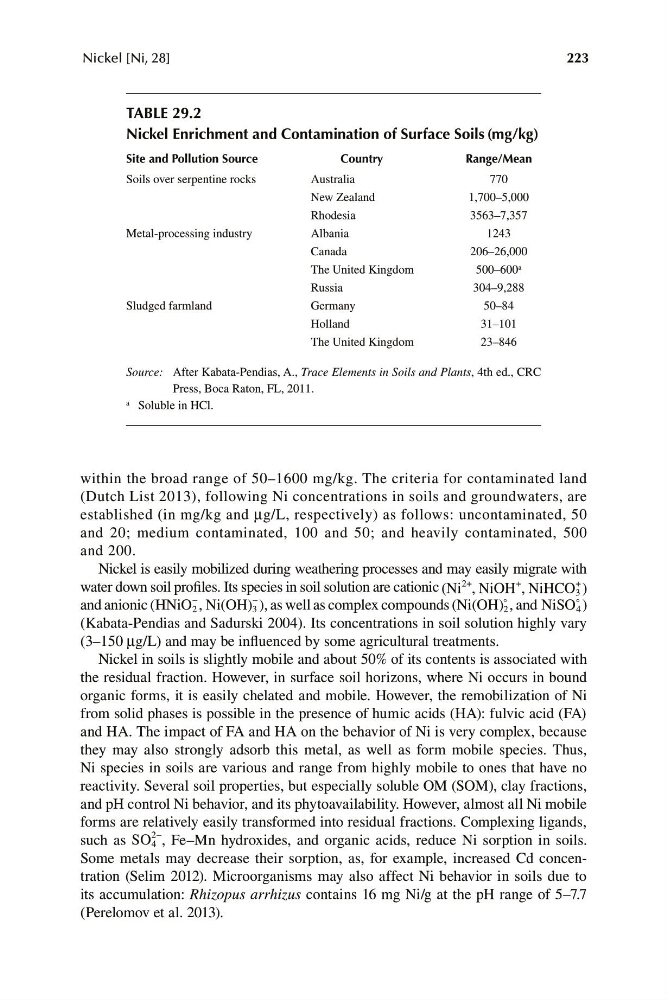
TABLE 29.2
Nickel Enrichment and Contamination of Surface Soils (mg/kg)
Site and Pollution Source
Country
Range/Mean
Soils over serpentine rocks
Australia
770
New Zealand
1,700–5,000
Rhodesia
3563–7,357
Metal-processing industry
Albania
1243
Canada
206–26,000
The United Kingdom
500–600 a
Russia
304–9,288
Sludged farmland
Germany
50–84
Holland
31–101
The United Kingdom
23–846
Source: After Kabata-Pendias, A., Trace Elements in Soils and Plants, 4th ed., CRC
Press, Boca Raton, FL, 2011.
a Soluble in HCl.
within the broad range of 50–1600 mg/kg. The criteria for contaminated land
(Dutch List 2013), following Ni concentrations in soils and groundwaters, are
established (in mg/kg and μg/L, respectively) as follows: uncontaminated, 50
and 20; medium contaminated, 100 and 50; and heavily contaminated, 500
and 200.
Nickel is easily mobilized during weathering processes and may easily migrate with
2+
+
+
water down soil profiles. Its species in soil solution are cationic (Ni , NiOH , NiHCO 3 )
D
and anionic (HNiO , Ni(OH) 3 ) , as well as complex compounds (Ni(OH) , and NiSO
D
4 )
2
2
(Kabata-Pendias and Sadurski 2004). Its concentrations in soil solution highly vary
(3–150 μg/L) and may be influenced by some agricultural treatments.
Nickel in soils is slightly mobile and about 50% of its contents is associated with
the residual fraction. However, in surface soil horizons, where Ni occurs in bound
organic forms, it is easily chelated and mobile. However, the remobilization of Ni
from solid phases is possible in the presence of humic acids (HA): fulvic acid (FA)
and HA. The impact of FA and HA on the behavior of Ni is very complex, because
they may also strongly adsorb this metal, as well as form mobile species. Thus,
Ni species in soils are various and range from highly mobile to ones that have no
reactivity. Several soil properties, but especially soluble OM (SOM), clay fractions,
and pH control Ni behavior, and its phytoavailability. However, almost all Ni mobile
forms are relatively easily transformed into residual fractions. Complexing ligands,
such as SO 4
2 , Fe–Mn hydroxides, and organic acids, reduce Ni sorption in soils.
Some metals may decrease their sorption, as, for example, increased Cd concentration (Selim 2012). Microorganisms may also affect Ni behavior in soils due to
its accumulation: Rhizopus arrhizus contains 16 mg Ni/g at the pH range of 5–7.7
(Perelomov et al. 2013).