

206
Trace Elements in Abiotic and Biotic Environments
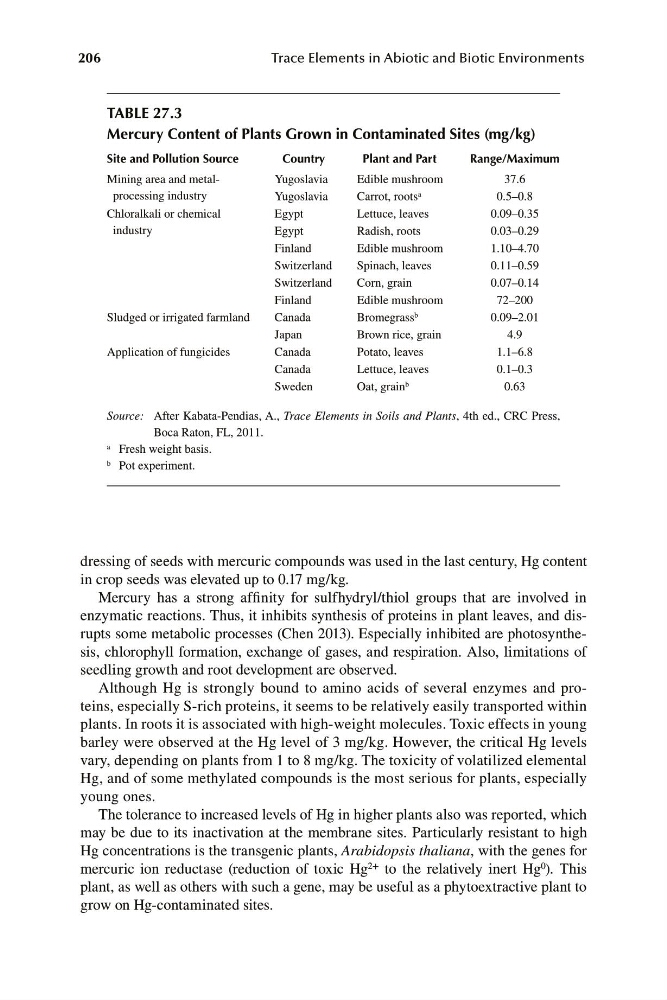
TABLE 27.3
Mercury Content of Plants Grown in Contaminated Sites (mg/kg)
Site and Pollution Source
Country
Plant and Part
Range/Maximum
Mining area and metalYugoslavia
Edible mushroom
37.6
processing industry
Yugoslavia
Carrot, roots a
0.5–0.8
Chloralkali or chemical
Egypt
Lettuce, leaves
0.09–0.35
industry
Egypt
Radish, roots
0.03–0.29
Finland
Edible mushroom
1.10–4.70
Switzerland
Spinach, leaves
0.11–0.59
Switzerland
Corn, grain
0.07–0.14
Finland
Edible mushroom
72–200
Sludged or irrigated farmland
Canada
Bromegrass b
0.09–2.01
Japan
Brown rice, grain
4.9
Application of fungicides
Canada
Potato, leaves
1.1–6.8
Canada
Lettuce, leaves
0.1–0.3
Sweden
Oat, grain b
0.63
Source: After Kabata-Pendias, A., Trace Elements in Soils and Plants, 4th ed., CRC Press,
Boca Raton, FL, 2011.
a Fresh weight basis.
b Pot experiment.
dressing of seeds with mercuric compounds was used in the last century, Hg content
in crop seeds was elevated up to 0.17 mg/kg.
Mercury has a strong affinity for sulfhydryl/thiol groups that are involved in
enzymatic reactions. Thus, it inhibits synthesis of proteins in plant leaves, and disrupts some metabolic processes (Chen 2013). Especially inhibited are photosynthesis, chlorophyll formation, exchange of gases, and respiration. Also, limitations of
seedling growth and root development are observed.
Although Hg is strongly bound to amino acids of several enzymes and proteins, especially S-rich proteins, it seems to be relatively easily transported within
plants. In roots it is associated with high-weight molecules. Toxic effects in young
barley were observed at the Hg level of 3 mg/kg. However, the critical Hg levels
vary, depending on plants from 1 to 8 mg/kg. The toxicity of volatilized elemental
Hg, and of some methylated compounds is the most serious for plants, especially
young ones.
The tolerance to increased levels of Hg in higher plants also was reported, which
may be due to its inactivation at the membrane sites. Particularly resistant to high
Hg concentrations is the transgenic plants, Arabidopsis thaliana, with the genes for
mercuric ion reductase (reduction of toxic Hg 2+ to the relatively inert Hg 0 ). This
plant, as well as others with such a gene, may be useful as a phytoextractive plant to
grow on Hg-contaminated sites.
Trace Elements in Abiotic and Biotic Environments
TABLE 27.3
Mercury Content of Plants Grown in Contaminated Sites (mg/kg)
Site and Pollution Source
Country
Plant and Part
Range/Maximum
Mining area and metalYugoslavia
Edible mushroom
37.6
processing industry
Yugoslavia
Carrot, roots a
0.5–0.8
Chloralkali or chemical
Egypt
Lettuce, leaves
0.09–0.35
industry
Egypt
Radish, roots
0.03–0.29
Finland
Edible mushroom
1.10–4.70
Switzerland
Spinach, leaves
0.11–0.59
Switzerland
Corn, grain
0.07–0.14
Finland
Edible mushroom
72–200
Sludged or irrigated farmland
Canada
Bromegrass b
0.09–2.01
Japan
Brown rice, grain
4.9
Application of fungicides
Canada
Potato, leaves
1.1–6.8
Canada
Lettuce, leaves
0.1–0.3
Sweden
Oat, grain b
0.63
Source: After Kabata-Pendias, A., Trace Elements in Soils and Plants, 4th ed., CRC Press,
Boca Raton, FL, 2011.
a Fresh weight basis.
b Pot experiment.
dressing of seeds with mercuric compounds was used in the last century, Hg content
in crop seeds was elevated up to 0.17 mg/kg.
Mercury has a strong affinity for sulfhydryl/thiol groups that are involved in
enzymatic reactions. Thus, it inhibits synthesis of proteins in plant leaves, and disrupts some metabolic processes (Chen 2013). Especially inhibited are photosynthesis, chlorophyll formation, exchange of gases, and respiration. Also, limitations of
seedling growth and root development are observed.
Although Hg is strongly bound to amino acids of several enzymes and proteins, especially S-rich proteins, it seems to be relatively easily transported within
plants. In roots it is associated with high-weight molecules. Toxic effects in young
barley were observed at the Hg level of 3 mg/kg. However, the critical Hg levels
vary, depending on plants from 1 to 8 mg/kg. The toxicity of volatilized elemental
Hg, and of some methylated compounds is the most serious for plants, especially
young ones.
The tolerance to increased levels of Hg in higher plants also was reported, which
may be due to its inactivation at the membrane sites. Particularly resistant to high
Hg concentrations is the transgenic plants, Arabidopsis thaliana, with the genes for
mercuric ion reductase (reduction of toxic Hg 2+ to the relatively inert Hg 0 ). This
plant, as well as others with such a gene, may be useful as a phytoextractive plant to
grow on Hg-contaminated sites.