

201
Mercury [Hg, 80]
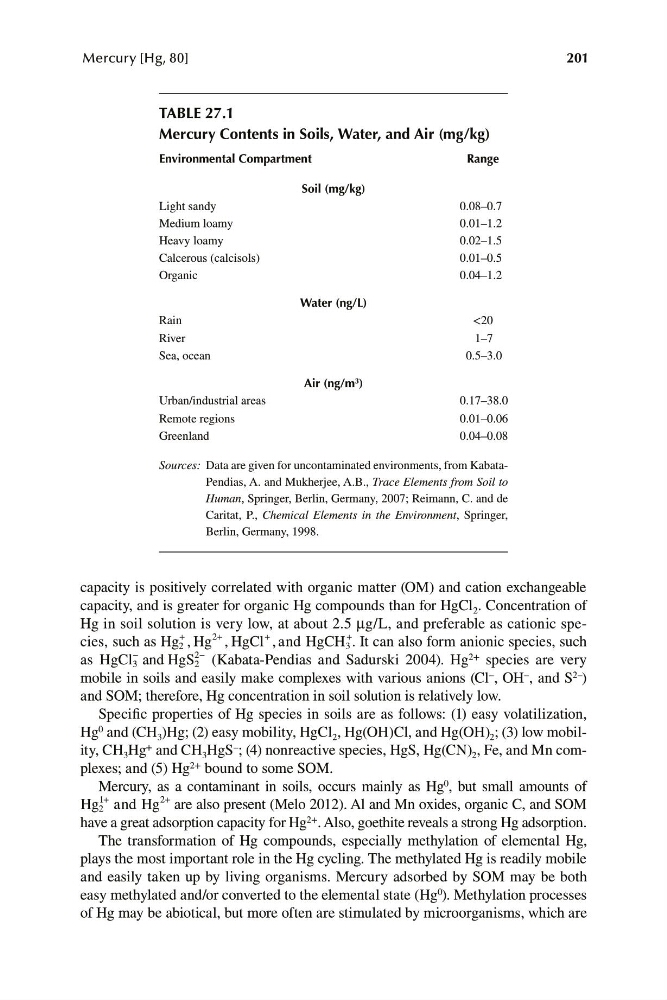
TABLE 27.1
Mercury Contents in Soils, Water, and Air (mg/kg)
Environmental Compartment
Range
Soil (mg/kg)
Light sandy
0.08–0.7
Medium loamy
0.01–1.2
Heavy loamy
0.02–1.5
Calcerous (calcisols)
0.01–0.5
Organic
0.04–1.2
Water (ng/L)
Rain
<20
River
1–7
Sea, ocean
0.5–3.0
Air (ng/m 3 )
Urban/industrial areas
0.17–38.0
Remote regions
0.01–0.06
Greenland
0.04–0.08
Sources: Data are given for uncontaminated environments, from KabataPendias, A. and Mukherjee, A.B., Trace Elements from Soil to
Human, Springer, Berlin, Germany, 2007; Reimann, C. and de
Caritat, P., Chemical Elements in the Environment, Springer,
Berlin, Germany, 1998.
capacity is positively correlated with organic matter (OM) and cation exchangeable
capacity, and is greater for organic Hg compounds than for HgCl 2 . Concentration of
Hg in soil solution is very low, at about 2.5 μg/L, and preferable as cationic spe2
cies, such as Hg 2 , Hg , HgCl , and HgCH 3
. It can also form anionic species, such
2
as HgCl 3 and HgS 2 (Kabata-Pendias and Sadurski 2004). Hg 2+ species are very
mobile in soils and easily make complexes with various anions (Cl – , OH – , and S 2– )
and SOM; therefore, Hg concentration in soil solution is relatively low.
Specific properties of Hg species in soils are as follows: (1) easy volatilization,
Hg 0 and (CH 3 )Hg; (2) easy mobility, HgCl 2 , Hg(OH)Cl, and Hg(OH) 2 ; (3) low mobility, CH 3 Hg + and CH 3 HgS – ; (4) nonreactive species, HgS, Hg(CN) 2 , Fe, and Mn complexes; and (5) Hg 2+ bound to some SOM.
Mercury, as a contaminant in soils, occurs mainly as Hg 0 , but small amounts of
1
2
Hg 2 and Hg
are also present (Melo 2012). Al and Mn oxides, organic C, and SOM
have a great adsorption capacity for Hg 2+ . Also, goethite reveals a strong Hg adsorption.
The transformation of Hg compounds, especially methylation of elemental Hg,
plays the most important role in the Hg cycling. The methylated Hg is readily mobile
and easily taken up by living organisms. Mercury adsorbed by SOM may be both
easy methylated and/or converted to the elemental state (Hg 0 ). Methylation processes
of Hg may be abiotical, but more often are stimulated by microorganisms, which are