

197
Manganese [Mn, 25]
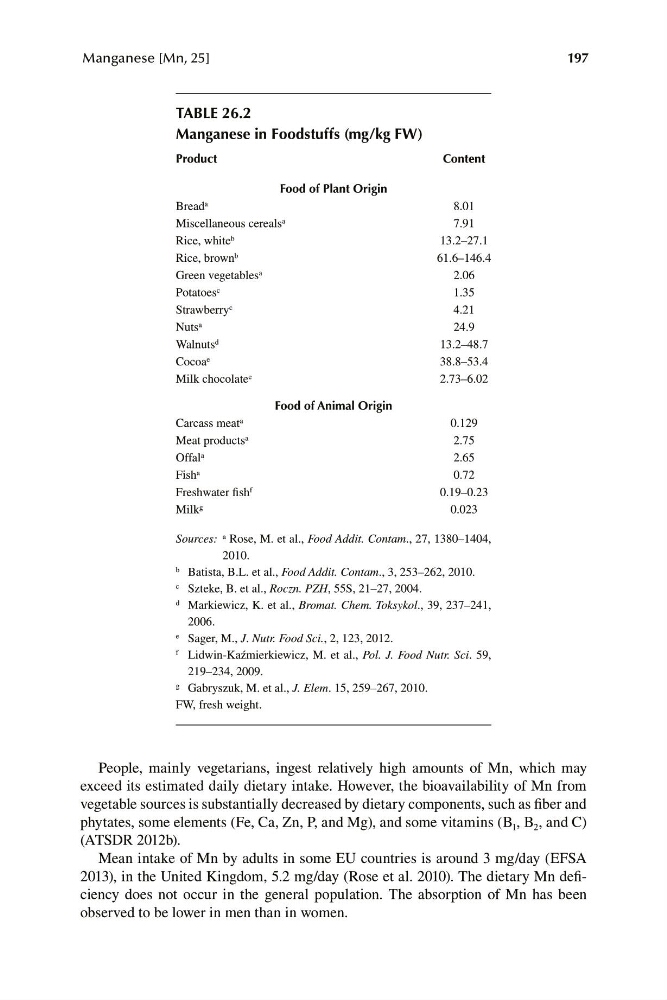
TABLE 26.2
Manganese in Foodstuffs (mg/kg FW)
Product
Content
Food of Plant Origin
Bread a
8.01
Miscellaneous cereals a
7.91
Rice, white b
13.2–27.1
Rice, brown b
61.6–146.4
Green vegetables a
2.06
Potatoes c
1.35
Strawberry c
4.21
Nuts a
24.9
Walnuts d
13.2–48.7
Cocoa e
38.8–53.4
Milk chocolate e
2.73–6.02
Food of Animal Origin
Carcass meat a
0.129
Meat products a
2.75
Offal a
2.65
Fish a
0.72
Freshwater fish f
0.19–0.23
Milk g
0.023
Sources: a Rose, M. et al., Food Addit. Contam., 27, 1380–1404,
2010.
b Batista, B.L. et al., Food Addit. Contam., 3, 253–262, 2010.
c Szteke, B. et al., Roczn. PZH, 55S, 21–27, 2004.
d Markiewicz, K. et al., Bromat. Chem. Toksykol., 39, 237–241,
2006.
e Sager, M., J. Nutr. Food Sci., 2, 123, 2012.
f Lidwin-Kaźmierkiewicz, M. et al., Pol. J. Food Nutr. Sci. 59,
219–234, 2009.
g Gabryszuk, M. et al., J. Elem. 15, 259–267, 2010.
FW, fresh weight.
People, mainly vegetarians, ingest relatively high amounts of Mn, which may
exceed its estimated daily dietary intake. However, the bioavailability of Mn from
vegetable sources is substantially decreased by dietary components, such as fiber and
phytates, some elements (Fe, Ca, Zn, P, and Mg), and some vitamins (B 1 , B 2 , and C)
(ATSDR 2012b).
Mean intake of Mn by adults in some EU countries is around 3 mg/day (EFSA
2013), in the United Kingdom, 5.2 mg/day (Rose et al. 2010). The dietary Mn deficiency does not occur in the general population. The absorption of Mn has been
observed to be lower in men than in women.